
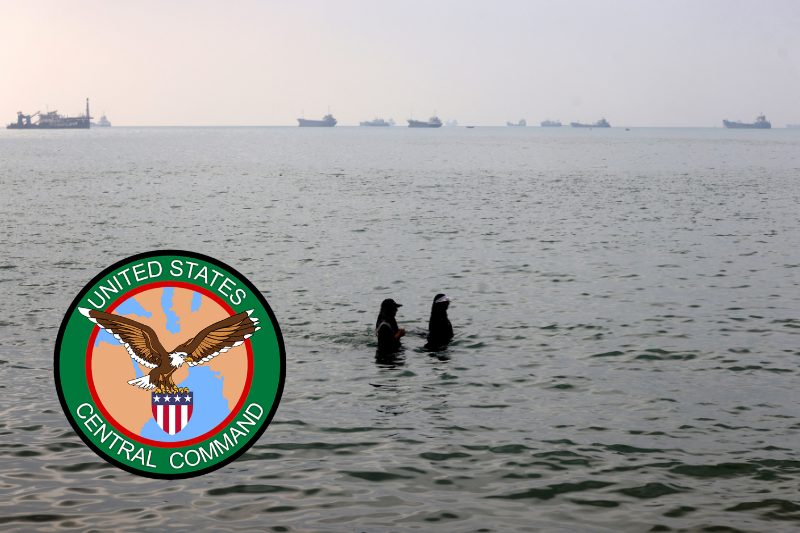
The U.S. military’s chokehold on Iran’s oil revenue is working — and the numbers prove it.
U.S. Central Command announced Saturday that more than 1 billion barrels of crude oil have passed through the Strait of Hormuz in recent months while Iran exported zero barrels due to America’s naval blockade.
The stark contrast underscores a dramatic shift in the regional balance of power. For decades, Iran leveraged its geographic position along the strait to threaten global energy markets and fund proxy militaries throughout the Middle East. Now, that same waterway has become the stage for one of the most consequential economic pressure campaigns in modern naval history.
Admiral Brad Cooper, CENTCOM’s commander, outlined the milestone in a video posted to X Saturday morning, celebrating what he called a “significant” achievement in cutting off the Iranian regime’s primary funding source.
“We’ve reached this significant milestone while assisting over 2,000 commercial ship transits through the strait by providing coordinated protection.”
Cooper credited U.S. forces with clearing transit lanes of dangerous mines, enabling thousands of commercial ships to safely navigate the waterway — all while denying Iran access to the very route that once fueled its terror operations.
The mine-clearing operation represents a massive undertaking that has required sustained deployment of specialized naval assets and personnel. These efforts have been critical not only for maintaining the blockade’s effectiveness but also for reassuring international shipping companies that the strait remains navigable despite heightened regional tensions.
The volume of crude oil, cargo, and liquid natural gas moving through the strait in the past two weeks exceeded any point in the last six months, Cooper confirmed.
This surge in traffic demonstrates that global energy markets have adapted to the new security environment. While Iran remains sidelined, other regional producers have increased their output to compensate, ensuring that worldwide oil supplies remain stable even as one of OPEC’s historically significant exporters has been effectively removed from the market.
The Strait of Hormuz is one of the world’s most critical energy shipping routes, connecting the Persian Gulf to the Gulf of Oman. Gulf countries use the waterway to supply about a fifth of the world’s oil across the globe — making it a strategic choke point in the U.S. conflict with Iran.
The narrow waterway, at its most constricted point only 21 miles wide, has long been considered the world’s most important oil transit corridor. Any disruption to shipping through the strait has historically sent shockwaves through global energy markets, affecting prices at gas pumps from Los Angeles to London. Iran’s previous threats to close the strait were among its most potent geopolitical weapons — a leverage now neutralized by American naval superiority.
Cooper emphasized that CENTCOM remains “clear-eyed and laser-focused” as it works with the U.S. interagency, all six partners in the Gulf Cooperation Council, and insurance and shipping companies to increase traffic flow through the strait.
The coordination with insurance companies is particularly noteworthy, as maritime insurance rates often reflect perceived risk levels in contested waters. By working directly with insurers to maintain reasonable premium rates, CENTCOM has helped ensure that commercial shipping remains economically viable, preventing Iran from achieving through market disruption what it cannot accomplish through military action.
“We’re also working with every partner in the region, enhancing their air defense, forming a new coalition attack drone unit and keeping the Strait of Hormuz and surrounding waters open and clear.”
The commander highlighted the hard work of U.S. military pilots, logisticians, culinary specialists, air defenders, intelligence analysts, and “members of every other career field” — on average in their mid-20s — who are executing the mission.
This demographic detail reveals the scope of the operational commitment. Thousands of young service members are sustaining a complex, round-the-clock mission that requires constant vigilance, technical expertise, and coordination across multiple domains of warfare. The reference to culinary specialists and logisticians underscores that naval blockades succeed or fail based not just on firepower, but on the unglamorous work of keeping ships supplied, crews fed, and operations running smoothly over extended deployments.
Update from CENTCOM Commander: pic.twitter.com/PTX6n9fn56
— U.S. Central Command (@CENTCOM) September 19, 2026
Iran has disputed the U.S. claim that the blockade cut off all exports. Iranian Oil Minister Mohsen Paknejad asserted last month that exports had only declined — not stopped entirely.
The Tehran government faces enormous domestic pressure to minimize the economic impact of the blockade. Acknowledging a complete halt to oil exports would represent a devastating admission that Iran’s economy — already strained by years of sanctions — has lost its most vital revenue stream. Paknejad’s public statements appear designed more for domestic consumption than international credibility, allowing the regime to maintain the fiction of continued operations even as tankers sit idle in Iranian ports.
But the numbers tell a different story: 1 billion barrels flowing past Iran’s coastline while the regime watches, unable to cash in.