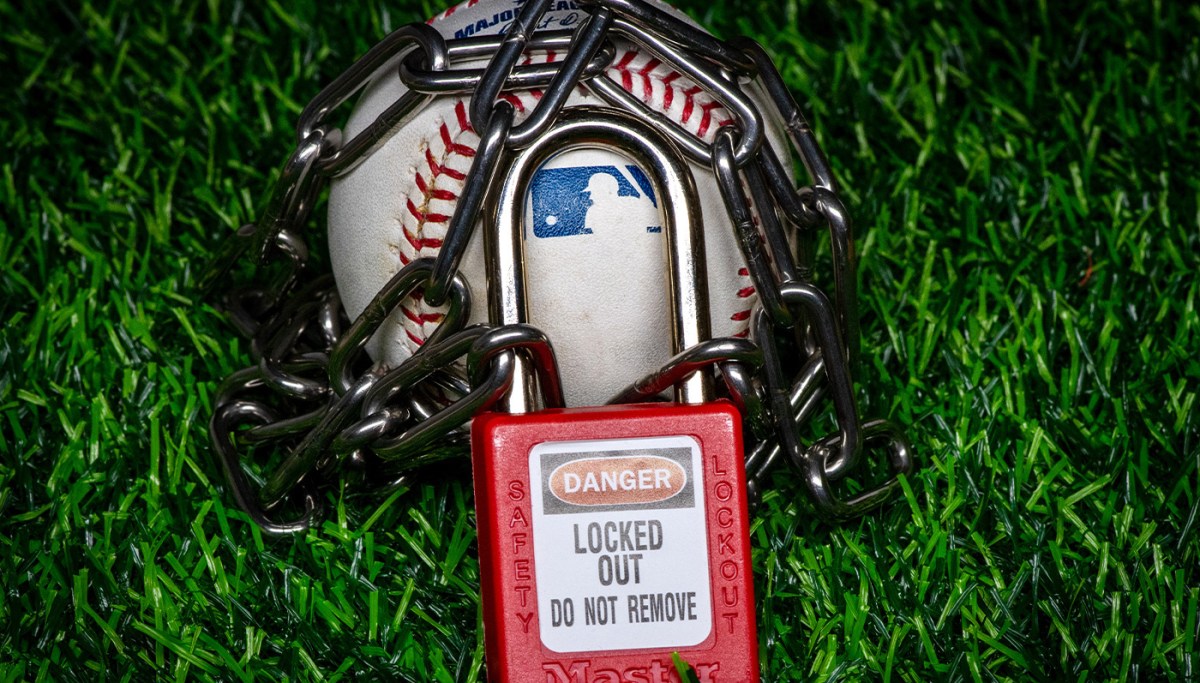
President Trump is weighing a White House intervention to prevent a Major League Baseball lockout before the owners’ current collective bargaining agreement with players expires Dec. 1. The two sides remain miles apart on owners’ demand for a salary cap — a demand the players union adamantly opposes.
“I would certainly do it if I could,” Trump told conservative radio host Clay Travis at the Texas-Tennessee game Sept. 26. “Baseball looks like it could have a strike. If it does, it would be too bad.”
“IF I COULD HELP, I’D LOVE TO HELP.”
The president added he would intervene “if it was appropriate” and expressed confidence that baseball’s owners and players “are going to work it out the same way as they do in all other sports.”
Trump could leverage the prestige of the White House to avert a baseball work stoppage — mustering public pressure, political sway, or even the National Labor Relations Board to impose a settlement, in theory. And if the Nov. 3 midterm elections go poorly for Republicans, as polling suggests, Trump could be looking for a conversation-changing win that would make him the political savior of America’s national pastime.
Owners Want a Cap — Players Refuse
Owners want to introduce a hard salary cap and floor system, similar to the NFL, NBA, and NHL, citing payroll disparities and a need for competitive balance. Smaller-market owners contend they don’t have the revenue to keep up with big spenders like the Los Angeles Dodgers and New York Mets.
The Dodgers have won two straight World Series titles and three over the last six years. The team is led by players earning deep into the eight figures annually, including outfielder Kyle Tucker and two-way phenom Shohei Ohtani. Tucker’s contract pays him an average of $60 million annually over four years; Ohtani’s deal is worth $700 million over a decade.
The MLB Players Association strongly opposes any cap. The union argues that a spending floor for low-spending teams is the real solution — forcing clubs to field competitive rosters rather than restricting player salaries.
Take the Milwaukee Brewers, operating this year with a payroll between $128 million and $153.4 million, depending on player benefits and calculations. Under a proposed $171.2 million minimum, the Wisconsin-based team would be forced to increase spending by roughly $20 million to $40 million to meet the new threshold.
Trump has publicly sided with MLB owners in their push for a hard cap.
“If you don’t have a salary cap, you don’t have a sport,” Trump told reporters aboard Air Force One on June 5. “They should have done it a long time ago.”
The president added it was “shocking, frankly, that they didn’t put a cap on many years ago.”
What a President Can — and Can’t — Do
Legally, the president can’t force either side to do anything. MLB is a billion-dollar, privately run league. Presidents have used legal measures against workers’ strikes in the past — but usually temporary tools to intervene in industries like ports and steel, which can send the nation spiraling economically if not resolved.
Not that previous presidents haven’t tried.
The last time the two sides seriously fought over a possible cap system, in 1994-95, the players went on strike for 232 days. After the cancellation of the 1994 World Series, President Bill Clinton attempted public mediation. Clinton appointed a special mediator and called both sides to a high-profile White House summit. But his efforts ultimately failed to broker a voluntary deal.
The strike only ended on April 2, 1995, after U.S. District Judge Sonia Sotomayor — now a Supreme Court justice — issued a preliminary injunction against what she called the owners’ unfair labor practices, forcing a return to previous labor terms.
Nearly a decade earlier, an ex-president successfully intervened. Former President Richard Nixon acted as a binding arbitrator in October 1985 to settle a compensation dispute between the league and the MLB Umpires Association.
Nixon’s intervention came at the height of his public comeback attempts after resigning over Watergate on Aug. 9, 1974. In May 1986, Nixon made the cover of Newsweek, with the headline, “He’s Back.”
When the current MLB labor agreement expires, Trump will still have more than two years left in the White House. But the precedent of Nixon averting a baseball-related strike could loom large in efforts to save the 2027 season.
Trump and Nixon once shared a long-standing relationship of mutual admiration. Trump, as a celebrity businessman in the 1980s, frequently corresponded with Nixon. And though their White House stints were separated by decades, the pair shared a common sense of grievance regarding the media.
Negotiating a baseball-related settlement could get added to the Nixon-Trump commonality list. Though with modern-day owners and players so far apart, it’s unclear if Trump’s usual hardball approach to politics would translate to the diamond.