
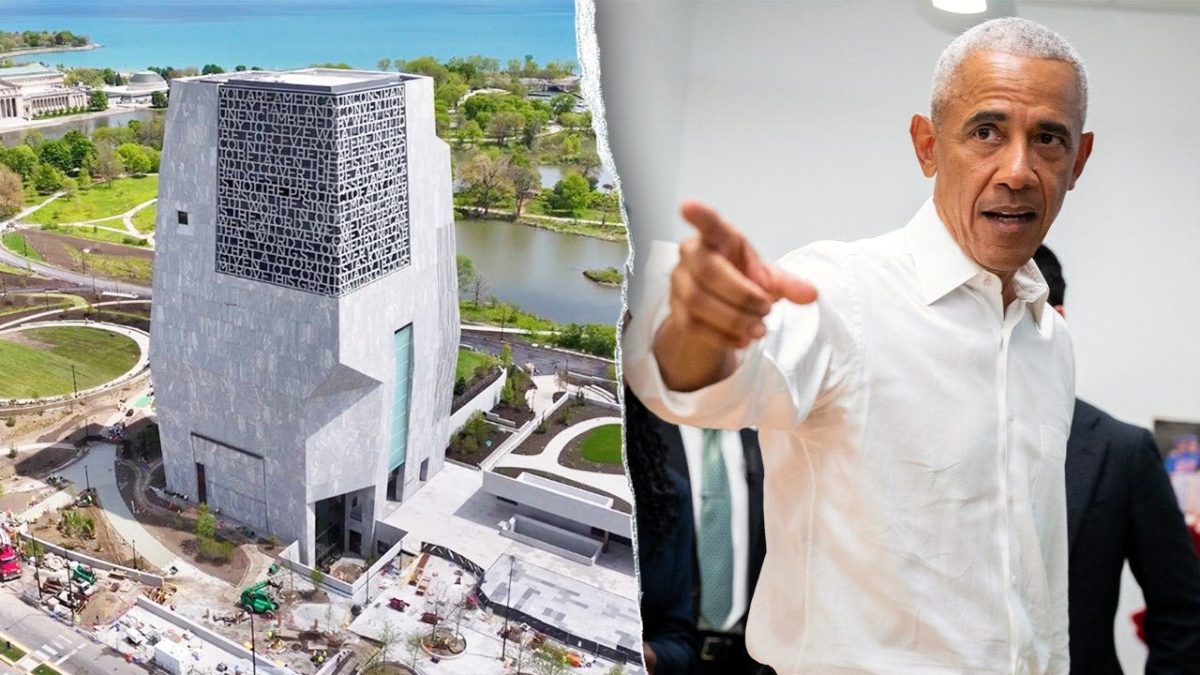
The $1 billion Obama Presidential Center opened last week in Chicago, but critics say it functions as the headquarters of Barack Obama’s private foundation — not the traditional presidential library the public expected.
Unlike every other modern presidential library, the Obama Center houses no presidential papers for public viewing. Instead, Obama’s records are stored elsewhere, with digital versions potentially available someday.
At its core, the center serves two purposes: a museum dedicated to Obama’s presidency and the headquarters of the Obama Foundation, Obama’s private nonprofit.
The sprawling 19.3-acre campus includes a “Democracy in Action Lab,” conference facilities, foundation offices, and a major athletic complex for youth sports — features not typically associated with a presidential library.
“We designed the center not to be some lifeless mausoleum,” Obama said during Thursday’s opening ceremony.
Signs reading “Bring Change Home” and “A Home For Action” surround the campus perimeter. The messaging mirrors how the Obama Foundation describes the center in annual reports — not as a traditional presidential library, but as a “campus” and “living institution.”
“We are building more than a campus. We are creating a living institution that will inspire, empower, and connect the next generation of leaders,” the foundation’s 2024 annual report reads.
“While we are non-partisan, we are not value-neutral. We have a point of view,” Obama said in his speech.
Presidential historian Tevi Troy, a former George W. Bush administration aide, told Fox News Digital the direction didn’t surprise him.
“Usually, these libraries are a monument to a presidency and the presidency is in the past, it’s in the rear-view mirror,” Troy said. “It looks like Obama wants to use it as some kind of activism center, something that continues to promote his ideas and his political views.”
“Obama was a community organizer. He’s an activist. That’s how he came up, and it doesn’t surprise me that he wants to go in this direction.”
Public Land Controversy
The center occupies roughly 19 acres of Jackson Park — Chicago’s equivalent of New York’s Central Park — under a controversial 99-year agreement city leaders approved for a one-time $10 payment.
Opponents argue that transferring public parkland to a private foundation violated the public trust doctrine, a legal principle intended to preserve public assets for public benefit.
Richard Epstein, a New York University law professor and one of the nation’s foremost experts on the public trust doctrine, represented the local Protect Our Parks group in legal challenges.
“When we were defeated, we weren’t told that we were wrong on the merits,” Epstein said. “We were told that we had no right to bring the complaint at all.”
Courts never fully examined whether the foundation had sufficient financial safeguards in place before receiving control of the site, including a long-promised $470 million reserve fund intended to shield taxpayers from future liabilities. A Fox News Digital investigation found that just $1 million has been deposited into the fund.
Critics also point out that hundreds of millions of taxpayer dollars were spent on surrounding road, utility and transportation improvements tied to the project.
“Bait and Switch”
Bob Grogan, chairman of the Illinois Republican Party, said the project was initially promoted as a presidential library to win public support and secure the land, but then morphed into something very different.
“This isn’t a presidential library. It’s a Democratic headquarters on the South Side.”
“They go and sell it with the most palatable thing,” Grogan said. “Then they just incrementally, drip by drip, make it worse until they get back to the reality.”
The National Archives and Records Administration — which has oversight on all other presidential libraries — told Fox News Digital that the Obama Center is operated entirely by the Obama Foundation and sits outside the federal presidential library system.
That means the foundation — not the federal government — decides how the center is run, what exhibits visitors see, and how Obama’s legacy is presented.
Troy said presidential libraries have evolved over time, but cautioned that the center should not lose sight of its traditional purpose.
“I worry about getting too far afield from the purpose of what these things are supposed to be, which are memorials to a presidency and a repository for all their documents,” he said.