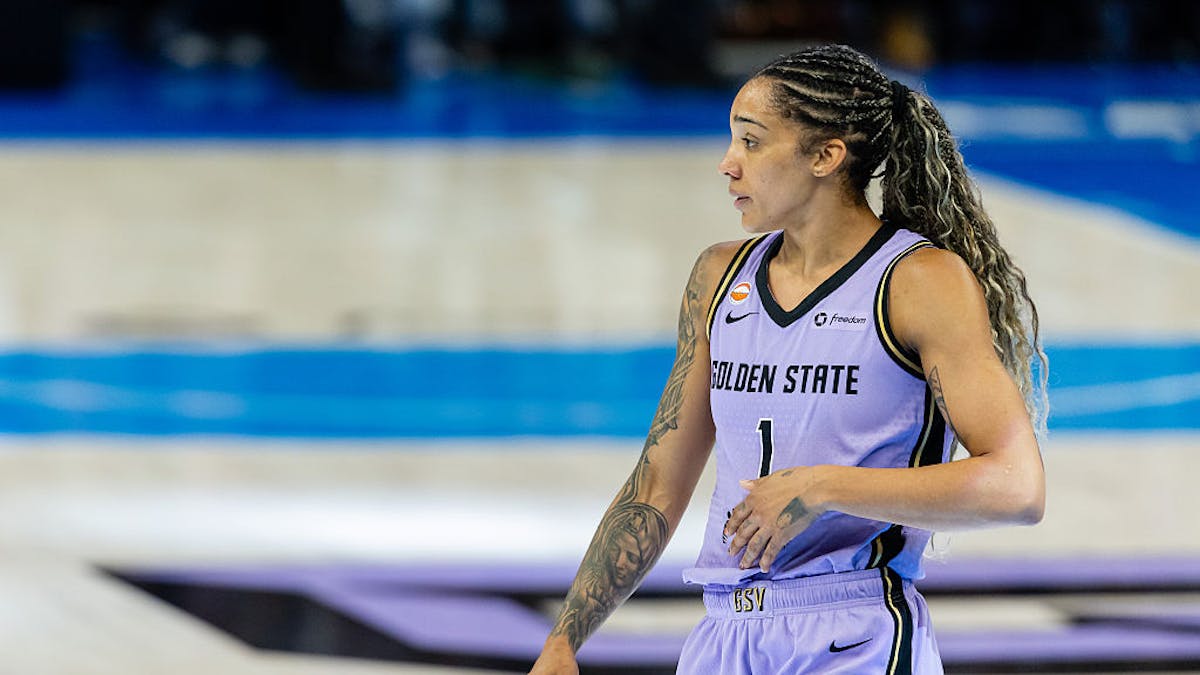
Golden State Valkyries star Gabby Williams just became the first active WNBA player to declare she’d gladly share a locker room with biological men identifying as women.
The declaration comes amid an intensifying national conversation about sex-segregated sports and facilities, a debate that has now firmly taken root within the WNBA itself. Williams’ remarks represent a significant moment in the ongoing controversy, as players across the league grapple with questions that extend far beyond basketball strategy and into fundamental issues of fairness, safety, and rights.
Williams called trans inclusion “our new battle” while claiming rights are being “stripped away” from transgender individuals.
“I would welcome a trans athlete on my team or against my team anytime. I don’t think it’s a problem in the world, it’s just another way to kind of attack trans people.”
Her comments frame the issue as a civil rights struggle, positioning those who oppose biological males in women’s sports as aggressors rather than advocates for female athletes. This framing has become increasingly common among progressive activists, though it stands in stark contrast to concerns raised by those who argue that sex-based categories in athletics exist specifically to ensure fair competition and safe spaces for women.
The statement puts Williams in direct opposition to Indiana Fever guard Sophie Cunningham, who ignited a league-wide firestorm last month by bluntly stating she wants to “protect young girls in a locker room, or young girls in sport who shouldn’t have to go against biological men.”
Cunningham’s position reflects what polls suggest is the majority view among Americans, who consistently express concern about fairness in women’s sports when biological males are allowed to compete. Her willingness to speak publicly on the issue broke an unofficial silence within the league, where many players have been reluctant to wade into such politically charged waters.
Cunningham shut down online mobs with a defiant follow-up: “I said what I said.”
Williams singled out former “non-binary” WNBA player Layshia Clarendon for praise, calling Clarendon “brave enough and courageous enough” to step into the forefront of the trans-athlete push.
Clarendon, who played in the WNBA from 2013 to 2022, became one of the league’s most prominent voices on gender identity issues and has been vocal about expanding access to women’s sports beyond biological females. By invoking Clarendon’s activism, Williams aligns herself with a growing movement within the league that views traditional sex-based categories as outdated or discriminatory.
“I think it’s trans rights that now is our new battle,” Williams stated. “That’s what I think I was saying, that the battles have changed. Our intentions have been the same, but now the environment has changed.”
This characterization suggests Williams sees her stance as part of a broader social justice continuum, though critics argue it conflates advocacy for one group with the potential erosion of protections for another. The tension between these competing frameworks—rights expansion versus rights protection—has become the central fault line in this debate.
The rift in the WNBA has already boiled over onto the court.
Minnesota Lynx head coach Cheryl Reeve strutted out in a “Trans Kids Belong” t-shirt, earning a public plug from ESPN announcer Rebecca Lobo. Meanwhile, Fever head coach Stephanie White ducked the issue entirely, claiming she wasn’t “educated enough from a scientific standpoint” to take a stand.
The contrast between Reeve’s activism and White’s reluctance illustrates the political minefield the issue has become for league figures. While some embrace the controversy as an opportunity to signal their values, others recognize that any position risks alienating significant portions of the fanbase, sponsors, or players themselves.
While coaches and execs hem and haw, Cunningham’s common-sense defense of female athletics has rallied fans nationwide — even drawing backing from White House Press Secretary Karoline Leavitt and activist Riley Gaines.
The support from high-profile political and advocacy figures underscores how WNBA locker room policy has become entangled with broader culture war battles. What might once have been handled as an internal league matter has now become a flashpoint in national politics, with implications that extend far beyond professional basketball.
The battle has spilled into the stands.
In Seattle, Storm co-owner Celeste Keaton was punished after flying off the handle in an expletive-laced tirade against two 16-year-old girls wearing gear supporting Cunningham’s position.
The incident highlights the raw emotions on both sides and raises questions about how leagues should handle disagreements that pit ownership against fans. The confrontation also demonstrates that this debate involves not just abstract policy questions but real conflicts between people with deeply held convictions about fairness, dignity, and what women’s sports should mean.
Williams’ invitation to biological men in women’s locker rooms marks the clearest fault line yet in a league now split between players defending female spaces and those demanding they be opened to males.