President Donald Trump and Chinese President Xi Jinping extended a critical trade pause Thursday, buying two more months to turn a fragile truce into a lasting deal — and keeping the world’s two largest economies off a November tariff cliff.
Before the two leaders sat down in the Oval Office, Treasury Secretary Scott Bessent announced the so-called Busan Agreement — set to expire November 10 — would now run through January 10. The extension keeps Chinese rare earths and critical minerals flowing to U.S. manufacturers after last year’s supply scare that rattled production lines.
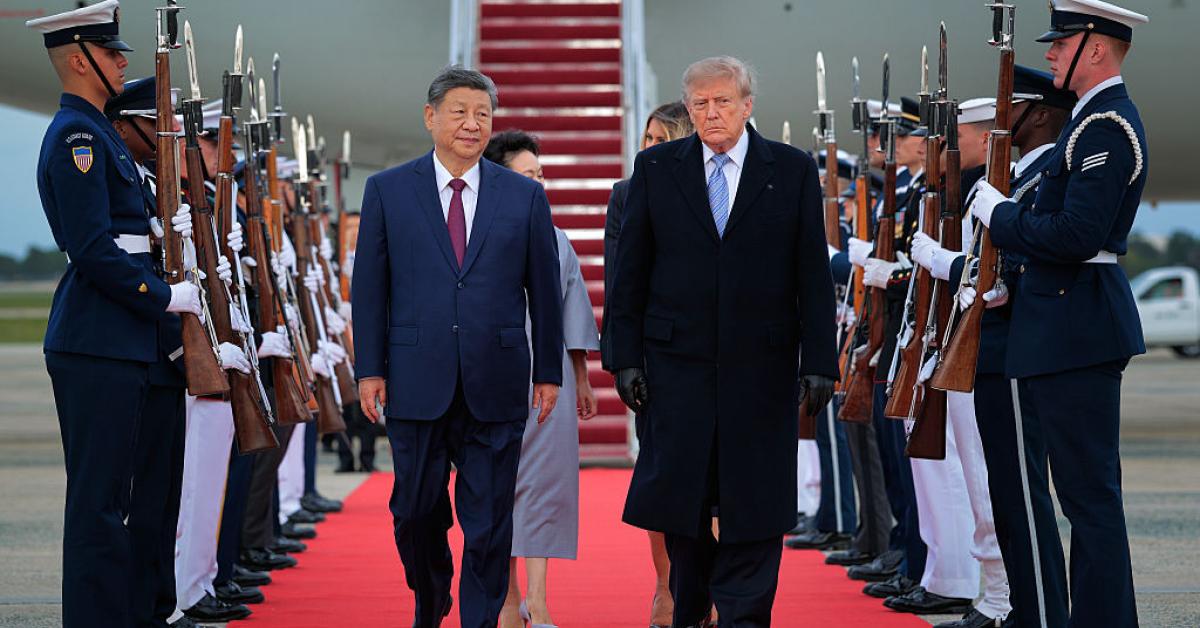
Trump greeted Xi with full state honors and called theirs a “truly great friendship” built since 2016. Xi answered with talk of “healthy” competition kept “within bounds.”
The pomp was real. So is the agenda.
What’s Actually on the Table
Bessent said Washington still wants more compliance on rare earth commitments that U.S. officials say Beijing has only partly filled. China wants a longer runway and clearer market access.
Negotiators have floated a reciprocal cut covering about $30 billion in goods on each side, plus Chinese purchases of U.S. farm products, energy, and Boeing aircraft through a Board of Trade Trump created after his May summit in Beijing.
The two-month clock isn’t a grand bargain. It’s a potential to reach one without slamming the brakes on global supply chains.
“WE ARE IN AN EXISTENTIAL STRUGGLE WITH CHINA ECONOMICALLY, IN TERMS OF SPACE, IN TERMS OF AI OR SUPERINTELLIGENCE. PRESIDENT TRUMP KNOWS THAT VERY WELL… BUT REMEMBER, OVER THE PAST YEAR, PRESIDENT TRUMP HAS TAKEN SOME STEPS THAT REALLY HAVE PUT THE U.S. IN A MUCH STRONGER POSITION.”
Rebecca Grant, vice president of the Lexington Institute and national security analyst, told Just The News.
Superintelligence — Trump’s Preferred Term for Advanced AI
Trump told reporters the visit would cover “security, technology, and ‘superintelligence'” — his preferred term for advanced AI. He said superintelligence would be “a big topic,” but he wants to “leave it exactly where it is,” adding that it’s “China’s position also.”
Xi struck a more formal note, saying both countries have “the capability and responsibility to develop and manage AI for good” and must keep it “always under human control.”
Officials revived a government-to-government AI dialogue first sketched in May. One proposal features a notification channel for AI incidents serious enough to threaten national security.
Jeff Smith, director of the Heritage Foundation’s Asian Studies Center, was blunt about trust: “I would not trust China to cooperate on this at all. I think China would use any form of cooperation to extract concessions.”
Smith did outline a scenario where both nations might share information. “Let’s envision a hypothetical scenario in which some AI agent was interfering with flight traffic control systems. You might want to let China know… so you can imagine scenarios where it would be helpful for us to have some kind of notification hotline.”
Thursday’s state dinner put industry names such as Apple’s Tim Cook, Nvidia’s Jensen Huang, and OpenAI’s Sam Altman in the same room as the two governments race to dominate the technology.
Competition isn’t going away. A shared warning system would at least put a phone line on the desk.
Taiwan — The Unspoken Chip
Beijing put Taiwan at the front of its readout. Xi told Trump China hopes the United States will “adhere to the correct position of opposing ‘Taiwan independence'” and handle the issue “with prudence.” The White House did not immediately issue a matching account.
The practical lever is hardware. The administration approved an $11 billion Taiwan arms sale last year, but a second package worth about $14 billion has been unsigned for months.
After the May meeting in Beijing, Trump called that package “a very good negotiating chip.”
Allies in Asia are watching whether the pause is leverage or a slide. U.S. law still requires Washington to help Taiwan defend itself. How that duty is timed is now part of the bargain.
Iran and the Strait of Hormuz
The Iran war is in its seventh month and has hammered shipping through the Strait of Hormuz. Trump wants Beijing to use its oil-purchasing leverage and political channels with Tehran.
Xi, according to state-controlled Xinhua, said China supports the United States and Iran returning to a 14-point memorandum reached in June and hopes talks resume quickly so the strait can stay open.
Officials have also discussed cutting China’s 15% tariff on U.S. LNG, a step that could revive about $6 billion a year in already-signed American gas contracts frozen since 2025.
Locking China into U.S. supply would give Beijing a hedge against a broken Gulf — and leave Iran with less leverage over its most important remaining energy customer.
Ukraine and Russia
The same session touched Russia’s war in Ukraine. Trump is expected to seek Xi’s help with Putin, and Ukrainian President Volodymyr Zelenskyy said he asked Trump to carry that request into the talks.
Thursday won’t settle the U.S.-China rivalry. It already did something rarer in this relationship: it kept the deal-making window open, put the hardest files on one table, and gave both leaders a reason to come back before the next deadline hits.