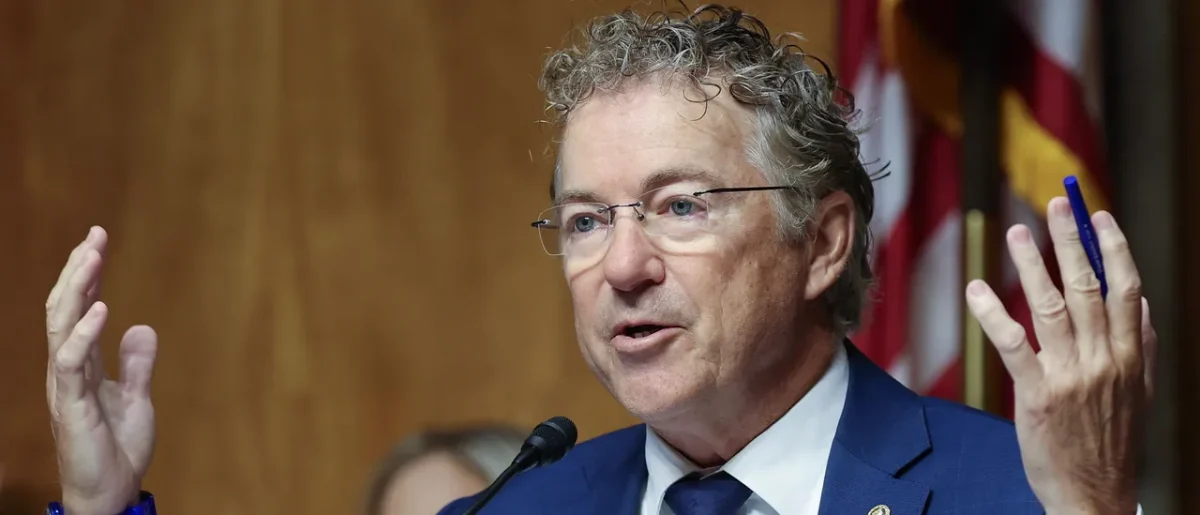
Rand Paul just blocked President Trump’s pick to lead ICE — forcing the White House to withdraw Oklahoma state trooper Lance Schroyer’s nomination on Thursday after the Kentucky senator stalled the confirmation for months.
The collapse of Schroyer’s nomination marks yet another setback for Trump’s immigration enforcement agenda and highlights the persistent challenge presidents face in filling key immigration positions. It also underscores how internal Republican divisions can derail even priorities central to the party’s base, particularly when personal conflicts between senators intersect with matters of executive branch appointments.
Paul chairs the Senate Homeland Security and Governmental Affairs Committee — meaning he controls whether Schroyer ever gets a hearing. According to Politico, Paul held up the process to demand more details about federal investigations into two Americans shot during ICE operations in Minneapolis this past January.
The Minnesota incident had drawn significant scrutiny from civil liberties advocates and raised questions about ICE operational protocols during enforcement actions. Paul’s insistence on obtaining comprehensive information about the investigations before proceeding reflects his long-standing concerns about federal law enforcement overreach and his reputation for demanding accountability from executive agencies regardless of which party controls the White House.
Paul also refused to say publicly whether he even supported Schroyer, the Washington Post reported.
The White House withdrawal notice hit the Senate on Thursday — nearly two months after Trump tapped Schroyer for the role.
Trump had praised Schroyer in late June, saying the 29-year law enforcement veteran has “what it takes to DETAIN AND DEPORT Illegal Alien Criminals.”
“The Senate must CONFIRM Lance, IMMEDIATELY — Do not delay.”
But Paul never moved the nomination forward.
The standoff illustrates the significant power individual committee chairs wield in the Senate confirmation process, where a single senator can effectively halt a nomination simply by declining to schedule hearings or votes. This procedural reality has frustrated presidents of both parties, particularly when their own party controls the Senate and intraparty disputes create unexpected obstacles to advancing their agendas.
The Kentucky Republican has a long-running feud with newly confirmed Homeland Security Secretary Markwayne Mullin — Schroyer’s former colleague and the man he would have reported to if confirmed.
The personal animosity between Paul and Mullin appears to have cast a shadow over the Schroyer nomination, raising questions about whether qualified candidates can receive fair consideration when caught in the crossfire of interpersonal conflicts between powerful senators. The situation demonstrates how personnel disputes at the highest levels of government can have cascading effects on the ability to staff critical national security positions.
🚨🚨🚨RAND PAUL just went in on Senator Markwayne Mullin for previously calling him a “freaking snake” and appearing to “justify” a violent assault against the Kentucky lawmaker in 2017
“Explain to the American public why they should trust a man with anger issues to set the… pic.twitter.com/wtf4tJfZf9
— Jennie Taer (@JennieSTaer) March 18, 2026
During Mullin’s confirmation hearing in March, Paul confronted him over past comments where Mullin called Paul a “freaking snake” and allegedly justified a 2017 assault on the Kentucky lawmaker.
“I just wonder if someone who applauds violence against their political opponents is the right person to lead an agency that has struggled to accept limits to the proper use of force,” Paul said at the time.
“Explain to the American public why they should trust a man with anger issues to set the proper example for ICE and Border Patrol agents.”
Paul’s concerns about leadership temperament and use-of-force policies at federal law enforcement agencies reflect broader debates about accountability and restraint in immigration enforcement. These issues have taken on heightened importance as ICE operations have expanded under the Trump administration’s deportation priorities.
Immigration hawks also questioned whether Schroyer had the experience to run the kind of mass deportation operation Trump’s base demands, Politico reported. The Senate hasn’t confirmed an ICE director in over 12 years.
The extended vacancy in confirmed leadership at ICE has meant the agency has operated under acting directors for more than a decade, creating instability and limiting long-term strategic planning. The inability to confirm permanent leadership reflects the politically fraught nature of immigration enforcement and the difficulty of finding nominees who can navigate both policy demands and Senate politics.
Paul’s office denied blocking the nomination outright, telling the Daily Caller that “our understanding is that the White House pulled the nomination. Senator Paul has not expressed opposition to the nominee.”
Translation: Paul slow-walked it until the White House gave up.
The careful wording from Paul’s office represents a familiar Washington dance, where senators avoid taking explicit positions that might draw political backlash while nonetheless wielding procedural power to achieve their preferred outcomes. By simply declining to act rather than publicly opposing Schroyer, Paul maintained plausible deniability while effectively killing the nomination through inaction.
Senator Mullin tried to justify a violent attack on me. Now he wants to lead ICE and Border Patrol?
You cannot restore law and order with someone who has an anger problem. America deserves better. https://t.co/BFrPsHvScE
— Rand Paul (@RandPaul) March 18, 2026