Ontario Premier Doug Ford answered President Trump’s “Lake America” executive order with a billboard-sized counter-message on the Canadian shoreline — declaring “Lake Ontario. Now and Always.”
The bold display represents the latest escalation in an increasingly public diplomatic dispute between the United States and Canada over geographic naming rights. What began as a surprise executive order from the White House has now evolved into a highly visible symbolic confrontation, with provincial leaders taking unprecedented steps to defend Canadian sovereignty over shared waterways.
The 24-by-12-foot sign stands on six-foot legs, putting its top about 18 feet above the ground — roughly two stories high. The message is repeated in French.
The bilingual presentation underscores the pan-Canadian nature of the response, acknowledging both official languages and signaling unity across linguistic communities. The sign’s imposing dimensions ensure visibility from considerable distances, including potentially from boats on the lake itself and aerial approaches to the region.
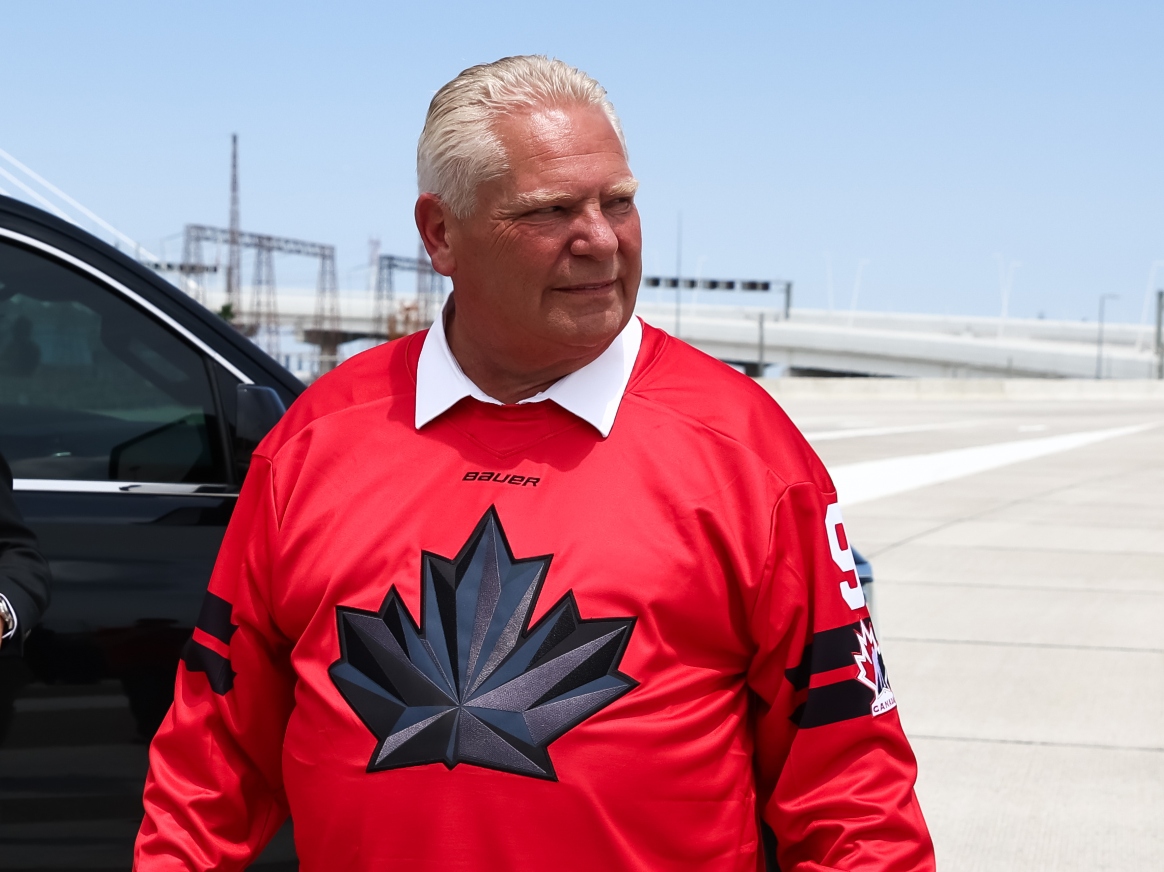
Ford was wearing a Team Canada soccer jersey when he unveiled the sign near Grimsby, Ontario, and posed for photographs.
The choice of location was strategic — Grimsby sits directly on the Lake Ontario shoreline, offering clear sightlines across the water and symbolically planting the Canadian position on the contested waterway itself. The Team Canada apparel added another layer of national symbolism to what was clearly choreographed as a patriotic moment.
Trump signed an executive order this week directing U.S. federal agencies to call Lake Ontario “Lake America” — the body of water that straddles both countries. Google announced it had begun rolling out changes to how its maps display the lake’s name for American users.
Lake Ontario is the smallest and easternmost of the five Great Lakes, bordered by Ontario to the north and New York State to the south and east. The shared waterway has been governed by binational treaties and cooperation agreements for generations, making the unilateral renaming particularly controversial from an international relations standpoint.
“LONG AFTER PRESIDENT TRUMP IS GONE, IT WILL STILL BE CALLED LAKE ONTARIO.”
Ford said Trump was trying to rename the lake because Ontario and Canada were “standing up for ourselves” and argued the name would outlast the president.
The premier’s comments reflect a broader Canadian frustration with what many north of the border perceive as arbitrary exercises of American power that disregard longstanding norms of bilateral cooperation. By framing the issue as one of permanence versus temporary political theatre, Ford attempted to minimize the significance of Trump’s action while simultaneously treating it seriously enough to warrant a physical monument in response.
Trump waved off Ford’s comments as “bluster,” calling him Prime Minister Mark Carney’s “flunky” and the conservative leader as the “less charismatic, intelligent, and overall unimpressive brother” of the late Toronto Mayor Rob Ford.
The personal nature of Trump’s response marks a departure from traditional diplomatic language between allied nations. By invoking Doug Ford’s late brother Rob, whose mayoralty was marked by controversy and international attention, Trump appeared to be employing the same combative rhetorical style that has characterized his approach to domestic political opponents.
Manitoba Premier Wab Kinew joined the cross-border repartee, comparing Trump to an aging rock band trying to revive an old hit.
“You know when, like, a rock band is really over the hill and you see them like in a casino playing some song from like 50 years ago, I think that’s the part of Donald Trump’s presidency we’re at now,” Kinew said, referring to Trump’s earlier executive order renaming the Gulf of Mexico the Gulf of America.
“And he’s trying to bring back that, and he’s trying to play the hits for his base. But I think everybody here thinks it’s a little sad and it’s not his best work.”
Kinew’s intervention demonstrates how the dispute has engaged political leaders beyond Ontario, turning what might have been a bilateral federal matter into a rallying point for provincial solidarity. His cultural metaphor attempts to reframe Trump’s actions as derivative and lacking originality, suggesting a pattern rather than an isolated incident.
Trump’s executive order gives the U.S. Department of the Interior 30 days to update the name change with the Geographic Names Information Service — the official repository of domestic geographic names in the U.S.
The timeline creates a practical deadline for the administrative implementation of the renaming within American federal systems, though it has no bearing on Canadian or international usage. The Geographic Names Information Service maintains standardization across federal agencies, meaning the change would affect everything from official government documents to federally produced maps and educational materials.
Canadian Prime Minister Mark Carney has publicly rejected the move, noting the lake’s indigenous roots and the name predates both the Canadian Confederation and the U.S. Declaration of Independence.
The historical argument carries particular weight in debates over naming rights, as “Ontario” derives from indigenous languages and represents a connection to the land that preceded European colonization and the establishment of either modern nation-state. By emphasizing this heritage, Carney positioned the Canadian response not merely as national pride but as respect for indigenous history and pre-colonial geography.
Google Maps now displays “Lake America” for U.S. users — Canada still sees “Lake Ontario.”
The tech giant’s decision to implement regionally different naming reflects the complexities of navigating disputed geographic nomenclature in the digital age, where mapping platforms have become arbiters of how millions of people understand physical geography.
It’s official! LAKE AMERICA on Google Maps. pic.twitter.com/CotsXetERJ
— Steven Cheung (@StevenCheung47) August 30, 2026