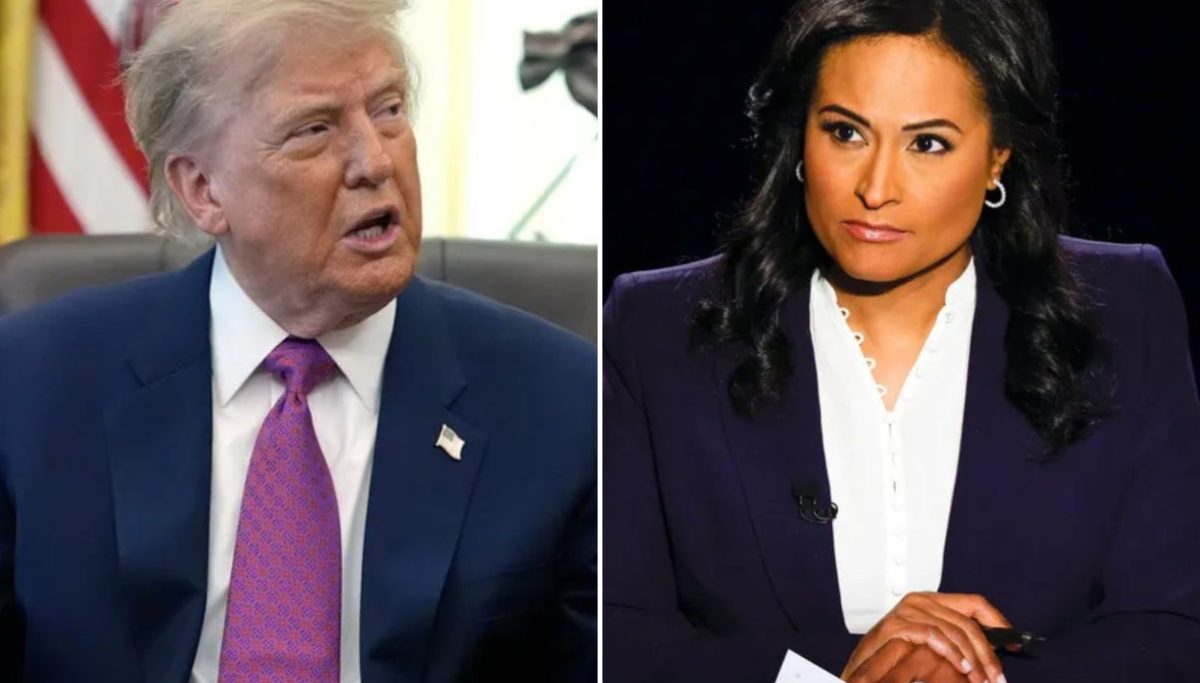
President Donald Trump announced he’s reporting NBC’s Kristen Welker to the Federal Communications Commission for “rebuke and punishment” after she falsely claimed his endorsement record shows “mixed results.”
The reality? Trump’s endorsement success rate sits at 100% for U.S. Senate races and 98% for U.S. House races in the 2026 cycle.
The dispute highlights an ongoing tension between the Trump administration and major broadcast networks over factual accuracy in political coverage. For Trump, whose political influence within the Republican Party is substantially measured by his ability to elevate candidates through endorsements, characterizations of his track record carry significant weight. Misrepresenting that record, he argues, misleads viewers about the actual state of his political standing and distorts the public’s understanding of power dynamics within the GOP.
Trump fired back minutes after Welker made the claim Sunday morning on Meet the Press, calling out the false reporting in a Truth Social post.
“Kristen Welker, the Unpopular ‘Hostess’ of the once great Meet the Press, now considered Meet the Fake Press, just stated that Donald Trump has ‘mixed results’ on his Endorsements of Candidates, when the recent WINS of Darline Graham and Mike Mazzei, stand at 100% for the U.S. Senate, and 98% for the U.S. House, recently and over the longterm.”
Trump pointed to specific recent victories — including candidates Darline Graham and Mike Mazzei — as proof the “mixed results” narrative is fabricated.
The term “mixed results” typically implies a roughly even split between successes and failures, or at minimum a substantial number of losses that complicate an otherwise positive record. A success rate in the high 90th percentile contradicts any reasonable use of that phrase. For political analysts and viewers trying to assess Trump’s current influence over the Republican Party’s candidate selection process, the difference between “mixed results” and a near-perfect winning record represents a fundamental mischaracterization of the political landscape.
The president didn’t stop at correcting the record. He escalated the issue to FCC Chairman Brendan Carr, demanding accountability for what he described as a threat to the country.
“How can anyone be allowed to say this, working for freely given Public Airwaves?” Trump wrote, attaching a graph and citations documenting his actual endorsement record.
Trump’s post included a direct message to the FCC: “I hope that Chairman Brendan Carr, and the fine people of his Commission, will take this Threat to our Country very seriously.”
The invocation of “public airwaves” is significant. Unlike cable networks or digital platforms, broadcast television networks like NBC operate under a different regulatory framework. They use electromagnetic spectrum that belongs to the American public, licensed to them by the federal government with the expectation that they serve the public interest. This distinction has historically given the FCC broader authority over broadcast content than it has over other media platforms, though the extent and application of that authority remains a subject of ongoing legal and political debate.
NBC operates under a broadcast license granted by the FCC, which gives the commission authority over content standards on public airwaves. Trump’s complaint argues that knowingly false statements about election-related matters — including candidate endorsements — violate those standards.
The question of whether false statements on political programming constitute a violation of broadcast standards touches on complex First Amendment issues. While the FCC does have enforcement mechanisms, the agency has historically been reluctant to intervene in matters that could be construed as regulating political speech or news judgment, even when factual accuracy is questionable. Trump’s formal complaint puts pressure on the commission to clarify where it draws the line between protected editorial discretion and misuse of the public airwaves through demonstrably false claims.
Welker has hosted Meet the Press since September 2023, taking over what was once considered the gold standard of Sunday political shows. Trump’s “Meet the Fake Press” jab reflects conservative frustration with what they see as the show’s shift from neutral interviewing to partisan framing.
The program, which first aired in 1947, has long been regarded as essential viewing for understanding Washington’s political dynamics. Its reputation was built on tough but fair questioning of political figures from both parties. Conservative media critics have argued that under recent leadership, including Welker’s tenure, the show has adopted editorial approaches that favor progressive narratives while presenting them as neutral fact-based journalism. This latest incident, in their view, exemplifies that trend.
The endorsement record Trump cited covers both recent primary wins and his broader track record across multiple election cycles. With high-90s success rates, his endorsement remains one of the most powerful forces in Republican primaries — a fact Welker’s “mixed results” characterization directly contradicts.
Understanding the actual power of Trump’s endorsement is crucial for anyone trying to make sense of Republican Party politics heading into future election cycles. Candidates, donors, and strategists all make decisions based on assessments of where political influence lies. When major news platforms provide inaccurate assessments of that influence, it potentially affects everything from fundraising to candidate recruitment to voter expectations.
The FCC has not yet publicly responded to Trump’s complaint. Chairman Carr, a Trump appointee, has previously signaled openness to enforcing broadcast standards more aggressively when networks misuse the public airwaves.