
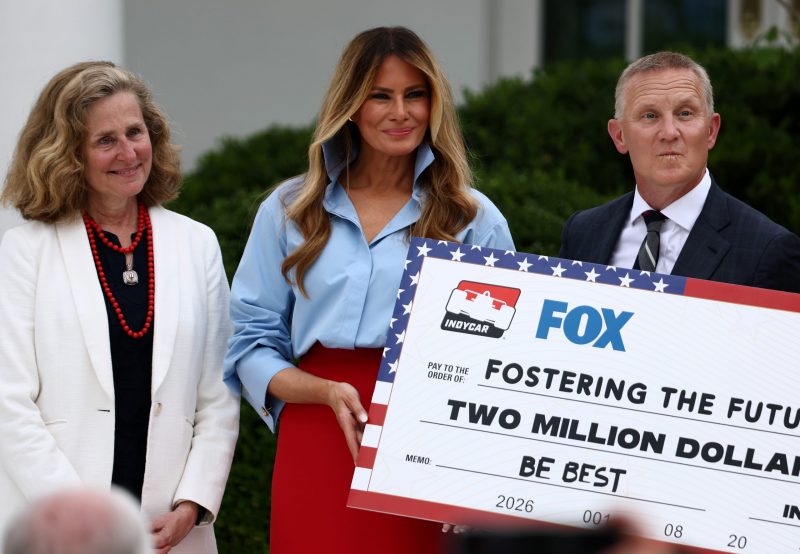
First Lady Melania Trump returned to the Rose Garden Thursday with a signature entrance—”I heard you missed me, here I am”—and a $2 million partnership to expand educational opportunities for America’s foster youth.
Standing alongside Fox Corporation and IndyCar executives, the First Lady announced that Indiana University and Purdue University will join her “Fostering the Future” initiative. The two schools become the newest members of a coast-to-coast alliance of 26 universities providing scholarships, housing assistance, and career training to young adults aging out of the foster care system.
The expansion addresses a critical gap in America’s social safety net. Each year, approximately 20,000 young adults age out of foster care, often facing homelessness, unemployment, and limited access to higher education. National statistics show that fewer than 3% of foster youth complete a four-year college degree, compared to more than 30% of the general population. This educational disparity has long-term economic consequences, affecting not only individual earning potential but also workforce development and social mobility across generations.
“Today, Indiana University and Purdue University join fostering the future’s growing coast to coast alliance of leading academic institutions. Congratulations and thank you. Together they expand a national network of 26 universities that prepare our foster youth to shape America’s growth. I’m very proud to share this last spring, fostering the future scholarships supported the education of our first doctor, he will change the lives of so many people.”
The announcement comes with a milestone: this spring, the initiative produced its first doctor—a foster youth who completed medical school through the program.
The achievement represents more than an individual success story. It demonstrates the potential return on investment when comprehensive support systems remove structural barriers to education. Medical school completion requires not just tuition coverage but sustained financial stability, housing security, and professional mentorship—precisely the wraparound services the Fostering the Future initiative provides. This holistic approach distinguishes the program from traditional scholarship models that address tuition alone while leaving students vulnerable to dropout due to housing insecurity or lack of basic necessities.
“Fostering the Future Graduates Will Build New Companies, Launch New Industries”
Indiana University and Purdue University are joining Fostering the Future’s growing national alliance of leading academic institutions.
For more updates, watch OAN on OAN Live. pic.twitter.com/lvMI37nJRA
— One America News (@OANN) August 20, 2026
The First Lady framed the initiative as an investment in America’s future workforce—not a handout, but a merit-based opportunity for young people trapped by circumstance.
Her emphasis on merit reflects a broader policy philosophy that positions educational access as economic strategy rather than social welfare. By characterizing foster youth as untapped talent rather than at-risk populations, the initiative reframes the national conversation around both higher education funding and foster care outcomes. This framing has implications for how similar programs might be structured and funded in the future, potentially influencing state-level policy decisions and corporate philanthropic priorities.
“Fostering the Future elevates America’s youth based on merit and talent, lifting them beyond economic circumstances and every other condition that may limit opportunity. Fostering the Future graduates will build new companies, launch new industries, and redefine what is possible for all Americans. Fostering the Future is more than an educational initiative—it is a generational investment in America’s talent pipeline.”
Beyond tuition coverage, the program provides housing support, career training, and financial resources designed to help foster youth transition into self-sufficient adulthood. The First Lady emphasized that the most valuable investment America can make isn’t in infrastructure or technology—it’s in the nation’s children.
The comprehensive nature of the support addresses what education researchers call the “hidden costs” of college attendance—expenses beyond tuition that frequently derail low-income students. For foster youth specifically, these challenges are compounded by the absence of family safety nets that traditional students rely on during emergencies or summer breaks. The program’s housing component alone removes a primary barrier that forces many foster youth to choose between continuing education and maintaining basic shelter.
.@FLOTUS: “Fostering the Future is more than an educational initiative; it is generational investment in America’s talent pipeline. Every student who graduates strengthens our workforce, accelerates innovation, expands economic opportunity, and reduces long-term dependence on… https://t.co/uxgCNE90Xwpic.twitter.com/aILk0xw5qg
— Rapid Response 47 (@RapidResponse47) August 20, 2026
With the addition of Indiana University and Purdue, the Fostering the Future network now spans 26 institutions from coast to coast—each committed to turning foster youth into the engineers, entrepreneurs, and innovators who will drive America’s next generation of growth.
The geographic expansion of the network creates regional hubs that increase access while allowing students to remain connected to their home communities. As the alliance grows, it establishes a national infrastructure that could serve as a model for addressing educational inequality across other underserved populations, potentially reshaping how public-private partnerships approach systemic barriers to higher education completion.