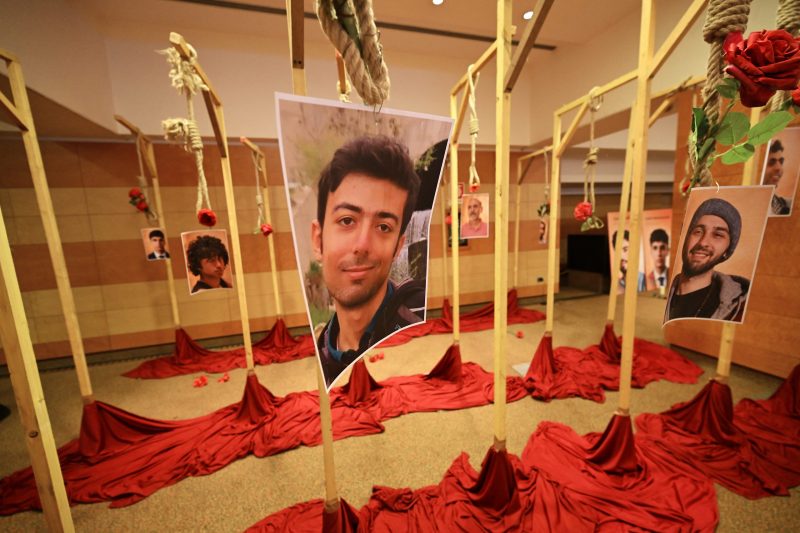
The Iranian regime executed another protestor early Sunday, bringing the total to 29 executions tied to the January protests since March 19th. The accelerating pace of executions has drawn international condemnation and highlights the regime’s intensifying crackdown on dissent following months of civil unrest that have challenged the government’s authority across the country.
Majid Adineh was put to death in Karaj Penitentiary west of Tehran, according to Oslo-based Iran Human Rights (IHR). The regime accused him of working for the United States and Israel — labels human rights organizations say are routinely applied to protestors to frame them as security threats. This pattern of characterizing domestic dissent as foreign-backed terrorism has become a hallmark of the Iranian government’s response to political opposition, allowing authorities to justify harsh sentences under national security provisions that carry the death penalty.
According to Iran’s state-affiliated Mizan News Agency, Adineh and another suspect were arrested on January 9th in Alborz province west of Tehran, allegedly carrying a revolver, ammunition, two tasers, two tear gas canisters, a rechargeable chainsaw, and a bottle of gasoline. The items listed in the state media report form the basis of the regime’s case that Adineh was engaged in planned acts of violence, though independent verification of these claims has been impossible given the secretive nature of Iran’s judicial proceedings for politically sensitive cases.
Adineh was convicted of “operational action in favor of hostile groups and the Zionist regime and the United States, war through deliberate arson, gathering and collusion with the intention of committing crimes against the country’s internal security, propaganda activity against the sacred system of the Islamic Republic of Iran.”
The outlet further claimed Adineh “was one of the agents of the American-Zionist coup and was affiliated with terrorist groups residing in a neighboring country.” These sweeping charges reflect the Iranian judiciary’s broad interpretation of crimes against the state, which international legal experts have criticized as violating due process standards and being used to criminalize peaceful political expression.
Many human rights organizations believe these labels are routinely used to depict protestors and political prisoners as national security threats, Iran International noted. This framing serves a dual purpose for the regime: it delegitimizes domestic opposition by portraying it as foreign interference, while simultaneously justifying severe punishments that might otherwise provoke greater international backlash.
This is the true face of Majid Adineh… 💔🕊️
A brave Iranian patriot from Karaj who stood up for freedom and was executed today by regime executioners.
Remember his face, say his name, and never let his memory or sacrifice be buried in silence. His courage lives on in our… https://t.co/Eh0h9HG1BRpic.twitter.com/DcrdUNzRIA
— APADRA 🇮🇷 (@DGascoign3) August 23, 2026
Iranian American journalist and dissident Masih Alinejad said the execution followed the regime’s pattern of operating in “secrecy” and “darkness.” Alinejad, who has been a prominent voice documenting human rights abuses in Iran and faces threats from the regime for her activism, has consistently highlighted how Iranian authorities conduct trials and executions with minimal transparency to avoid domestic and international scrutiny.
“Another young protester has been executed at dawn. Majid Adineh, detained on January 9 in Mohammadshahr, Karaj, was reportedly executed in secrecy and near-total silence. Most of us never even saw his face or knew his name until after he was hanged. The authorities accused him of carrying a weapon. They did not even accuse him of killing anyone. Yet they executed him. This is how the Islamic Republic operates: arrest them in darkness, execute them at dawn, and hope the world never learns their names.”
Another young protester has been executed at dawn.
Majid Adineh, detained on January 9 in Mohammadshahr, Karaj, was reportedly executed in secrecy and near-total silence.
Most of us never even saw his face or knew his name until after he was hanged.
The authorities accused him…
— Masih Alinejad (@AlinejadMasih) August 23, 2026
Iranian officials claim more than 3,000 people have been lost to “acts of terrorism” originating from the U.S. and Israel during the widespread unrest. The government has consistently attributed the protests to external forces rather than acknowledging domestic grievances over economic conditions, political freedoms, and social restrictions that have fueled public anger.
However, many human rights organizations and U.S. officials report significantly higher counts related to the regime’s crackdown on protestors earlier this year. The stark discrepancy between official Iranian figures and independent assessments reflects the challenge of documenting casualties and abuses in a country where press freedom is severely restricted and international monitors have limited access. This information gap makes it difficult for the international community to hold the regime accountable and complicates efforts to provide accurate documentation of human rights violations occurring within Iran’s borders.