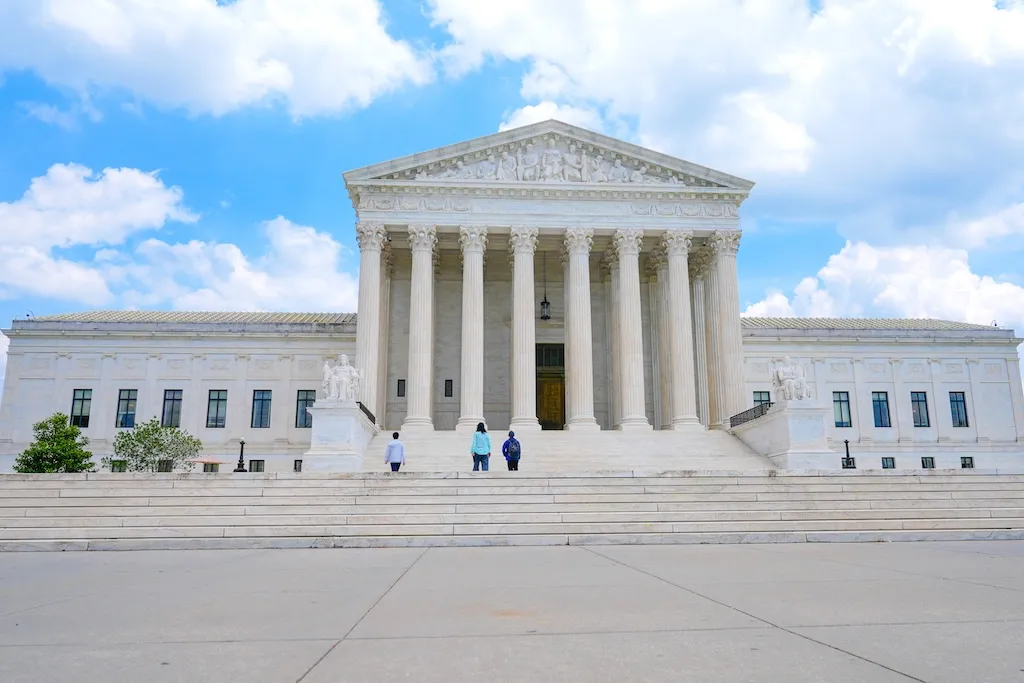
House Judiciary Committee Chairman Jim Jordan just passed a resolution that could permanently lock the Supreme Court at nine justices — blocking Democrats from packing the bench for partisan gain.
The resolution, if approved by two-thirds of both chambers, would be sent to the states as a constitutional amendment fixing the number of justices at nine.
Democrats proposed expanding the court to 13 justices in 2021 and again in 2023. With potential Democratic majorities looming in January, the threat to judicial independence has never been more urgent.
“It is a measure which should be so emphatically rejected that its parallel will never again be presented to the free representatives of the free people of America.”
Those words came from a Democrat-controlled Senate Judiciary Committee in 1937 — stopping FDR’s court-packing scheme before it reached the House floor. Roosevelt wanted to add as many as six justices to push through his New Deal programs. Even his own party called it a power grab.
For over 150 years, Congress has not altered the number of justices on the court. That stability preserved the court’s independence as an institution that renders decisions based on law, not politics.
But the left sees the court as an obstacle. When rulings don’t go their way, they threaten to change the referee instead of the rules.
The first round of court-packing would set off a cycle of retaliation. Each new congressional majority would add justices to offset those added by its predecessor. With every expansion, the court’s ability to check government excess would disappear.
History proves the danger. In 2004, Venezuelan President Hugo Chavez expanded that country’s Supreme Tribunal from 20 to 32 members. The court became a tool for consolidating power and marginalizing opposition. The rule of law collapsed.
Alexander Hamilton called the judiciary the “least dangerous” branch — exercising “neither force nor will but merely judgment.” That role as a final check against government abuse will not be regained once lost.
Congress must pass the proposed amendment and send it to the states for ratification.