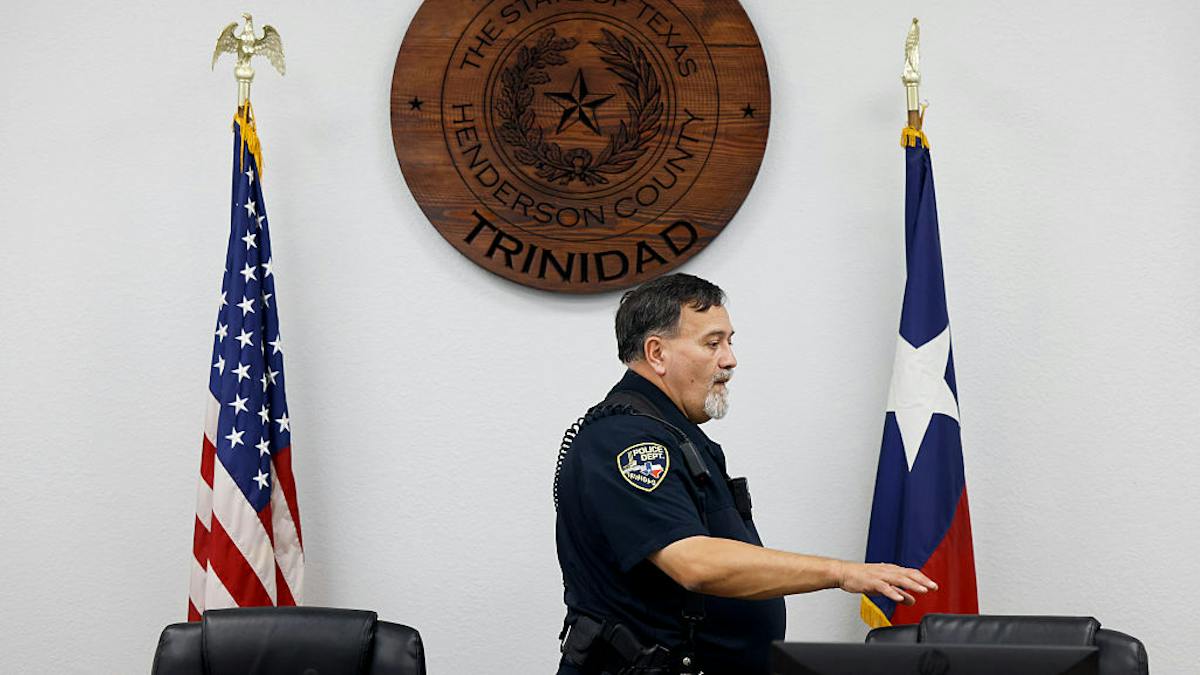
A Texas police department that arrested a mother for a Facebook post criticizing the town’s water supply has been shut down by state regulators after investigators found it failed to meet minimum law enforcement standards. The case has raised significant questions about how small-town police departments handle criticism and whether adequate oversight mechanisms exist to protect citizens’ First Amendment rights when local law enforcement oversteps its authority.
The Texas Commission on Law Enforcement revoked Trinidad’s license to operate its own police department on September 9. State investigators determined the five-officer department “failed to meet minimum standards” and “was unable to provide evidence that the agency provides public benefit to the community.” The decision to revoke a municipality’s police license is relatively rare in Texas and typically occurs only after serious and systemic failures have been documented. Such revocations represent a recognition that a department has become dysfunctional to the point where it can no longer serve its core mission of protecting public safety.
The shutdown comes months after officers arrested Jennifer Combs and jailed her overnight over a Facebook post about Trinidad’s drinking water. The arrest drew national attention to the small town of fewer than 1,000 residents and sparked widespread concern among civil liberties advocates about the criminalization of online speech critical of local government.
“FOR MONTHS, CITIZENS WHO QUESTIONED THIS DEPARTMENT WERE DISMISSED, ATTACKED AND IN MY CASE ARRESTED. WE WERE NEVER THE PROBLEM. WE WERE EXPOSING IT.”
Combs had written that she had seen reports of people being hospitalized after drinking the city’s water. Police charged her with felony false alarm or report, claiming the post created “fear, panic, or unnecessary emergency response within a community.” The charge carried potential prison time and represented an extraordinary escalation of what began as a citizen raising concerns about public health. Legal experts who reviewed the case questioned whether the statute was ever intended to criminalize social media posts expressing concerns about municipal services.
A Henderson County grand jury later declined to indict her, and the charge was dropped. The grand jury’s refusal to indict suggested that even after reviewing the evidence presented by police, ordinary citizens found the prosecution lacked merit.
On April 21, the city itself issued a notice advising residents to boil their water to “avoid harmful bacteria.” A separate investigation by the Texas Commission on Environmental Quality subsequently found problems with Trinidad’s water supply. These developments proved particularly significant because they validated the very concerns Combs had expressed—concerns for which she had been arrested and jailed just weeks earlier.
The department’s response to criticism sparked additional controversy. The day after Combs’ arrest, police arrested Winston Noles after he stood outside City Hall holding a sign criticizing the police. That charge was also later dropped. The back-to-back arrests created a pattern that suggested the department was systematically targeting citizens who voiced dissent, raising constitutional concerns about retaliation against protected speech.
Police Chief Charles Gregory defended Combs’ arrest and called the case against her “cut and dry.” He resigned in June. He had previously told the Trinidad City Council that he had “nothing to hide” regarding the arrests. Gregory’s departure came amid mounting pressure from both residents and outside observers who viewed the arrests as clear overreach.
After Gregory’s resignation, the judge who approved the search warrant in Combs’ case questioned the “accuracy, completeness, and reliability” of the information Trinidad officers had presented to him. This judicial rebuke was particularly damning, as it suggested officers may have misled the court to obtain authorization for their actions.
The Henderson County District Attorney’s Office announced in August that it would no longer accept cases from the Trinidad Police Department. This extraordinary step effectively meant that the department had lost the confidence of prosecutors—a devastating blow to any law enforcement agency’s ability to function.
The state investigation uncovered far broader failures. The department lacked 18 required policies, including policies governing professional conduct, use of force, vehicle pursuits, and active-shooter situations. These missing policies represented fundamental gaps in the framework that guides officer decision-making and accountability, suggesting the department had been operating without basic safeguards for years.
Trinidad Mayor Dennis Haws said he was not surprised by the state’s decision.
“There’s been a lot of neglect through the years,” Haws told Fox 4. “We are moving in a positive direction. We’ve got to get past all of this.” His acknowledgment of long-term neglect raised questions about why municipal leadership had not intervened earlier to address the department’s deficiencies.
The department’s law-enforcement responsibilities will be transferred to the Henderson County Sheriff’s Office while Trinidad considers a permanent arrangement. This transition period will test whether the community ultimately decides to rebuild its own department under new leadership or permanently contracts with county law enforcement.
Combs celebrated the shutdown as vindication. She wrote that citizens who questioned the department “were dismissed, attacked and in my case arrested.”
“We were never the problem,” she said. “We were exposing it.”