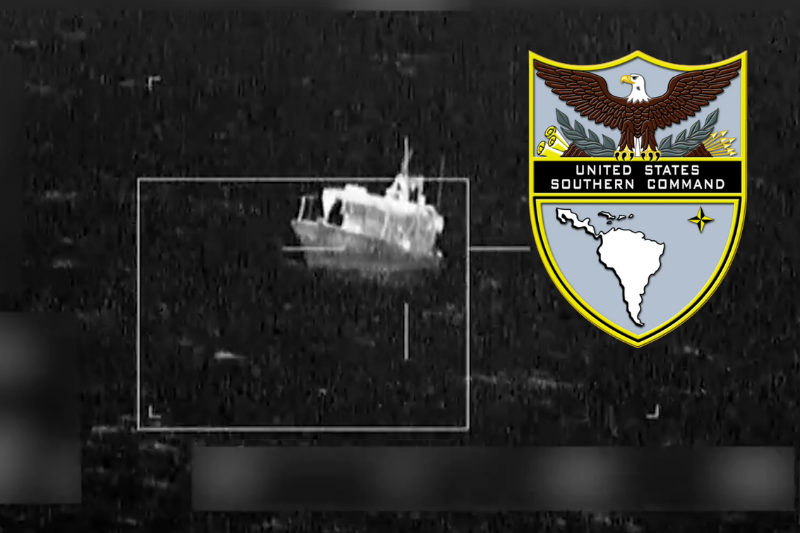
U.S. Southern Command delivered a decisive blow to narco-terrorism Friday, sinking a floating refueling station that served the Los Choneros crime syndicate in the eastern Pacific Ocean. The operation represents a significant escalation in U.S. military efforts to disrupt the infrastructure that enables transnational criminal organizations to transport illicit narcotics across vast ocean distances.
Marines and Sailors launched from USS San Antonio boarded and cleared the vessel without incident before sending it to the bottom. The successful boarding and clearance operation demonstrated the precision and coordination required for maritime interdiction missions in international waters, where criminal networks have increasingly exploited gaps in surveillance and enforcement.
“Today’s operation is a stark example of the Americas Counter Cartel Coalition’s power to dismantle the sophisticated, clandestine narco-terrorist tactics and capabilities that have enabled the trafficking of dangerous drugs destined for American communities.”
SOUTHCOM announced in a press release that the operation targeted a vessel previously identified and sanctioned by the Department of the Treasury. Intelligence confirmed the ship supported Los Choneros — a violent narco-terrorist organization based in Ecuador’s Manabí Province. The Treasury Department’s sanctions designation had marked the vessel as part of the financial and logistical apparatus supporting organized crime, making it a legitimate target for interdiction under international law and bilateral agreements with regional partners.
Los Choneros is one of Ecuador’s most prominent criminal syndicates, involved in drug trafficking, extortion, and robbery throughout the region. The organization has expanded its operations significantly in recent years, capitalizing on Ecuador’s strategic position along major cocaine trafficking routes from Colombia and Peru to markets in North America and Europe.
The interdiction came through coordination between SOUTHCOM, Ecuador’s government, and Joint Task Force Western Hemisphere. U.S. forces searched and secured the vessel before sinking it. Those removed were escorted to Ecuador. The multinational nature of the operation reflects growing cooperation among Western Hemisphere nations facing common security threats from transnational criminal organizations that operate across borders and exploit jurisdictional boundaries.
SOUTHCOM Commander Gen. Francis L. Donovan, who directed the strike, said the coalition dealt a decisive blow to an operation moving significant amounts of drugs through the region. The general’s emphasis on coalition operations underscores the strategic importance of partner nation engagement in countering threats that no single country can effectively address alone.
“Working together with our Ecuadorian partners, our coalition dealt a decisive blow to a narco-terrorist operation responsible for moving significant amounts of drugs through the region. Together with our regional partners, we are committed to defeating narco-terrorists in the Western Hemisphere.”
On Aug. 28, at the direction of #SOUTHCOM Commander Gen. Francis L. Donovan, and in coordination and collaboration with the Government of Ecuador, Joint Task Force Western Hemisphere (JTF-WHEM) successfully interdicted a vessel operating as a floating refueling station in support… pic.twitter.com/ZEj735JRmP
— U.S. Southern Command (@Southcom) August 29, 2026
The military said the operation cuts off a critical node in the traffickers’ logistics chain as part of the Americas Counter Cartel Coalition’s broader mission to dismantle narco-terrorism networks. Floating refueling stations have become essential infrastructure for drug trafficking organizations operating semi-submersible vessels and go-fast boats that require extended range to avoid detection and interdiction. By eliminating these mobile support platforms, military operations force traffickers to operate closer to shore or reduce their operational range, making them more vulnerable to detection and capture.
The Friday strike followed SOUTHCOM’s earlier operation Monday, when U.S. forces conducted what the command described as a kinetic strike on a suspected drug-trafficking boat in the eastern Pacific. The rapid succession of operations within a single week signals an intensified operational tempo and suggests intelligence has identified a concentration of cartel activity in specific maritime corridors.
Donovan made clear the coalition’s stance at the time: “We will not permit narco-terrorists to operate with impunity in the Western Hemisphere, nor will we allow their deadly poison to reach American communities.” This declaratory policy reflects a broader shift toward proactive disruption of criminal infrastructure rather than purely reactive interdiction of individual drug shipments.