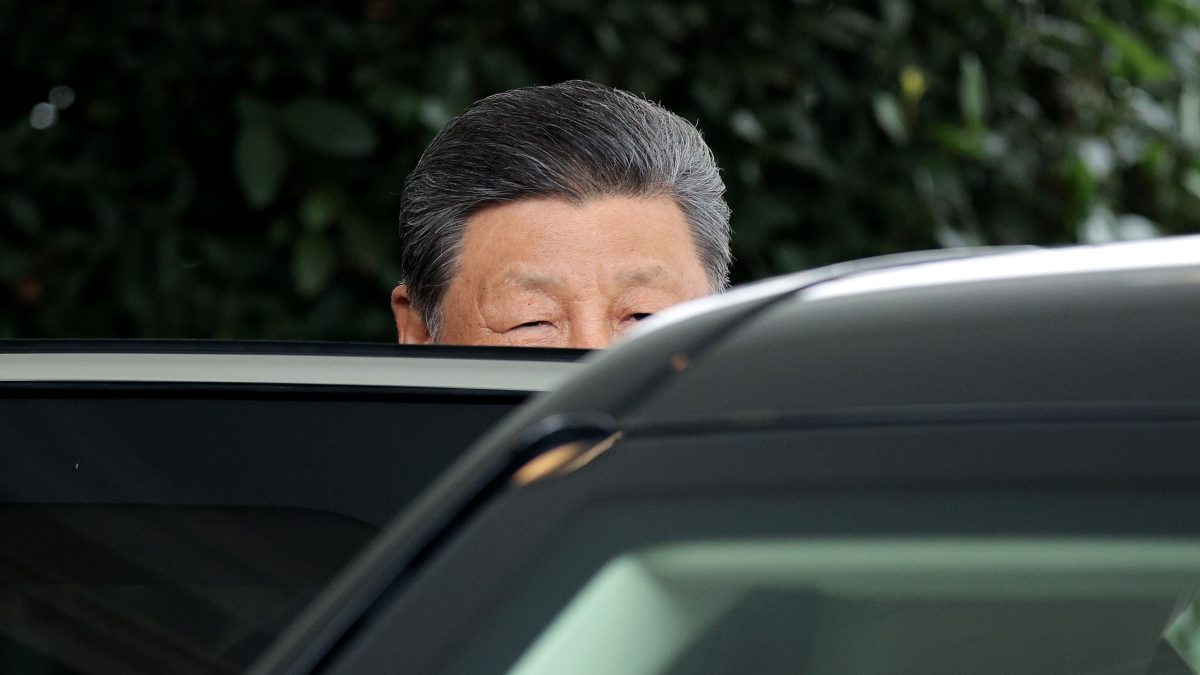
Xi Jinping spent two days in the United States — red carpets, state dinners, military honors at the White House. President Trump showed him Marine One. Television cameras followed him everywhere.
Yet Americans still don’t understand who Xi Jinping really is.
In public, Xi rarely speaks unscripted. He smiles, shakes hands, and nods at precisely the right moments. His face reveals nothing — whether pleased, angry, or suspicious. Americans judge politicians by spontaneous answers, jokes, and even gaffes.
With Xi, that method fails entirely.
Hiding himself has been the key to his political survival.
Communist regimes produce a curious pattern. Founders like Lenin and Mao possess enormous personalities and capacity for brutality. But in later generations, a strong personality becomes a political liability. Standing out creates enemies. Independent ideas look like challenges to the leader.
Nikita Khrushchev had a distinctive personality and his own agenda. His comrades removed him. By the Brezhnev era, the Soviet system rewarded a different type — cautious, unthreatening, bureaucratic.
There is a more frightening possibility: a man who learns to conceal himself until he acquires supreme power.
Stalin was such a man.
Xi grew up with unusually intimate knowledge of this world.
His father, Xi Zhongxun, was a Communist revolutionary — and repeatedly a prisoner of his own party. During a 1935 purge in northwest China, he was arrested by fellow Communists and narrowly escaped death. Beginning in 1962, he was purged again and spent 16 years under investigation, in detention, and under political supervision.
In 1978, after his rehabilitation, Xi Zhongxun was sent to Guangdong province.
That’s where the author of this analysis met him.
The author had been branded a counterrevolutionary after describing Maoist rule as a “feudal-fascist dictatorship.” Soon after Xi Zhongxun arrived, those cases were overturned. Before the formal rehabilitation, Xi Zhongxun summoned the group for a meeting.
“I spent 16 years in Communist prisons. For five of those years, I wore shackles.”
Here was one of the men who had helped build the Communist regime, telling young dissidents he had also been its prisoner.
Xi Jinping grew up inside that contradiction.
Born in 1953, he spent his early childhood among Beijing’s privileged Communist elite. Then, when he was nine, his father fell from power. During the Cultural Revolution, the family was torn apart. His father was denounced, detained, sent away. His sister Xi Heping died amid the persecution. Xi himself was publicly humiliated because of his father.
His mother, Qi Xin, remained a loyal Communist Party member. Accounts of Xi’s youth describe her as participating — under extraordinary political pressures — in the public denunciation of her own son.
Imagine the world the young Xi saw. He lived among China’s most privileged political families, while his own father was being persecuted by the same party that had given the family its privileged position.
In 1969, at 15, Xi was sent to the desperately poor village of Liangjiahe in Shaanxi province. He initially fled back to Beijing but was caught. According to later recollections, during one period of detention he escaped at night and went home, hoping his mother would give him something to eat.
She reportedly went out in the rain to alert the authorities.
He was taken back into custody and eventually returned to the countryside.
Xi learned very young how merciless Communist politics could be.
Yet he did not reject the system. He struggled to join it.
After repeated applications, Xi was admitted to the Communist Party. He was selected to attend Tsinghua University and entered the party bureaucracy, rising through Hebei, Fujian, Zhejiang, and Shanghai before reaching the summit in Beijing.
That trajectory may tell us more about Xi than his speeches do.
He had seen what happens when a powerful man loses power. Yesterday’s comrades become today’s accusers. Friends disappear. Even family members may be compelled to stand on the other side.
Xi’s great political skill was that for many years he did not appear threatening.
Consider Bo Xilai, another son of a Communist revolutionary. Bo was flamboyant, theatrical, openly ambitious. Xi was almost his opposite. Both approached the pinnacle of Chinese politics.
One became China’s supreme leader. The other received a life sentence and remains in prison.
Before Xi became general secretary in 2012, many party elders regarded him as honest, steady, and unassuming. That mattered enormously.
Their generation had survived Mao. Many had been imprisoned. Others had been publicly humiliated. Families had been destroyed. Xi’s own family had suffered all three.
After Mao’s death, these survivors tried to make sure China would never again be dominated by a single leader for life. They did not create democracy, but they gradually created rules governing retirement, succession, and the transfer of power. Jiang Zemin eventually stepped down. Hu Jintao did the same.
For the first time in Communist China, supreme power appeared to have an expiration date.
Xi concealed himself remarkably well.
Only after he reached the top did the answer begin to emerge.
Power flowed steadily toward him. The party, government, military, and security apparatus came increasingly under his personal control. His anti-corruption campaigns removed large numbers of senior officials. Collective leadership receded.
In 2018, China abolished the constitutional two-term limit on the presidency. In 2022, Xi began a third term as general secretary of the Communist Party.
The old revolutionaries who had suffered under Mao thought they were choosing a safe, unassuming man who would never subject them or their families to another strongman’s arbitrary power.
History played a remarkable trick on them.
Xi’s father had been imprisoned by the Communist Party, nearly killed in one purge and deprived of freedom for 16 years in another. His sister died amid the Cultural Revolution. Xi himself experienced humiliation, exile to the countryside, and detention.
Such experiences might teach a man why power must be limited.
They can also teach him a very different lesson: Never be the man who loses it.