
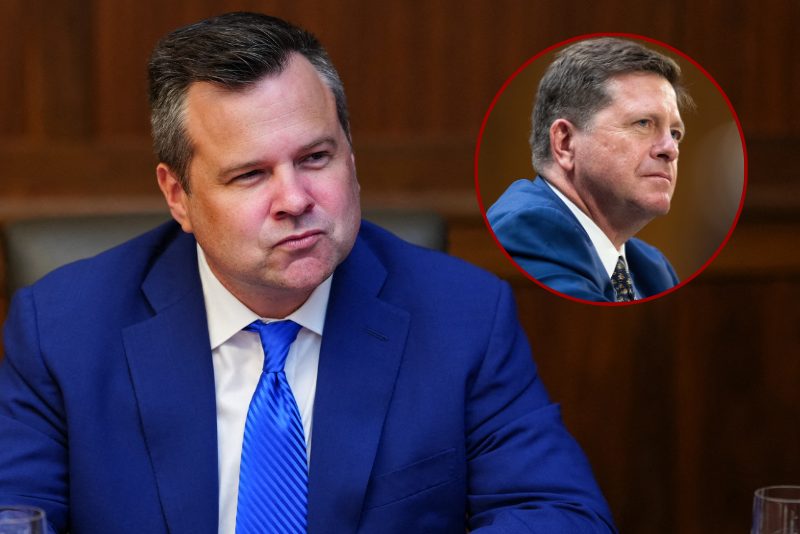
The Trump administration’s intelligence leadership is changing hands Monday, following an announcement by outgoing Acting Director Bill Pulte that accelerates the handoff to Senate-confirmed Director of National Intelligence Jay Clayton.
The move reverses earlier reports that Pulte would remain in place for up to two weeks to oversee an extended overlap with Clayton. Such transition periods are common in sensitive national security roles, allowing incoming officials to receive briefings and build relationships with career staff before assuming full authority. The compressed timeline represents a departure from this traditional approach and signals the administration’s urgency to complete the leadership change at the Office of the Director of National Intelligence.
Pulte confirmed the updated timeline in a statement on X, noting the decision followed discussions with President Trump and Clayton.
After speaking with the President Trump and Jay Clayton, we have decided the DNI transition will take place this coming Monday. I am eternally grateful to President Trump for the opportunity to serve as Director of National Intelligence, while he completed historic…
— Pulte (@pulte) August 1, 2026
Pulte expressed confidence in Clayton’s ability to lead the U.S. intelligence community.
“I have no doubt that Jay will do a tremendous job. I have offered Jay my complete and total support as he transitions to take over this incredible agency.”
The transition follows the Senate’s 51–47 vote on July 28 to confirm Clayton, a former Securities and Exchange Commission chairman and U.S. Attorney for the Southern District of New York. The narrow margin reflected continued partisan divisions over intelligence leadership and broader concerns about the direction of the intelligence community under the Trump administration. Clayton’s background in financial regulation and federal prosecution represents an unconventional profile for the position, which has typically been filled by officials with extensive intelligence or military experience.
The Trump administration nominated Clayton in June.
Pulte’s tenure drew sharp criticism from Democrats who questioned his qualifications to lead the nation’s 18 intelligence agencies. A private executive and Federal Housing Finance Agency director, Pulte faced scrutiny from lawmakers across the aisle. The Director of National Intelligence position was created in 2004 as part of post-9/11 intelligence reforms to coordinate the work of agencies ranging from the CIA and NSA to the Defense Intelligence Agency and FBI’s intelligence operations. The role requires managing competing institutional interests while providing the president with unified intelligence assessments on threats facing the nation.
During his time as acting director, Pulte spearheaded a major initiative to eliminate government bloat, achieving roughly 30% reduction in personnel to build a leaner, more efficient workforce. The scale of these cuts was unprecedented in the intelligence community’s recent history and represented one of the most dramatic restructurings since the ODNI’s creation two decades ago.
He also prioritized government transparency by advancing declassifications of critical election integrity records, fulfilling long-standing commitments to public accountability.
Pulte defended the moves as necessary steps to right-size a bloated agency. Critics argued the rapid changes risked destabilizing core functions and questioned whether the 30% figure reflected pure firings or also included routine returns of detailed personnel to their home agencies and unfilled positions. The debate highlighted broader tensions about the balance between organizational efficiency and maintaining institutional expertise in sensitive intelligence work, where relationships with foreign partners and deep subject-matter knowledge often take years to develop.
Clayton now assumes the permanent directorship at a defining moment for the U.S. intelligence community. The agency he inherits has undergone significant upheaval, with workforce reductions potentially affecting everything from daily intelligence briefings to long-term strategic analysis. Rebuilding internal cohesion while maintaining operational effectiveness will be among his most pressing challenges.
Beyond managing internal restructuring and organizational morale, he faces immediate policy challenges on Capitol Hill. One of the most crucial is the ongoing legislative gridlock over reauthorization of Section 702 of the Foreign Intelligence Surveillance Act. This surveillance tool has been a cornerstone of counterterrorism and counterintelligence operations, allowing intelligence agencies to collect communications of foreign targets located outside the United States without individual warrants.
The foreign-intelligence collection authority expired in June this year.
Existing court certifications have allowed related collection to continue into 2027, but formal renewal remains unresolved amid ongoing debate between congressional leaders and the Trump White House. The stalemate reflects deep disagreements over privacy protections, oversight mechanisms, and the scope of intelligence gathering powers in an era of rapidly evolving technology and changing threat landscapes.
Clayton is expected to be sworn in early next week to formally assume full operational command of the ODNI. His success will likely depend on his ability to navigate both the political pressures from the administration and Congress while earning the trust of the intelligence professionals who conduct the day-to-day work of protecting national security.