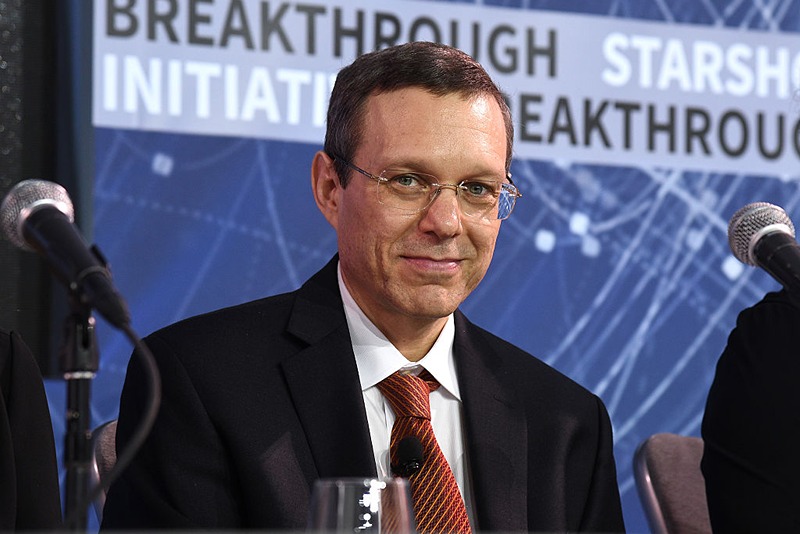
The Trump administration has appointed a Harvard astronomer who challenges the scientific establishment to lead a new Pentagon-probing council investigating unidentified anomalous phenomena.
Avi Loeb, a cosmologist who served as head of Harvard’s astronomy department for nearly a decade, will helm the newly formed UAP Science Advisory Council. The panel will investigate origins of unidentified orbs and other mysterious objects reported by military officials in recent years.
The council will report to a higher-level UAP Governance Board overseen by the Office of the Director of National Intelligence. The initiative is part of a broader push by the Trump administration to increase transparency and declassify information regarding the highly debated issue.
“My impression is the government is baffled by not being able to infer the nature of some of these objects.”
Also selected for the council: Timothy Gallaudet, a retired U.S. Navy Rear Admiral and oceanographer who has previously advocated for disclosure regarding recovered craft, and Ben Lamm, a billionaire tech entrepreneur.
The establishment of the council comes amidst bipartisan congressional pressure on the White House for further disclosure. Republican lawmakers have argued that elements of the federal government have historically suppressed evidence of extraterrestrial encounters. The Pentagon office tasked with investigating UAPs has asserted that no definitive evidence of alien life has been discovered.
Loeb first captured widespread public attention in 2017 when he proposed that Oumuamua — an interstellar object passing through our solar system — showed signs of being an artificial alien artifact rather than a standard space rock.
He later established the Galileo Project at Harvard University to search for evidence of extraterrestrial life. In 2023, he spearheaded an expedition that retrieved metallic fragments from the Pacific Ocean, proposing that the debris could have originated from alien technology.
Loeb’s willingness to think outside the box has drawn pushback from the academic establishment. Some peers have criticized his fast-paced style and his willingness to share information directly with the public rather than waiting for traditional peer-review processes.
Arizona State University astrophysicist Steve Desch has challenged Loeb’s theories.
“I don’t know what’s going to come of this, but we’re not going to get any closer to answering these questions with him in charge.”
Loeb has disregarded his critics’ comments, saying they lack the imagination needed to explore new ideas.
The Harvard scientist has promised a grounded approach to his new position and will tackle issues from a national security perspective.
“It’s like a detective story. It’s a lot of fun, as long as you don’t pay too much attention to the critics.”
Following their inaugural meeting last month, the committee submitted a formal request to the Pentagon for more than 50 multimedia files and documents regarding documented UAP events. While the proceedings remain confidential, Loeb has committed to public briefings and the creation of a website to disclose their results.
“Let’s keep our eyes on the orbs, not the social media.”
The council’s work represents a significant step toward transparency on a topic that has sparked intense debate across partisan lines for decades.