
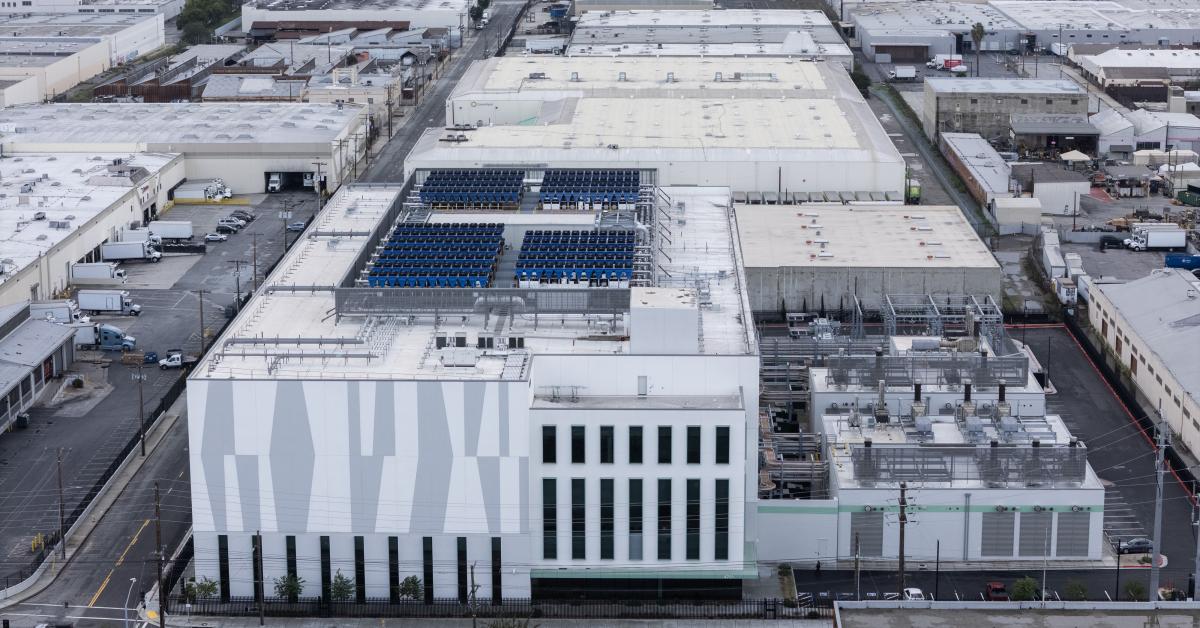
Anna Clement worries the peaceful backyard where she teaches her four 10-year-old quadruplets is about to be shattered. A proposed 1.5-million-square-foot data center on 410 acres across the street threatens to bring constant mechanical humming — the kind you feel, not just hear.
“There is a low humming that you can’t measure by decibels,” said Clement, whose home sits in South Whitehall Township, Lehigh County.
Just beyond her trees sits Parkland High School, the fifth-largest high school in Pennsylvania. Superintendent Mark Madson shares her alarm.
“Noise & vibration” topped the list of concerns Madson sent to the township in May about the data center proposal — dubbed “Project Atlas.”
“Low-frequency data center noise easily penetrates building walls and travels hundreds of feet,” Madson wrote in the letter, obtained through a Right-to-Know request.
A township-funded sound study confirmed the worst fears: at night, predicted noise from the data center would exceed current ambient sound by 30 decibels — perceived as eight times louder.
Parkland’s 3,200-plus students are there when school is in session. But residents like Clement face 24/7 exposure.
“Our goal is no data center. You are doing irreparable harm to the community for a short-term tax break.”
That’s Greg Sussman, president of the South Whitehall Civic Alliance, a nonprofit fighting the project. A father of two school-aged children, Sussman figures his backyard is about 1,000 feet from where the data center will stand.
The developer, Edged U.S., promises “noise levels less than 54 dB at property lines, as quiet as a conversation.” The company also claims zero water used for daily cooling and that it will become the largest taxpayer in Lehigh County.
Many locals aren’t buying it. At least 600 people packed a recent meeting to oppose the plan. Republican state Sen. Jarrett Coleman, who represents the area, says it’s “not the right fit.”
The battle mirrors similar fights across Pennsylvania — and nationally. Texas Gov. Greg Abbott ordered audits of all data center projects last week. New York Gov. Kathy Hochul imposed a temporary moratorium three weeks earlier.
In Pennsylvania, Democratic Sen. James Malone demanded lawmakers return from summer break to vote on data center moratorium legislation. “We don’t have time to waste,” Malone said publicly.
Even Gov. Josh Shapiro — whose enthusiasm for artificial intelligence helped stoke Pennsylvania’s data center boom — appears to be shifting. Reports indicate his administration will announce executive actions on data centers soon.
“It is time those people elected to lead should do their job,” said Ginny Marcille-Kerslake, senior organizer for Food & Water Watch. “That goes straight up to the governor.”
Les Blomberg, executive director of the Vermont-based Noise Pollution Clearinghouse, confirmed residents have reason for concern. Low-frequency noise is “a type of noise that penetrates walls, travels further, and is very difficult to block with barriers,” he said.
Laura Sheets, a Michigan attorney whose firm filed class-action lawsuits over data center noise in New Jersey, Massachusetts, and Michigan, says local noise ordinances weren’t designed for this.
“You can hear it inside your home and outside,” Sheets said.
Not everyone opposes the project. Neighbor Liam Reynolds, a 32-year-old ironworker, doesn’t think noise will be an issue. Cedar Crest Boulevard — the busy major road separating his home from the high school — already produces louder noise than the data center likely will, he figures.
Still, he’s against the plan for a different reason: obsolescence. “Data centers might be obsolete in the not-too-distant future,” Reynolds said. “Feed corn will never be obsolete.”
The township Planning Commission is set to hold a Sept. 23 meeting at the high school focused solely on Project Atlas. The commission can recommend action to township commissioners, who have until Oct. 31 to make a final decision.
Tom Petrucci, the township manager, said the township engineer has “a lot of issues” with the proposal — but the review process remains neutral. “We are reviewing the project the way we would any other,” he said. “Comprehensive and neutrally.”