
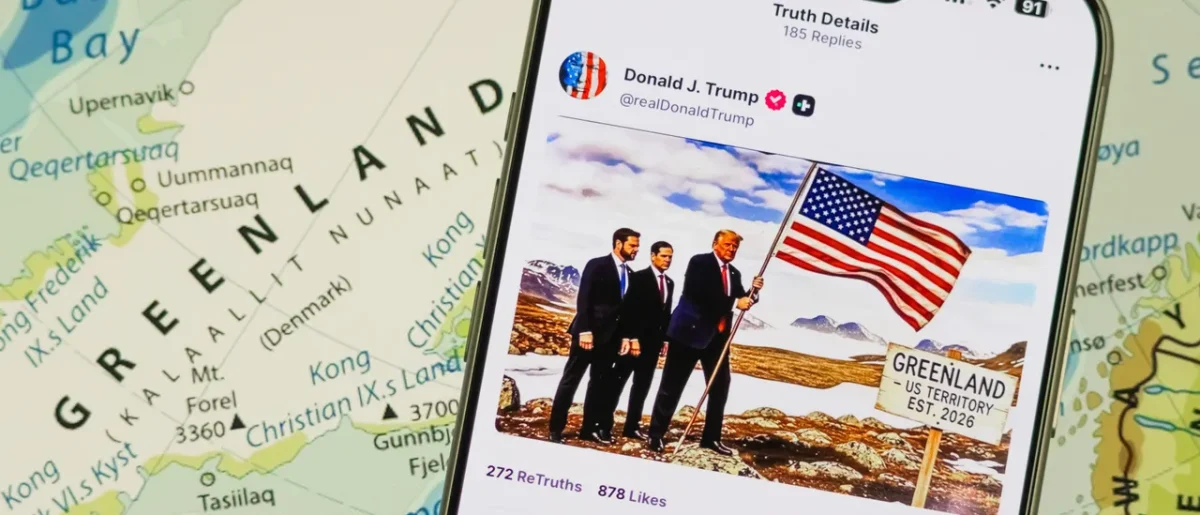
President Donald Trump announced the United States has secured “permanent control over security” in Greenland following a landmark agreement with Denmark — a deal he called a “dream come true” for America’s national security.
The announcement marks a dramatic culmination of decades of American strategic interest in the world’s largest island, which sits at a crucial juncture between North America and Europe. Greenland’s geographic position has made it a focal point for Arctic security concerns, particularly as melting ice caps open new shipping routes and resource extraction opportunities that have attracted the attention of both allies and adversaries.
The president revealed the agreement in a Friday Truth Social post, stating the administration now has the “complete ability to do what is necessary in Greenland” to protect U.S. interests.
“For over 100 years, Presidents have known the strategic importance of Greenland, but NONE of them were able to do anything about it. I am proud to be the President that permanently and conclusively addressed this very important situation.”
Trump’s reference to a century of presidential interest is grounded in historical fact. The United States has maintained a significant military presence in Greenland since World War II, when American forces established bases to counter Nazi Germany’s operations in the Arctic. The Thule Air Base, established in 1951, has served as a critical early-warning radar installation throughout the Cold War and into the present day, monitoring for ballistic missile launches and tracking satellites.
Under the terms, no American adversary — including China or Russia — can establish a military base or make sensitive investments in Greenland without explicit U.S. approval. Trump described the framework as an “Infinite Life” agreement with no expiration date.
This veto power represents a significant evolution in the security relationship between the United States and Denmark, which has maintained sovereignty over Greenland since 1814, though the territory gained home rule in 1979 and expanded self-governance in 2009. The arrangement appears to formalize and expand security protocols that have existed in various forms for decades, but never before with such explicit American authority over third-party access.
The deal grants the United States authority to develop a large permanent military presence across the Arctic island. According to Trump’s announcement, Greenland will contribute to the development and construction of the expanded U.S. military infrastructure.
The commitment from Greenland to participate in infrastructure development suggests a cooperative framework that goes beyond a traditional basing agreement. Such arrangements typically involve host-nation contributions to facility construction, local employment opportunities, and economic development initiatives that benefit the territory’s roughly 56,000 residents, the majority of whom are Inuit.
Trump first floated the idea of acquiring Greenland during his first term, proposing to purchase the autonomous Danish territory outright. When he returned to office, he escalated pressure on Denmark by threatening sweeping tariffs on European allies and refusing to rule out military action.
The gambit worked.
Denmark and several European nations initially deployed troops to Greenland in response to Trump’s pressure campaign. But Trump pivoted to negotiations after withdrawing both the tariff threats and the military-force option earlier this year, setting the stage for Friday’s announcement.
The diplomatic maneuvering reflects a significant shift in transatlantic relations and demonstrates the administration’s willingness to use unconventional leverage with traditional allies to achieve strategic objectives. The initial European military response underscored how seriously Denmark and its NATO partners took Trump’s rhetoric before diplomatic channels produced this agreement.
Trump framed the agreement as historic, writing that “this is a great one for the United States of America, Denmark, Greenland, and all of our Allies.”
“We will be very protective of it! This is a dream come true for the United States of America, one that is very important, historic, and special.”
The strategic importance of Greenland has grown dramatically in recent years as Russia and China expand their Arctic military and commercial operations. Control over Greenland’s airspace and waters gives the United States a decisive advantage in monitoring adversary submarine movements and securing critical undersea internet cables.
Defense analysts have long warned that the Arctic represents a new frontier for great power competition. Russia has invested heavily in icebreaker fleets and Arctic military bases, while China has declared itself a “near-Arctic state” and pursued mining and infrastructure investments across the region. The undersea cables that carry much of the world’s internet traffic pass through waters near Greenland, making their protection a matter of both economic and national security.
Trump closed his announcement by promising a “magnificent future” for the partnership between the U.S., Denmark, and Greenland’s people.