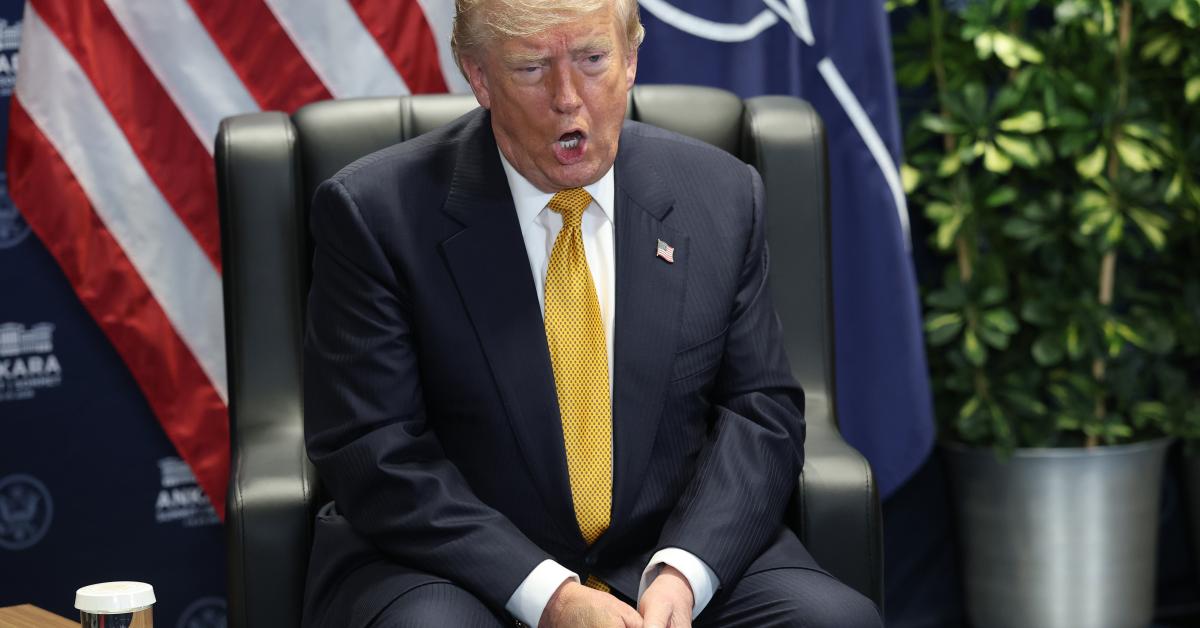
President Donald Trump says Iran is desperate for a deal — and losing on every front.
Trump told NewsNation on Friday that the Iranian regime wants to negotiate an end to the seven-month war, but he hasn’t decided whether to accept their terms. The president’s remarks represent his most detailed public assessment yet of Iran’s current strategic position and willingness to negotiate, offering insight into how the administration views the ongoing military confrontation.
“Right now, they want to make a deal because they’re losing in every way,” Trump said.
The conflict has raged since late February, when the United States and Israel launched their joint military operation against Iran. Since then, Tehran has attacked commercial vessels in the Strait of Hormuz and threatened further strikes. The U.S. has responded by hitting Iranian targets in and around the critical waterway. The Strait of Hormuz, a narrow channel between the Persian Gulf and the Gulf of Oman, serves as one of the world’s most strategically important oil transit chokepoints, with roughly one-fifth of global petroleum supplies passing through the waterway. Any disruption there has immediate ramifications for global energy markets and the broader international economy.
“If the deal’s not a correct deal, then I wouldn’t even think about it. But right now, they want to make a deal because they’re losing in every way.”
Trump made clear he won’t accept just any agreement. “If the deal’s not a correct deal, then I wouldn’t even think about it,” he said, according to The Epoch Times. The president’s insistence on favorable terms echoes his broader negotiating philosophy, which he has applied to trade agreements, diplomatic arrangements, and military posturing throughout his time in office. His approach typically emphasizes leverage and the willingness to walk away from deals that don’t serve American interests.
Iran is hemorrhaging money and taking heavy military losses, Trump explained. The regime’s dual battlefield defeats — financial collapse and military setbacks — are driving Tehran’s sudden interest in negotiating. Economic sanctions, combined with the costs of sustained military operations and the loss of critical infrastructure from American strikes, have placed extraordinary strain on Iran’s already fragile economy. The country has struggled with currency devaluation, diminished oil revenues, and widespread domestic unrest over deteriorating living conditions.
Publicly, though, the terrorist regime that has controlled Iran since 1979 shows no eagerness to make concessions. The Islamic Republic has long maintained a defiant posture in the face of international pressure, particularly from the United States, which it has characterized as its primary adversary since the revolution that toppled the Shah. Iranian leadership has historically used nationalistic rhetoric and anti-American sentiment to maintain domestic support, even during periods of severe economic hardship.
A spokesperson for Iran’s Atomic Energy Organization said Friday the regime has “sufficient cards and options” to defend itself.
“If you are under attack, you have all the cards at your disposal to defend yourself. Therefore, we have more than one card; of course, we have sufficient cards and options,” the official said.
He added: “But beyond these options, we have the resolve — a strong resolve to defend our country. And of course, regardless of how much pressure they exert on us, we will overcome this situation.”
The stark contrast between Trump’s characterization of Iran as desperate and Tehran’s public defiance highlights the information war accompanying the physical conflict. Both sides have strong incentives to project strength: the Trump administration to demonstrate the effectiveness of its military and economic pressure campaign, and the Iranian regime to maintain credibility with domestic audiences and regional allies who depend on perceptions of Iranian resilience.
The United States confirmed Friday that Iran will be allowed to send a core delegation to next week’s United Nations General Assembly in New York. Under international agreements governing the United Nations headquarters, the U.S. is generally obligated to permit access to UN proceedings for member states, even those with which it has hostile relations. However, the administration retains authority to impose restrictions on the movement and activities of foreign delegations while they’re on American soil.
But State Department spokesman Tommy Pigott made clear Iranian officials won’t be allowed to treat the trip as a luxury getaway.
“While ordinary Iranians endure brutal repression, water and electricity shortages, and soaring inflation, the regime’s officials want to go on shopping sprees in New York. Not on our watch,” Pigott wrote Thursday on X.
“We will not let the Iranian regime’s elites exploit [UN General Assembly] for a luxury retail splurge paid for by the Iranian people’s suffering, all while the regime funnels Iran’s wealth to support its terrorist proxies.”
Trump’s comments Friday suggest he sees Iran’s military and economic desperation as leverage — but he’s not rushing into any deal that doesn’t protect American interests. The president appears to be calculating that time favors the United States in any negotiation, with Iran’s position weakening as the conflict continues to drain its resources and erode its military capabilities.