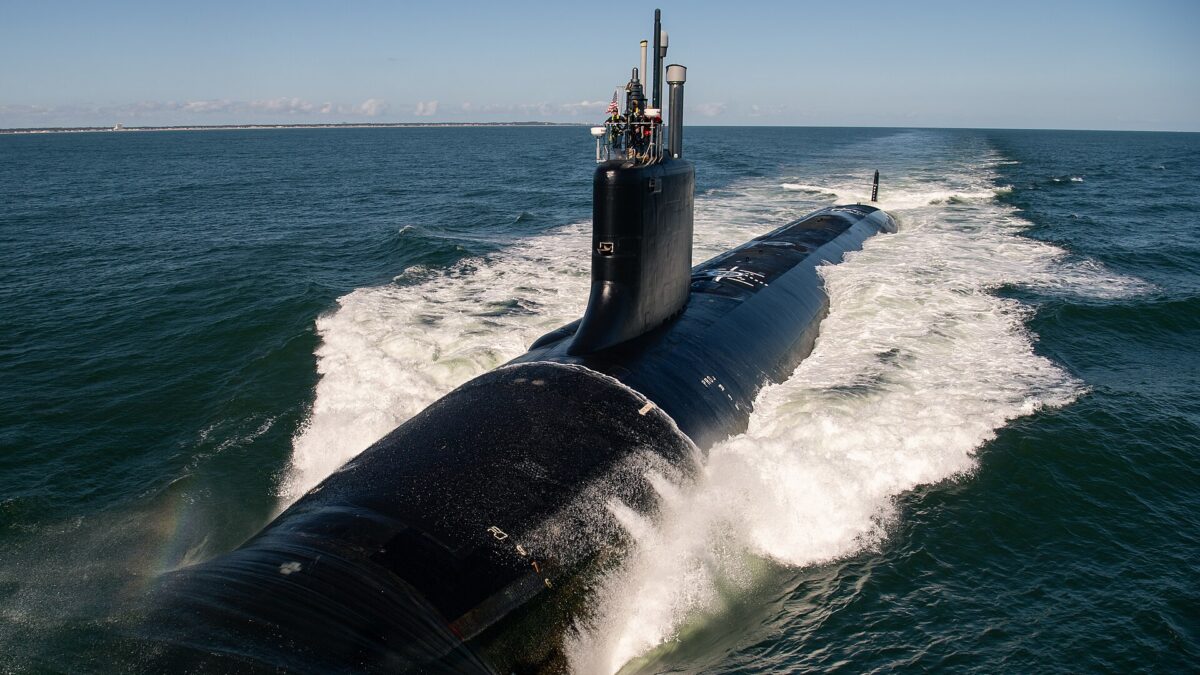
President Trump signed a presidential memorandum Thursday ordering a major expansion of America’s shipbuilding capacity — including creation of a fifth public Navy yard to handle the nation’s growing submarine fleet.
The presidential order titled “Rebuilding the United States Navy and America’s Shipbuilding Industrial Base” opens the door to increased collaboration with allied nations on shipbuilding, the establishment of a new public shipyard, and technological changes to the Navy’s newest aircraft carrier.
The memorandum represents one of the most comprehensive efforts to address American naval capacity in recent memory, touching on everything from domestic manufacturing capability to international partnerships and technological decisions affecting billion-dollar warships. It reflects growing concern within the administration about the United States’ ability to maintain naval superiority in an era of heightened global competition.
The directive comes after decades of Navy shipbuilding setbacks — cost overruns, delays, cancellations, and a fleet shrinking faster than the country can build replacements.
These challenges have become increasingly apparent as naval construction programs have struggled to meet timelines and budgets. The problems span multiple ship classes and have affected everything from aircraft carriers to destroyers to support vessels. Industry experts have pointed to a combination of factors including reduced domestic shipbuilding capacity, workforce shortages, supply chain complications, and increasingly complex vessel designs that push the boundaries of existing construction capabilities.
“The United States Navy has experienced a series of shipbuilding setbacks stemming from overly complex designs and iterative design change procedures, which have resulted in cost growth, delays, and cancellations.”
The order requires the Department of War to “restore both capacity and competition to the maritime industrial base as it expands our naval force structure.”
This language signals a recognition that the current shipbuilding infrastructure is insufficient to meet the Navy’s long-term needs. The emphasis on competition suggests the administration believes that consolidation in the shipbuilding industry has contributed to the problems facing naval construction programs.
Trump is expanding what the administration calls the “Finland Model” — based on a memorandum of understanding signed by the United States and Finland last year on medium icebreaker construction — to three different classes of ships.
The Finland arrangement was seen as a pilot program to test whether international partnerships could help address domestic capacity constraints while ultimately building up American capabilities. The expansion to three ship classes indicates the administration views that initial effort as successful enough to warrant broader application.
Under the model, foreign shipbuilders can initially construct up to two vessels overseas before shifting subsequent construction to the United States.
But there’s a catch: the foreign supplier must simultaneously build a new shipyard in the United States or assume ownership of an existing one, hire and train an American citizen workforce, and source a U.S. supply chain for construction and maintenance of all ships at the U.S. shipyards.
These requirements are designed to ensure that international partnerships result in genuine technology transfer and lasting domestic capability rather than simply outsourcing American naval construction. The provisions reflect concerns that previous industrial partnerships have sometimes failed to deliver promised benefits to the American workforce and manufacturing base.
The new fifth public Navy Yard is coming to the Pacific.
The edict directs Secretary of War Pete Hegseth, in consultation with Acting Navy Secretary Hung Cao, to submit a plan within 120 days aimed at enhancing “nuclear-powered submarine and aircraft carrier readiness” — including creation of the fifth public Navy Yard.
Currently, the United States operates four public Navy yards: Portsmouth Naval Shipyard in Maine, Norfolk Naval Shipyard in Virginia, Puget Sound Naval Shipyard in Washington, and Pearl Harbor Naval Shipyard in Hawaii. The creation of a fifth facility would represent the first such expansion in decades and underscores the administration’s commitment to addressing submarine maintenance backlogs that have plagued the fleet in recent years.
This new yard must possess sufficient drydock capacity to assist with upkeep and maintenance of the nation’s growing submarine fleet. The plan will assess potential locations near the U.S. Pacific Fleet, including those in the continental United States, Alaska, Hawaii, and existing U.S. territories.
The Pacific focus reflects the Navy’s increasing operational emphasis on that region and the strategic importance of having adequate maintenance facilities positioned to support vessels deployed there. Submarine maintenance has become a particular bottleneck, with vessels sometimes waiting months or longer for yard availability.
The memo’s final major prong directs Hegseth to submit a plan within 60 days requiring “measures to replace the Electromagnetic Aircraft Launch System and Advanced Weapons Elevators with steam and hydraulic systems” for construction of the future USS Doris Miller (CVN-81), an upcoming Ford-class aircraft carrier.
That move would represent a major departure from the technologies introduced aboard the Ford class and potentially require significant redesign work on a carrier already under construction. The electromagnetic systems were intended to provide advantages over traditional steam catapults, but they have experienced well-documented reliability issues during the operational testing of earlier Ford-class carriers.
The edict builds upon Trump’s April 2025 executive order and subsequent “Maritime Action Plan” aimed at reversing America’s shipbuilding decline.
This decades-long trend has resulted in the Navy retiring ships faster than the country can build new ones — the naval fleet has shrunk significantly since the end of the Cold War. At its peak in the 1980s, the Navy operated nearly 600 ships, while today’s fleet numbers significantly fewer vessels even as global demands on American naval power have remained high.