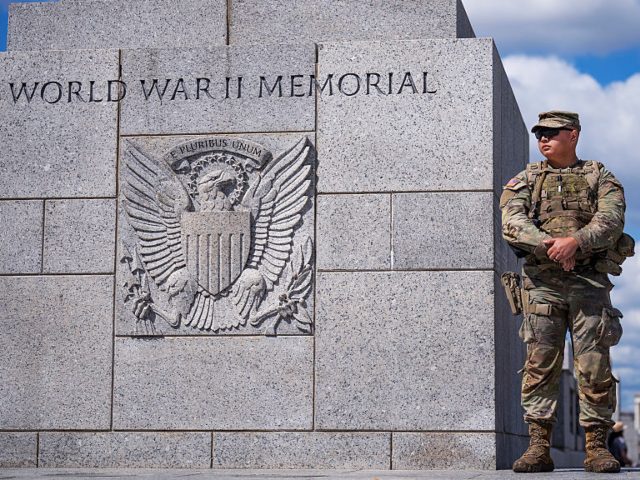
President Donald Trump condemned the vandalism of the World War II Memorial on the National Mall, calling the act an enormous insult to America’s fallen heroes. The memorial, which honors the 16 million Americans who served in the armed forces during World War II and the more than 400,000 who died, has stood as one of the nation’s most sacred sites since its dedication in 2004.
Trump posted to Truth Social Thursday shortly before authorities announced charges against the suspect. His response reflected the deep significance Americans place on memorials honoring those who served in what is often called “the greatest generation” — veterans whose numbers have dwindled significantly in recent years.
“Our beautiful World War II Memorial was just hit by Spray Painting Vandals,” Trump wrote. “THERE CAN BE NO GREATER INSULT TO THOSE AMERICAN HEROES WHO DIED IN WORLD WAR II.”
“First the Reflecting Pool, now this,” he continued. “We are on their trail! Where do these animals come from???”
“THERE CAN BE NO GREATER INSULT TO THOSE AMERICAN HEROES WHO DIED IN WORLD WAR II.”
The perpetrator spray-painted “Clean Hands Dirty $” across the memorial, according to Washington, DC, freelance photographer Andrew Leyden. Someone also poured bubbles into the memorial’s fountains. The vandalism represents not just property damage but an attack on a site that serves as a place of reflection and remembrance for millions of visitors annually, including surviving veterans and their families.
U.S. Attorney for the District of Columbia Jeanine Pirro announced two felony charges against Melissa L. Farris on Friday morning — Depredation Against Property of the United States and Destruction of Veterans’ Memorials. The latter charge specifically addresses the particular severity of defacing monuments dedicated to those who served in America’s armed forces, recognizing that such acts carry implications beyond simple vandalism.
“Vandalizing our World War II Memorial is a despicable attack on a sacred monument honoring the Americans who fought and died for our freedom,” Pirro wrote on X. “Those Americans include my father and grandfather.” Her personal connection to the memorial underscores the generational impact of World War II service on American families across the country.
Farris is now in custody. The charges carry penalties of up to ten years in prison, reflecting the serious nature federal law assigns to attacks on memorials honoring America’s veterans and military service members.
The vandalism comes as Trump undertakes beautification efforts throughout the nation’s capital, an initiative he has promoted as restoring dignity and proper maintenance to federal monuments and public spaces. The president has made the condition of Washington’s memorials and landmarks a priority of his administration, arguing that they had fallen into disrepair.
Under Trump, 22 fountains in and around DC have been fixed and are now functioning, including in Meridian Hill Park. These restoration projects represent part of a broader effort to improve the appearance and functionality of the capital’s public infrastructure.
The president also lined the bottom of the Reflecting Pool with blue sealant — a project he maintains was sabotaged by vandalism. The iconic pool, which stretches between the Lincoln Memorial and the World War II Memorial, has long been one of Washington’s most photographed landmarks.
“A National Park Service career employee, a highly credible witness, saw David Hearn (ActBlue) in broad daylight vandalize the Reflecting Pool by ‘violently’ ripping and tugging at the Pool’s somewhat delicate coating,” Trump wrote Monday.
“There was substantial other damage to the Reflecting Pool, also but, unfortunately, there is no video or proof, other than the damage, itself,” he wrote. “We are working on the Pool, and it will reopen shortly.”
Trump acknowledged some contractor error from rushing the job for a July 4th opening, but called it “a very small area of this massive Pool, and was relatively inconsequential.” The timeline pressure stemmed from the administration’s desire to have the restoration complete for Independence Day celebrations, one of the most significant dates on Washington’s ceremonial calendar.
Vandals have graffitied the World War II Memorial besides just adding bubble soap. “Clean Hands Dirty $” painted on the side. pic.twitter.com/eFsbt6yoVO
— Andrew Leyden (@PenguinSix) August 13, 2026
Someone has just poured bubble soap into the World War II Memorial Fountains on the National Mall. pic.twitter.com/3UDCxHCdmC
— Andrew Leyden (@PenguinSix) August 13, 2026