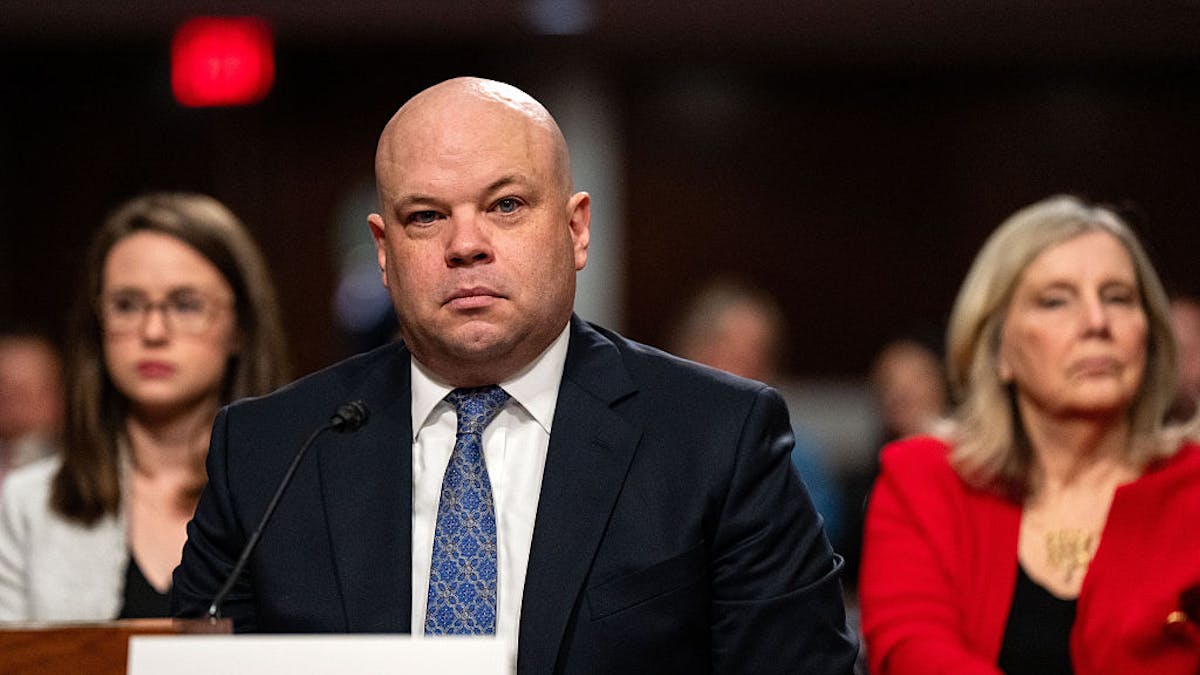
President Donald Trump wasted no time filling the Army’s top civilian post after Dan Driscoll’s sudden resignation Monday, tapping Adam Telle — a Capitol Hill veteran with deep legislative roots — to serve as acting Army secretary.
The appointment comes at a critical juncture for military leadership, with the Army secretary position serving as the civilian overseer of all Army operations, personnel decisions, budget allocation, and strategic direction. The role, which sits atop a department managing over 1 million active duty and reserve soldiers, requires both administrative acumen and political deftness—qualities Trump evidently believes Telle possesses in abundance.
Telle already serves as assistant secretary of the Army for Civil Works, managing flood defense systems, navigation waterways, and major infrastructure initiatives nationwide. But his real currency is political.
The Civil Works portfolio, while significant in its own right, represents just a fraction of the Army’s overall mission. That position primarily oversees the U.S. Army Corps of Engineers’ civilian infrastructure projects, a far cry from the sweeping responsibilities he now inherits. The Army secretary role encompasses everything from weapons procurement and training doctrine to personnel readiness and force deployment—responsibilities that will test whether Telle’s political savvy can translate to military administration.
The Alabama native spent over two decades working alongside Republican heavyweights in the Senate, including a stint as Trump’s top Senate liaison during his first administration.
That extensive Hill experience positions Telle uniquely among recent Army secretaries, many of whom came from military backgrounds or defense industry positions. His political network could prove invaluable as the Army navigates budget battles and seeks congressional support for modernization initiatives. The legislative relationships he’s cultivated over two decades may help him secure funding and approval for critical programs that previous secretaries struggled to advance through the appropriations process.
That role put him at the center of landmark wins: the Abraham Accords and the launch of the U.S. Space Force.
These accomplishments demonstrate Telle’s ability to shepherd complex, high-stakes initiatives through the political process—experience that becomes particularly relevant as he assumes leadership during an active military conflict. The Abraham Accords required delicate diplomatic coordination, while establishing Space Force demanded navigating bureaucratic resistance and securing bipartisan legislative support for the first new military branch since 1947.
“Great Patriot, who is respected by all.”
That’s how Trump described his new military chief. Defense Secretary Pete Hegseth echoed the praise on X, calling Telle “strong and whip smart” and predicting he’ll be an “immediate asset” to America’s soldiers.
The public endorsements from both Trump and Hegseth signal an effort to project continuity and confidence amid the sudden leadership transition. Such strong backing from the commander-in-chief and the defense secretary suggests Telle enters the role with their full political support—a marked contrast to the relationship that apparently deteriorated between Hegseth and his predecessor.
Huge congrats to Adam. Strong and whip smart. He is indeed a great Patriot — and will be an immediate asset to the @USArmy. https://t.co/AOOlUgw4E6
— Pete Hegseth (@PeteHegseth) September 3, 2026
Driscoll stepped down after months of reported friction with Hegseth. His exit came six months into the Iran war, as American forces absorbed Iranian missile fire over the weekend following U.S. strikes on Iranian launchers near the Strait of Hormuz.
The timing of the leadership change raises questions about continuity during active combat operations. A secretary’s departure mid-conflict is highly unusual and potentially disruptive to operational planning, procurement decisions, and force management. The Iran conflict has already placed significant strain on Army resources and personnel, making stable civilian leadership particularly crucial for maintaining readiness and morale.
Telle’s résumé reads like a Senate playbook. He served as chief of staff to Sen. Bill Hagerty (R-TN), managed a $70 billion portfolio for the Senate Homeland Security Subcommittee, and steered national security policy for the late Mississippi Sen. Thad Cochran — including leading critical Hurricane Katrina recovery efforts.
His experience managing massive budgets on Capitol Hill directly translates to the Army secretary position, which oversees one of the federal government’s largest departmental budgets. The Hurricane Katrina recovery work also demonstrated his ability to coordinate large-scale operations under crisis conditions—experience that could prove relevant as he manages an Army engaged in combat operations.
When Trump first nominated him for the civil works post in March 2025, Telle sailed through Senate confirmation with a 72–22 vote. Every “no” vote came from Democrats and Bernie Sanders.
That relatively strong bipartisan confirmation vote suggests Telle maintained working relationships across the aisle despite his Republican credentials. However, as acting secretary rather than a nominee, he can serve without fresh Senate confirmation—at least temporarily—allowing Trump to install his choice immediately without navigating the confirmation process during wartime.
The Mississippi State graduate — computer science and communication degrees, former student body president — now steps into one of the military’s most critical posts.
The married father of two will oversee the U.S. Army as acting secretary at a moment when American forces are engaged in active combat operations against Iran.
Whether his political expertise can compensate for his lack of traditional military or defense industry background remains to be seen. What’s clear is that Trump has chosen loyalty, political skill, and administrative experience over conventional military credentials at a moment when the Army faces its most significant combat test in years.