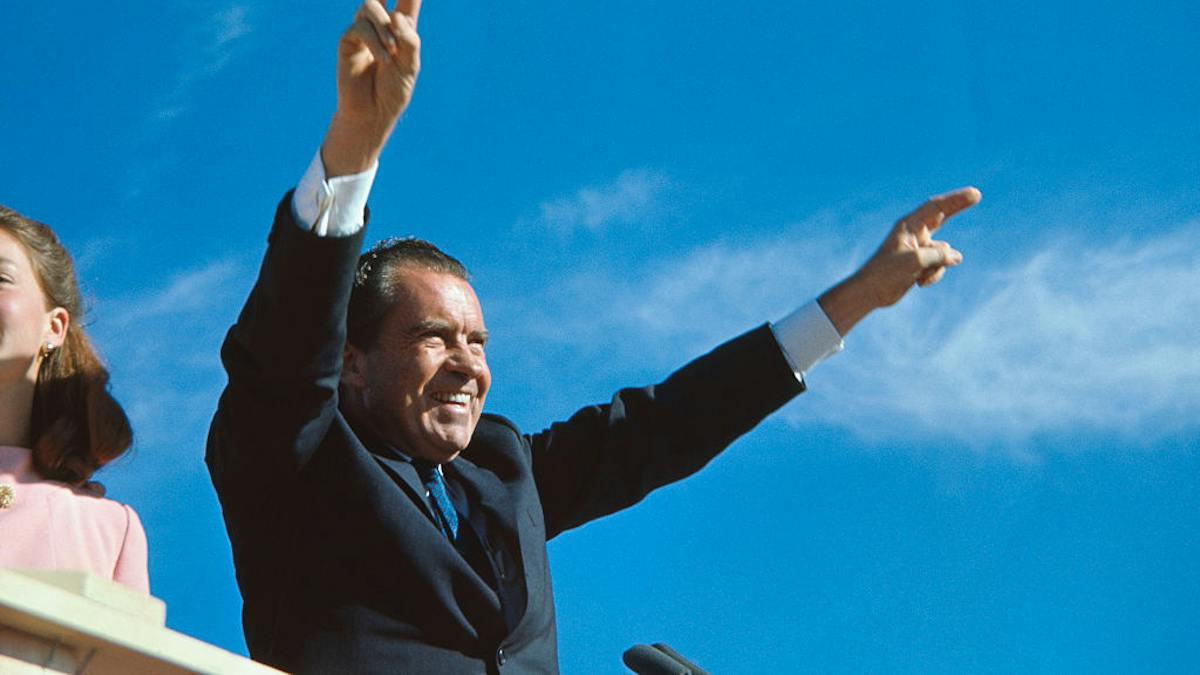
The Trump Justice Department is taking a fresh look at whether partisan prosecutors weaponized the government against Richard Nixon — the same pattern conservatives say was used against President Donald Trump.
The review centers on the conduct of the special prosecutor’s office that investigated Nixon and the Watergate scandal, The Wall Street Journal reported. The review is still preliminary; no full investigation has been launched yet.
The move represents a potentially significant reassessment of one of the most consequential political scandals in American history. For decades, the Watergate investigation has been portrayed in popular culture and academia as a triumph of the justice system over executive corruption. But a growing body of research has raised questions about whether the prosecutors themselves engaged in ethical violations and political bias that tainted the proceedings.
Former Nixon staffer and author Geoff Shepard gave a presentation to the Justice Department’s Office of Professional Responsibility (OPR) — the same office the Biden administration refused to grant access in 2022.
That earlier denial of access to Shepard became a point of contention among conservatives who argued the Biden DOJ was attempting to suppress legitimate scrutiny of past prosecutorial conduct. The willingness of the Trump administration to hear Shepard’s presentation marks a stark reversal in approach and signals a broader reexamination of how federal law enforcement has been used for political purposes across multiple administrations.
“Given his expertise and scholarship on Watergate, he was recently invited to give a presentation to OPR, but that presentation does not constitute an investigation. OPR remains focused on ensuring that Department attorneys meet the highest professional standards.”
The Office of Professional Responsibility was established in 1975 — right after Watergate — to ensure DOJ attorneys “perform their duties in accordance with the high professional standards expected of the nation’s principal law enforcement agency.”
The timing of OPR’s creation is significant. It emerged directly from the institutional upheaval of the Watergate era, intended to provide internal oversight and accountability for Department lawyers. The irony that this office is now being asked to scrutinize the very prosecutorial team whose excesses helped prompt its creation is not lost on observers of this development.
Nixon resigned from office amid the Watergate break-in investigation just two years after he won 49 states in the 1972 election.
That landslide victory represented one of the most dominant electoral performances in modern American history, making Nixon’s dramatic fall from power all the more stunning. The speed and totality of his political collapse have long been cited as evidence of the severity of his wrongdoing. However, Shepard and others now argue that the swiftness of his downfall may have been engineered through prosecutorial misconduct rather than achieved through fair legal process.
Shepard confirmed the review on his website. He said OPR “was tasked with undertaking a fresh look at my allegations of wrongdoing by attorneys with the Watergate Special Prosecution Force.”
He met with two OPR lawyers on September 21 and “spent two hours” walking them through official documents he has “uncovered in the past twelve years of research.” He expects OPR to submit a report at some point.
“There is no telling what they might conclude, but at the very least there is a full, fresh DOJ review of what I’ve uncovered,” Shepard said.
Shepard’s research has spanned more than a decade, during which he has filed numerous Freedom of Information Act requests and combed through archival materials at the National Archives. His work has produced several books challenging the conventional narrative of Watergate, though his conclusions have remained controversial among mainstream historians and legal scholars.
His presentation was titled “Watergate as Lawfare.”
The term “lawfare” has gained prominence in recent years to describe the use of legal systems and institutions to delegitimize or damage political opponents rather than to pursue genuine justice. By framing Watergate through this lens, Shepard is arguing that the tactics deployed against Nixon presaged modern prosecutorial strategies that conservatives believe have been used against Republican politicians and causes.
Shepard argues Nixon did not receive due process and that prosecutors engaged in misconduct while pursuing the case. This included secret meetings between prosecutors and judges about the case — and the fact that the special prosecutor’s office consisted of partisan actors opposed to Nixon.
These ex parte communications — meetings between one party and a judge without the other party present — would typically be grounds for serious ethical concerns or even case dismissal. If Shepard’s allegations are substantiated, they would suggest systemic problems with how the Watergate prosecution was conducted at the highest levels of the judicial process.
Nixon’s popularity has increased in recent years as conservatives argue he was one of the first victims of the deep state that relentlessly pursued President Donald Trump.
This reassessment of Nixon has coincided with growing conservative skepticism about federal institutions and their role in political controversies. What was once seen as justified accountability is now being reinterpreted by some as an early example of an entrenched bureaucracy working to remove an elected president it opposed.
“If you look at the story of how the deep state took down Richard Nixon, it’s not all that different from what the same groups of people — the same institutions — tried to do to Donald Trump in the first Trump administration. There is a parallel.”
Vice President JD Vance made that case earlier this year — drawing a direct line from the Watergate prosecutors to the lawfare campaign against Trump.
The review marks the latest effort by the Trump DOJ to root out weaponization of federal law enforcement against conservatives.