
The Trump administration can’t seem to agree on whether artificial intelligence companies should be allowed to train their models on Americans’ copyrighted work without paying for it.
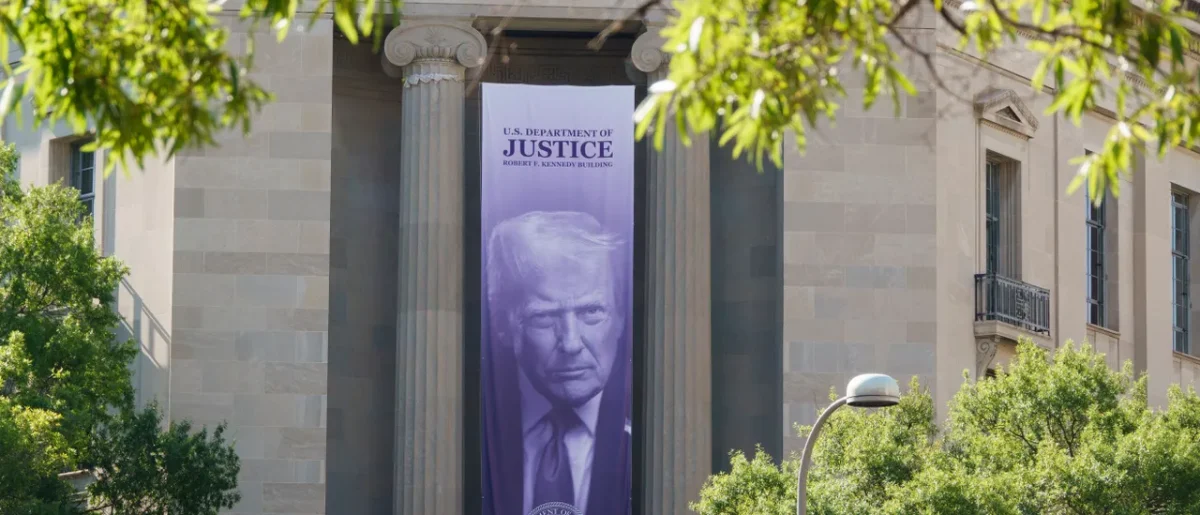
The Department of Justice told a federal judge this week that AI training on copyrighted books is fair use — and that forcing AI labs to license content would only help Big Tech and “old mainstream media.”
That position directly contradicts the White House’s own March AI policy framework, which said the copyright question remains legally unsettled.
“IT IS NOT IN THE PUBLIC’S INTEREST FOR THE LARGEST TECHNOLOGY COMPANIES TO HAVE AN OLIGOPOLY ON LLM TRAINING DUE TO LICENSING ENTRY BARRIERS THAT FUNCTION PRIMARILY AS LARGE SUBSIDIES FOR OLD MAINSTREAM MEDIA COMPANIES.”
The DOJ argued OpenAI copies the works to train its models — but not to republish them.
“An OpenAI LLM thus uses the copyrighted work not to duplicate the work’s expressive content, but as part of a process to learn and act on statistical patterns in written text, including vocabulary, syntax, and knowledge,” the department explained in its Tuesday court filing.
Associate Attorney General Stanley E. Woodward Jr. doubled down on X, saying President Trump “has made clear that AI dominance is critical to promote national security, prosperity, and economic mobility for all Americans.”
“This Administration will never let our Nation be at a disadvantage relative to our foreign adversaries based on a plainly incorrect understanding of copyright law,” Woodward said.
🚨Last night, the Justice Department filed a historic statement of interest arguing that the training of AI large language models on written works does not violate copyright law under the doctrine of “fair use.” @POTUS has made clear that AI dominance is critical to promote…
— Stanley E. Woodward, Jr. (@ASGWoodward) September 2, 2026
But the White House AI framework published in March took a softer line — acknowledging the copyright question isn’t settled and suggesting the courts should decide.
One tech policy expert says the DOJ’s position goes too far.
“The administration believes that AI training is fair use … but they also recognize the complexity of the litigation, the complexity of the issue … And ultimately, they said the court should decide,” Evan Swarztrauber, principal at CorePoint Strategies and a former adviser to FCC Chairs Ajit Pai and Brendan Carr, told the Daily Caller. “That’s very different than what the DOJ submitted, which is this fairly aggressive position that nearly all cases of training are fair use, and that licensing is negative. They basically attack licensing.”
Swarztrauber pushed back on the DOJ’s claim that licensing only benefits “old mainstream media.”
“The New York Times is uniquely situated. They have a lot of money to adjudicate their rights. Smaller players don’t,” he said. He argued that licensing is the only viable way to compensate smaller creators.
The New York Times sued OpenAI in 2023, alleging the AI company’s ChatGPT models were being trained with millions of the outlet’s articles. The NYT argued that these models were journalism competitors because they could “generate output that recites Times content, verbatim, closely summarizes it, and mimics its expressive style.”
Microsoft was also named in the lawsuit, as the NYT alleged Copilot featured verbatim sections of the outlet’s articles in chatbot responses.
Anthropic faced similar accusations of building AI models with copyrighted books.
Anthropic’s Project Panama, uncovered in an August 2024 lawsuit against Claude’s creator, involved purchasing millions of books to then cut off their spines and scan the pages before throwing the books away.
WTF
AI companies are purchasing large quantities of used and rare books. Scanning their contents to train models. Then turning the originals to pulp.
The sum of human thought, digitized and shredded.
Every book that gets scanned disappears from the physical world permanently.… pic.twitter.com/zCDV0tFaci
— Shruti (@heyshrutimishra) July 29, 2026
The destruction process was depicted in a July 29 video posted on X — showing thousands of books being reduced to pulp after scanning.