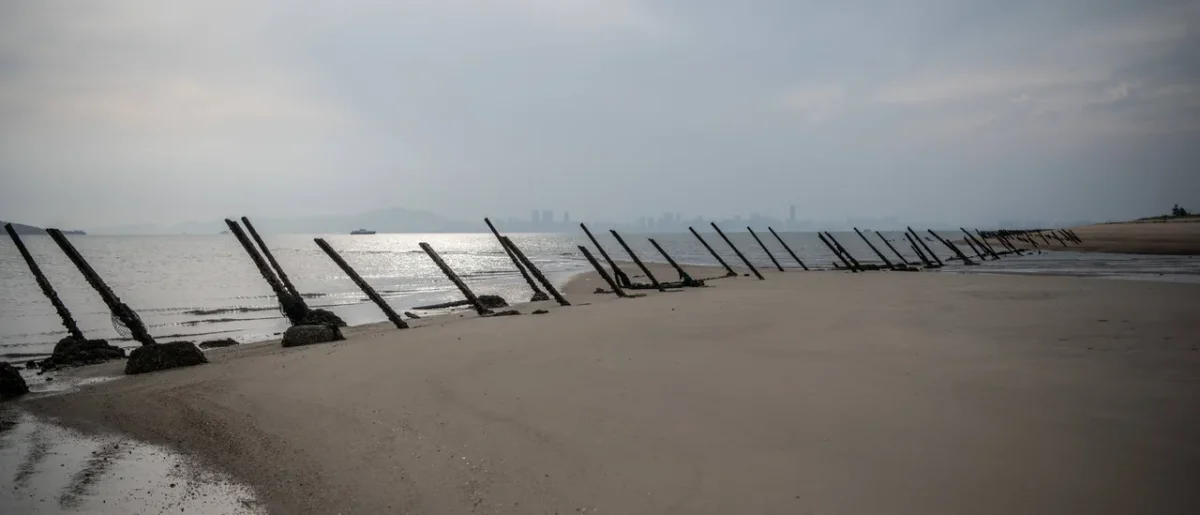
Taiwan is pouring $35 billion into its military next year — the first time the island’s defense budget has crossed 1 trillion Taiwan dollars — as Beijing sends warplanes and warships near Taiwan’s shores almost daily.
The 2027 spending plan pushes military expenditures above 3% of GDP, a direct answer to mounting Chinese aggression and pressure from Washington to stop relying on American taxpayers for protection.
China claims Taiwan as its territory and has never ruled out invading the island by force. Taiwan has governed itself independently since 1949, but the communist regime in Beijing treats reunification as inevitable — by negotiation or conquest.
“China is increasing its military spending and capabilities in unprecedented fashion. We strongly urge Taiwan to invest in defensive military drones. Further delays in drone funding are a concession to the CCP.”
That warning came from a senior Trump administration official speaking to the Daily Caller News Foundation. The message: Taiwan needs to spend smarter, not just more.
Taipei plans to direct the new funds toward drones, missiles, and indigenous submarine programs — the kinds of systems that make an amphibious invasion a nightmare for Chinese generals. Funding for Taiwan’s coast guard is also included in the defense total because of its maritime security role.
President Lai Ching-te has pledged to raise military spending to 5% of GDP by 2030, recognizing that deterrence requires credible firepower, not just diplomatic posturing.
The spending increase follows blunt advice from Washington. American Institute in Taiwan Director Raymond Greene told a June forum that Taiwan should “spend smarter” by investing in unmanned systems that can quickly strengthen deterrence — not legacy platforms that take years to field.
Trump himself cast uncertainty over U.S. support for Taiwan during his May summit with Chinese President Xi Jinping in Beijing, telling Fox News that a delayed $14 billion weapons package for Taiwan would depend on China and calling the arms sale a “very good negotiating chip.”
That package still hadn’t reached Congress as of early August, though lawmakers indicated they’d approve it quickly once submitted.
“I’m not looking to have somebody go independent and we’re supposed to travel 9,500 miles to fight a war,” Trump said during a May interview with Bret Baier on Fox News. “I’m not looking for that.”
Another Trump administration official put it more bluntly: “The President has proposed a $1.5T U.S. defense budget. Taiwan faces a direct existential threat and should spend proportionally more.”
The new proposal could face a legislative fight in Taiwan’s opposition-controlled legislature, which only passed the central government’s 2026 budget last week after a record 266-day delay.
That delay threatened $2.4 billion in defense spending for weapons procurement, maintenance, and training — including funding for HIMARS rocket systems.
Secretary of War Pete Hegseth has publicly urged American allies and partners in Asia to raise military spending, arguing that defense expenditures should reflect the threats they face and pointing to higher European spending as an example.
Taiwan’s neighbors also view the island as a regional security linchpin. Japan has warned that stability around Taiwan is directly tied to its own national security.
Japanese PM Sanae Takaichi has once again reaffirmed Tokyo’s stance on Taiwan.
She says, “Japan’s own security is linked with Taiwan’s security & if China dares to invade Taiwan, Japan will surely intervene.
That’s powerful! pic.twitter.com/yATsT3O5Wd
— Isabella Anderson (@IsabellaAn67) August 19, 2026
A Chinese attack or blockade involving military force against Taiwan could constitute a “survival-threatening situation” for Japan, potentially allowing Tokyo to exercise collective self-defense under Japanese law, Japanese Prime Minister Sanae Takaichi said in November.
Japan’s Defense Ministry has published a white paper describing China’s military buildup and growing pressure on Taiwan as part of the greatest strategic challenge facing Japan.
Those concerns are partly driven by geography. During Chinese military exercises surrounding Taiwan in 2022, Beijing fired nine ballistic missiles — five landed inside Japan’s exclusive economic zone, and another came down roughly 80 kilometers from Japan’s Yonaguni Island.
Tokyo has since repeatedly called for the peaceful resolution of cross-strait tensions and warned against attempts to alter the regional status quo through force or coercion.
Japan adopted plans in 2022 to bring security-related spending to roughly 2% of GDP and authorized the development of counterstrike capabilities — a substantial shift in Japan’s postwar defense posture.