
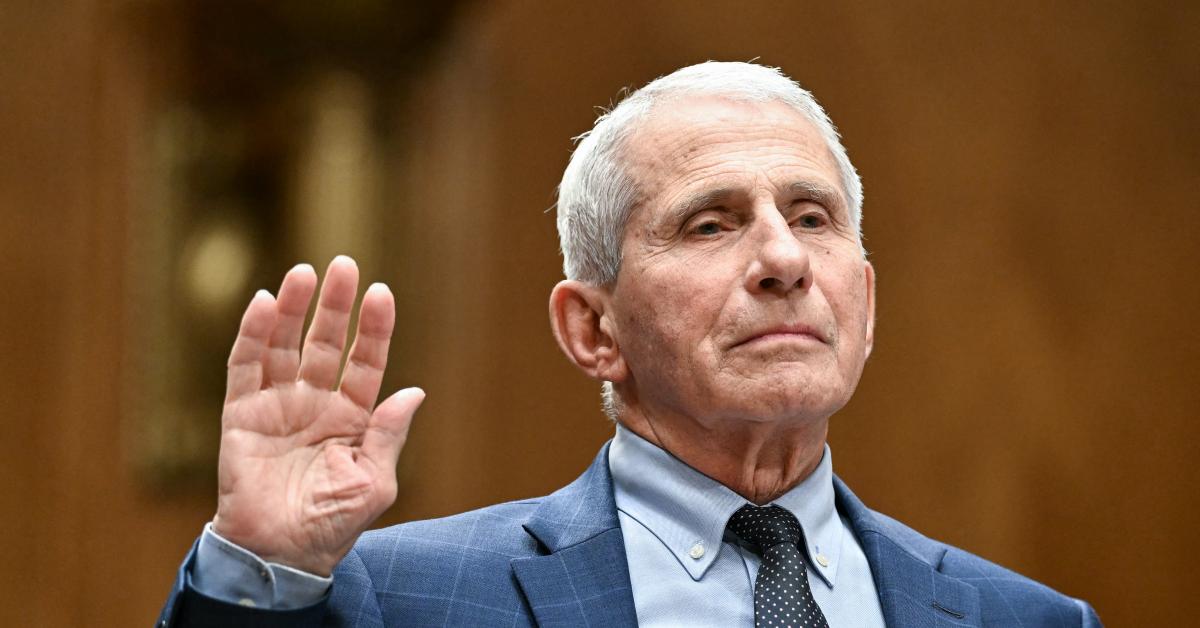
BREAKING: In an unprecedented Thursday-morning vote, the U.S. Senate Homeland Security and Governmental Affairs Committee has voted 8 to 5 in the roll call — along strict party lines, with two additional Democratic senators opposing by proxy vote — to hold former COVID-response chief Dr. Anthony Fauci in criminal contempt of Congress.
All eight Republicans on the committee voted YES. Five Democrats voted NO in person; two more registered their NO vote by proxy.
And in a move designed to bypass the delay of a full Senate floor vote — where Democrats would likely stall or block — Chairman Sen. Rand Paul (R-KY) confirmed the resolution will be sent directly to the Department of Justice as a criminal referral.
What Triggered the Vote
The contempt charge stems from last week’s Senate hearing, where Dr. Fauci was called to testify about his role in the federal COVID-19 pandemic response. Under oath, and facing a battery of questions about gain-of-function research, lab-leak coverups, and his private diary entries released to the public earlier this summer, Fauci did something no former high-ranking federal health official had ever done in modern history.
He invoked the Fifth Amendment. Not once. Not a dozen times. But more than 100 separate times — refusing to answer virtually every substantive question put to him.
Sen. Paul warned Fauci on the record, multiple times during that hearing, that a blanket refusal to answer every question under the Fifth Amendment does not match how the Fifth Amendment actually works. The Fifth protects a witness from self-incrimination on specific questions — not from testifying about anything at all.
Fauci ignored the warnings. Today’s vote is the direct legal consequence.
The DOJ Referral Path
Rather than push the resolution to a full Senate floor vote — where Senate Democrats could delay, filibuster, or block — Paul told CBS News he intends to send the contempt referral directly to the U.S. Department of Justice.
This is a legally recognized process. When a congressional committee votes to hold a witness in criminal contempt, the referral can be sent to the U.S. Attorney’s Office for the District of Columbia to decide whether to prosecute. That’s how Steve Bannon was ultimately convicted of criminal contempt and served time in federal prison — a precedent Paul has referenced directly.
Once the referral hits Trump’s DOJ under Acting AG Todd Blanche, the decision on whether to seek a grand jury indictment falls to career prosecutors. Under the Biden administration, contempt referrals against politically-favored figures were routinely ignored. Under a Trump DOJ, that political shield disappears.
“A Small Amount of Justice”
Republican members of the committee wasted no time in celebrating the vote publicly. Sen. Bernie Moreno (R-OH), one of the eight yes votes, framed the moment bluntly:
“This is a small amount of justice. But it’s a start.”
The framing is intentional. To Moreno and other Republican committee members, holding a hearing where Fauci refused to answer questions was never going to be the final chapter. The whole point of forcing his testimony under oath, the Republicans argued, was to build the paper trail that would justify a criminal referral to prosecutors who would actually prosecute.
Today’s vote closed that loop.
What Fauci Faces
Criminal contempt of Congress is a federal misdemeanor under 2 U.S.C. § 192. Conviction carries a fine of up to $100,000 and a prison sentence between one month and one year.
The relevant precedent, again, is Steve Bannon — the former Trump advisor who was convicted of the same offense and sentenced to four months in federal prison for refusing to comply with a congressional subpoena.
Fauci, unlike Bannon, complied with the subpoena to appear. But the committee’s argument is that appearing while refusing to answer any substantive question — under a blanket Fifth Amendment claim the committee alleges was improperly invoked — amounts to functional non-compliance.
That’s the argument prosecutors would need to build in a courtroom. And it’s the argument Paul is now handing directly to Trump’s DOJ.
The Bigger Picture
Five years ago, questioning Dr. Fauci in public was treated as social heresy. Federal agencies deferred to him. Mainstream media anchors called him “America’s doctor.” Elected officials who challenged him publicly were mocked as anti-science extremists.
Today, a bipartisan-in-appearance-only committee of the United States Senate has voted to hold him in criminal contempt.
The distance between those two facts is the story of what patriots have been saying all along: that the COVID-era public health apparatus never had the accountability structures the American people were told it did. And that the machinery of federal enforcement can turn — quickly — once the political incentives change.
The referral now moves to DOJ. What happens next depends entirely on whether the department’s career prosecutors decide the case Paul is handing them meets the bar for a grand jury indictment.
Given the precedent Bannon set, and given the specificity of Paul’s on-the-record warnings during the hearing, that bar may already be met.