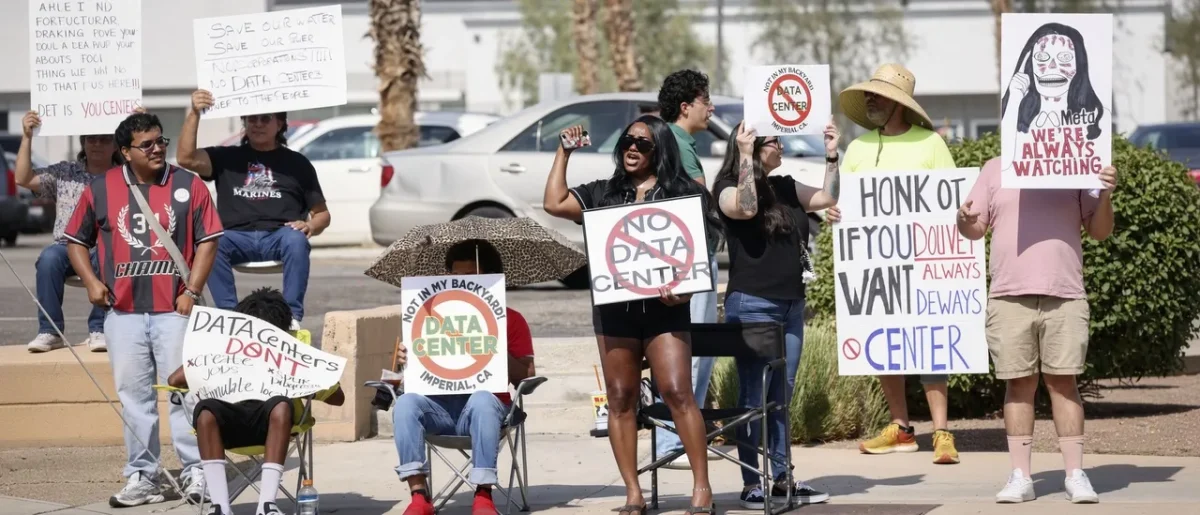
Data centers have become a flashpoint issue heading into the November midterms, with voters across party lines rejecting Big Tech’s push to build massive facilities that drain local water supplies and spike electricity bills.
The backlash has scrambled traditional political allegiances. President Trump backs the projects as essential to beating China in AI. Democrats and Republicans in contested races are rushing to distance themselves from unpopular data center deals they previously championed.
“The only reason that communities throughout the U.S.A. should not want Data Centers is if they want to end up being backwards and poor,” Trump wrote on Truth Social in late August. “If they want to be successful and rich, with far lower taxes and jobs all over the place, let Data Reign.”
White House assistant press secretary Liz Huston defended the president’s position, telling reporters Trump’s leadership is “turning data centers into engines of growth and opportunity for communities across the country that want them, all while cementing America’s dominance over China in the global AI race.”
“WHEN YOU HAVE BERNIE SANDERS AND GREG ABBOTT SINGING A SIMILAR TUNE, YOU KNOW THAT AN ISSUE HAS TRANSCENDED TRADITIONAL PARTISAN POLITICS.”
But Americans rank the economy as their top concern — grocery prices continue rising, fuel costs remain elevated, and 30-year mortgage rates now exceed 7%. Many voters see data centers as another example of corporate elites profiting while working families pay the price.
A New Jersey data center spilled roughly one small tanker truck’s worth of diesel into a creek in mid-September. Another facility in Georgia consumed more than 29 million gallons of water, causing low-pressure water flow for its host community.
Vermont Independent Sen. Bernie Sanders called for a moratorium on data center construction in December 2025. Sanders and New York Democratic Rep. Alexandria Ocasio-Cortez in March proposed the Artificial Intelligence Data Center Moratorium Act, which would pause data center building nationwide until AI companies ensure the projects won’t spike utility prices or harm communities.
Texas Republican Gov. Greg Abbott — who once sought to make Texas the “new tech mecca” — issued a pause on data centers in August as Texans rejected their construction. Pennsylvania Gov. Josh Shapiro reversed his pro-AI stance after initially calling the state’s streamlined approval process a “game changer.”
“We will not let them bully my fellow Pennsylvanians,” Shapiro said in August. “If these companies want to do business here they need to comply with the strictest guardrails in the nation on data center development.”
🚨 @GovernorShapiro puts data center developers on notice 🚨
“We will not let them bully my fellow Pennsylvanians. If these companies want to do business here they need to comply with the strictest guardrails in the nation on data center development.” pic.twitter.com/wLXYuW0tAo
— Pennsylvania Governor’s Office (@PAGovOffice) August 18, 2026
Colin McGlynn, AI policy advisor at Demand Progress, told reporters the issue has united Americans across the political spectrum. “When you have Bernie Sanders and Greg Abbott singing a similar tune, you know that an issue has transcended traditional partisan politics,” McGlynn said. “Big Tech CEOs have been going around talking and acting like cartoon supervillains while building computers the size of Manhattan.”
The data center fight is playing out in two high-profile Senate races. Former Ohio Democratic Sen. Sherrod Brown praised Amazon data center construction in 2015 but now attacks Republican Sen. Jon Husted as “the face of data centers” in Ohio. Husted authored the Ratepayer Protection Act, requiring data centers to pay their own energy costs rather than passing them to local residents.
Senate Democrats blocked the bill’s advancement in late September, 57-43, despite the House adopting it 417-3 in mid-September.
“After failing Ohio families during his 32 years in Washington, Sherrod Brown is once again resorting to lies instead of facing his abysmal record head-on,” Amy Natoce, a Husted campaign spokesperson, said. “Senate Democrats blocked it. Sherrod Brown and his friends would rather play politics and stick Ohio families with higher electric bills than pass a commonsense solution.”
A Marist Poll found Husted trailing Brown by eight points. The National Republican Senatorial Committee warned in an August memo that Americans’ dislike for data centers could cost the GOP a key Senate seat in Ohio.
Michigan Republican Senate candidate Mike Rogers called for a one-year moratorium on new data centers in August. “While I don’t support a federal ban, Michigan needs stronger guardrails to protect community control, prevent utility price hikes, protect our water and stop pay-to-play schemes,” Rogers said.
Pro-AI super PACs are pouring money into the midterms. Leading the Future, backed by OpenAI President Greg Brockman and venture capital firm Andreessen Horowitz, has raised more than $140 million for the midterm elections and is running campaigns for both Republican and Democratic candidates.
More than 60% of voters would support building data centers if developers met local community requirements, according to internal polling obtained by the DCNF that was shared with Senate Republicans. Those requirements include paying for their own energy usage, not increasing local residents’ electricity rates, and funding the infrastructure upgrades needed to support the data center.
Polling on which party voters trust more on data centers remains split. Forty-two percent trust Republicans more on AI, while 40% trust Democrats more, according to a September New York Times and Siena University poll. Less than one percent of voters in that survey ranked AI as their top issue ahead of November.
Mark Bednar, a principal at Monument Advocacy and former head of communications for Speaker Kevin McCarthy, said Republicans should stop framing data centers purely as a national security issue. “At times, Republicans have relied exclusively on America’s competition with China as an explanation for why data center construction is important,” Bednar said. “While that may be true and central to policy-making and long-term planning, it’s been an insufficient talking point to voters.”
Chris Borick, a political science professor at Lehigh University, summed up the political stakes: “If you’re in power right now and you are dealing with this issue, you have a target on your back. It’s a recognition that the ground shifted under their feet and they were not ready for that to happen.”
Not invoked, 57-43: Motion to invoke cloture on the motion to proceed to Cal. #684, H.R.9340, Ratepayer Protection Act.
— Senate Cloakroom (@SenateCloakroom) September 30, 2026