Two federal judges appointed by Barack Obama and Joe Biden just blocked President Donald Trump’s White House ballroom and military complex — and Trump is calling them out.
The controversy centers on one of the most ambitious White House construction projects in modern history, raising fundamental questions about presidential authority and the separation of powers. At stake is not just a building project, but the question of whether a sitting president has the constitutional authority to make major alterations to the executive mansion without explicit congressional approval.
A divided federal appeals court ruled Friday that the Trump administration must halt construction of the $400 million White House ballroom because Congress never authorized the project. The court claimed the president doesn’t have unilateral authority to replace the East Wing with the planned 90,000-square-foot ballroom.
The ruling represents a significant check on executive power, with the majority opinion focusing on the principle that major capital projects require congressional appropriation. The decision hinged on whether the president’s general authority to maintain and operate the White House extends to undertaking massive construction projects that fundamentally alter the building’s footprint and purpose. Legal scholars have noted that while presidents routinely make renovations and improvements, projects of this scale and cost have historically involved congressional consultation or authorization.
Trump fired back on Truth Social, arguing that presidents have every right to renovate, improve, and secure the White House — because they’re elected by the American people, not Congress.
“Two Judges, one appointed by Barack Hussein Obama, the other by Sleepy Joe Biden, said in a ruling on the desperately needed SECURE Ballroom/Military Complex, including a major DronePort on the roof, that ‘Each President is a temporary tenant … of the White House.'”
Trump didn’t stop there. In the same Truth Social post, he reminded the judges that presidents are NOT tenants.
“We are not tenants, who pay rent and do all other things that a tenant must do, we are PRESIDENTS, elected by the people of the United States of America, and have many rights, including the right to fix, renovate, secure, protect, and beautify the White House grounds, which has been built and rebuilt, renovated and rerenovated, repaired and, simply, MADE BETTER, many times since 1792, and never needing the permission of Congress.”
The president’s response highlights a longstanding tension in American government between the executive branch’s operational independence and Congress’s power of the purse. His invocation of popular election as a source of authority reflects a broader constitutional debate about whether the president’s democratic mandate grants inherent powers beyond those explicitly enumerated in Article II of the Constitution.
Trump called the court’s decision a threat to national security — pointing out that the judges just halted a project that was already largely built and funded.
The national security argument adds another dimension to the legal battle. If the complex indeed includes security-critical infrastructure like the drone detection and defense systems Trump has described, halting construction could potentially leave those systems incomplete and the White House vulnerable. This raises questions about whether courts should defer to executive determinations of national security needs, or whether such claims require independent judicial scrutiny to prevent executive overreach.
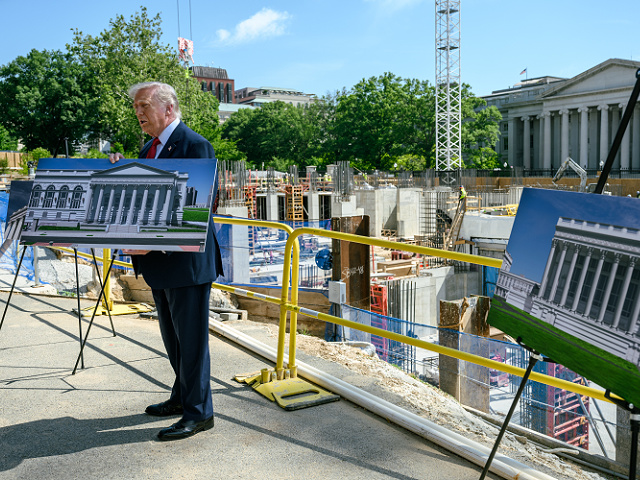
Before the ruling, Trump shared an aerial photo showing construction underway at the White House’s East Wing. He said the project was on budget and ahead of schedule.
The military complex under construction includes a drone port on the roof — though Trump noted in a Tuesday Truth Social post that the steel for the structure had already been fabricated and would be installed soon.
The timing of the court’s intervention, coming after substantial construction has already occurred and materials have been fabricated, creates additional complications. Halting the project now could result in wasted taxpayer dollars if the work must be undone or materials scrapped. This practical consideration may factor into any appeals or requests for stays of the court’s order.
The White House has been renovated, expanded, and rebuilt multiple times since 1792. Trump’s argument: every president before him had the authority to make the People’s House better. Why would he need Congress’s permission now?
Historical precedent does support Trump’s claim that the White House has undergone repeated transformations. However, the scale and cost of this particular project may distinguish it from past renovations. The legal question ultimately turns on where to draw the line between routine presidential maintenance authority and major construction projects that require legislative approval — a boundary that this court decision attempts to define more clearly than ever before.