
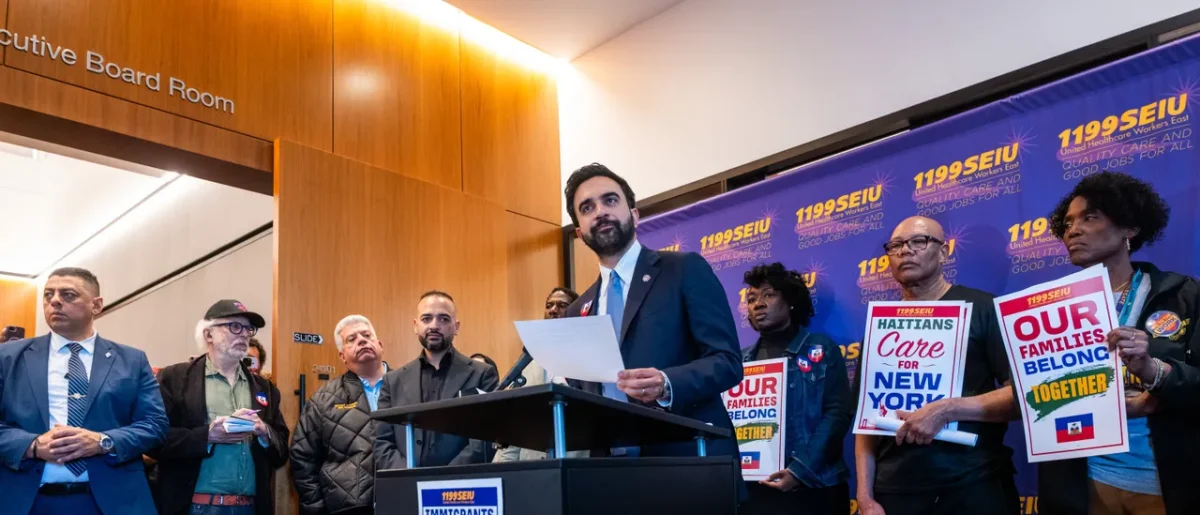
New York City is firing dozens of Haitian municipal employees after federal courts cleared the path for President Trump’s termination of their Temporary Protected Status to take effect.
The city had no choice but to separate from Haitian workers who lost their work authorization, Mayor Zohran Mamdani admitted in a Friday statement. The dismissals follow a June Supreme Court decision in Mullin v. Doe that lifted the final legal barrier to the Department of Homeland Security’s termination order.
The city was legally compelled to review work authorization and fire employees who couldn’t establish alternative legal status.
The legal requirement puts municipal employers in an impossible position. Under federal immigration law, employers who knowingly continue to employ workers without valid work authorization face steep penalties, including fines and potential criminal prosecution. New York City, despite its progressive immigration policies and stated commitment to protecting immigrant communities, cannot exempt itself from these federal employment verification requirements. The city’s human resources departments are bound by the same I-9 employment eligibility verification rules that govern every other employer in the United States.
Mamdani tried to soften the blow by offering free legal help and city staff assistance to walk affected Haitians through their options — but the bottom line is clear: Democrat sanctuary-city promises hit a wall when Trump’s immigration enforcement reaches the Supreme Court.
The concept of “sanctuary city” status has often been misunderstood by both supporters and critics. While such policies typically prevent local law enforcement from cooperating with federal immigration authorities and limit information sharing with ICE, they do not—and legally cannot—shield city employees from federal employment eligibility requirements. The distinction highlights a fundamental tension in immigration policy: cities can refuse to actively assist in immigration enforcement, but they cannot violate federal employment law in the process.
U.S. District Judge Ana C. Reyes, a Biden appointee, removed the last legal block of the termination order Wednesday. Her order confirmed that the stay preventing DHS Secretary Kristi Noem’s termination of Haiti’s TPS designation is “no longer in effect.”
The decision by Judge Reyes carries particular significance given her appointment by President Biden, signaling that even judges nominated by Democratic presidents recognize the executive branch’s broad authority over immigration decisions. The lifting of the stay represents the final collapse of a multi-layered legal strategy that immigrant advocates had pursued through various federal courts in an attempt to preserve protections for Haitian TPS holders. Each level of judicial review ultimately sided with the administration’s authority to terminate the designation.
In a late Friday statement, Mayor Mamdani says NYC is firing Haitian municipal employees on TPS because of federal court rulings upholding the Trump admin’s termination of the program (the statement doesn’t actually say this, but a Mamdani spox confirms that’s what’s happening). pic.twitter.com/ZIHGTzGLu2
— Chris Sommerfeldt (@C_Sommerfeldt) August 7, 2026
Geoff Pipoly, lead counsel for the Haitian plaintiffs, told reporters his clients are “continuing to litigate the Constitutional claim that remains live following the Supreme Court’s ruling.” He compared the Haitian workers’ situation to Venezuelan TPS holders, whose protections were terminated in 2025 while the case was still in court.
The ongoing constitutional litigation suggests that legal battles over TPS terminations may continue for months or even years, even as the practical effects—including job terminations—proceed immediately. This creates a devastating paradox for affected workers: they lose employment and work authorization while their lawyers continue fighting in court, with little realistic prospect that any eventual legal victory could reverse the employment consequences they face today.
The Supreme Court’s decision means roughly 348,000 Haitians who held Temporary Protected Status as of June 2025 now face the same uncertain future.
That figure represents families, longtime U.S. residents, and workers who have built lives in American communities over many years. Many TPS holders have been in the United States for over a decade, having initially received protection following natural disasters or political instability in their home countries. The termination affects not just the individual TPS holders but also their U.S.-citizen children, spouses, and extended family members who depend on their income and stability.
TPS is a temporary benefit that does not lead to lawful permanent resident status or grant any other immigration status, according to U.S. Citizenship and Immigration Services. The program is typically granted due to ongoing war, environmental disasters, or “extraordinary conditions” — but Trump has argued the program became a backdoor amnesty scheme under prior administrations.
The temporary nature of TPS has long been a point of contention in immigration policy debates. While the statute clearly describes the protection as temporary, in practice many TPS designations have been renewed repeatedly for decades, creating what critics call a quasi-permanent status without the legal framework of permanent residency. Supporters counter that conditions in designated countries often remain unsafe or unstable for extended periods, making renewals both legally justified and morally necessary. The Trump administration’s position represents a significant shift toward enforcing the “temporary” aspect more strictly than previous administrations of both parties.
New York City championed itself as a sanctuary city for years. Now it’s firing Haitian workers because federal law — and the Supreme Court — say it has to.
The situation illustrates the practical limits of local resistance to federal immigration policy. While cities can adopt welcoming rhetoric and decline to actively cooperate with immigration enforcement, they ultimately operate within a federal legal framework that constrains their ability to protect immigrant residents from the consequences of federal policy changes. The New York City terminations may preview similar actions in other progressive cities that employ TPS holders in municipal positions.