
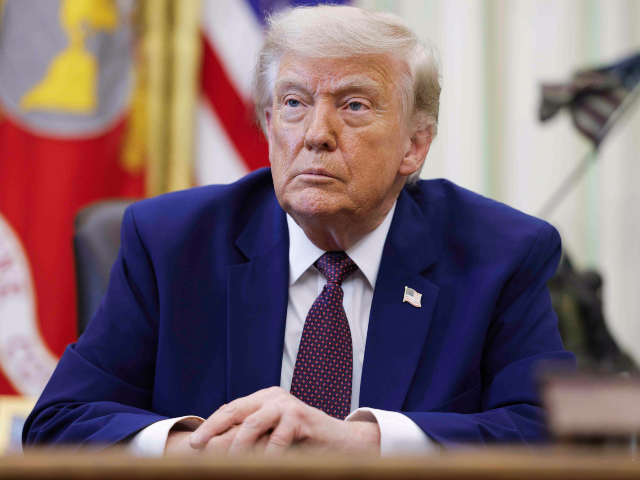
Iran issued sweeping threats Saturday as President Donald Trump reportedly prepares one of the harshest bombing campaigns yet against the regime — targeting power plants, refineries, and energy infrastructure that could plunge Tehran into darkness.
The new offensive could begin as soon as this weekend, according to multiple reports, while U.S. embassies across the Middle East urged Americans to consider leaving the region immediately.
CBS News reported Friday that the United States and Israel were preparing what could become one of the harshest bombing campaigns of the conflict against Iranian energy infrastructure, with power plants and refineries among the likely targets. High-level discussions Friday reportedly included the possibility of cutting electricity across Tehran.
“We’ll be hitting them very hard. And you know at some point, they’re going to say, ‘We just can’t take it anymore.'”
Trump publicly signaled Friday that his patience with the regime is rapidly running out.
“We’ll be hitting them very hard,” Trump told reporters during a Cabinet meeting at Camp David. “And you know at some point, they’re going to say, ‘We just can’t take it anymore.'”
Asked about reviving diplomacy with Tehran, Trump offered an even more direct answer: “I think we just want to win.”
The president also said he was “losing faith” in reaching an agreement with Iran, accusing Tehran of repeatedly lying and breaking its word during negotiations.
“All they do is make me angry,” Trump said, describing Iranian negotiators as “very dishonest” and “very dishonorable” to deal with.
White House press secretary Karoline Leavitt accused Tehran of violating the memorandum of understanding it signed with Washington last month by attacking commercial vessels and killing American service members.
“President Trump is not going to stand by and allow this terrorist behavior to occur,” Leavitt said. “Iran will continue to pay until they come to the table in what President Trump deems a meaningful way.”
The new offensive could begin within days and last several days, according to a Wall Street Journal report Friday. Although Trump reportedly authorized an attack plan presented to him Friday at Camp David, CBS News and Axios reported that a final execution order had not yet been issued, leaving open the possibility that a diplomatic breakthrough could still avert the operation.
Multiple U.S. sources told CBS that Israel had been notified of the plans and was coordinating with Washington. An Israeli official, however, pushed back on reports of direct Israeli participation, saying Jerusalem had neither been informed of a decision to fully restart military operations nor asked to join an attack.
The latest planning comes after the Wall Street Journal reported earlier in the week that U.S. Central Command had prepared options for an intensive 10-to-14-day air campaign aimed at severely degrading Iran’s remaining missile capabilities.
The mounting signs of imminent U.S. military action have placed Israel on heightened alert.
Two Israeli sources told the Jerusalem Post on Saturday that officials believe Trump is nearing a decision on renewed military operations, potentially on a larger scale.
“We are on high alert and awaiting the president’s final decision,” an Israeli official said.
Ynet News separately quoted an Israeli source saying, “We are very close to the point of decision.”
Israel’s working assumption is that Tehran could launch ballistic missiles at the Jewish state in response to a major American attack even if the IDF does not initially participate.
Concerns over a potentially imminent escalation spread across the region Saturday as U.S. diplomatic missions issued broad new security warnings.
U.S. embassies in Israel, Bahrain, Iraq, Jordan, Kuwait, Lebanon, Oman, Qatar, Saudi Arabia, the United Arab Emirates, Egypt, and elsewhere in the Middle East urged Americans to consider leaving or prepare to depart should the confrontation escalate.
“Americans in the region should consider departing, or be prepared to depart should there be escalation,” the State Department warned Saturday, adding that Americans outside the Middle East should “seriously reconsider travel to and through the region.”
The warning cited the possibility of flight cancellations, airspace closures, and other travel disruptions, while cautioning that Iran and groups supporting Tehran could target U.S. diplomatic facilities, businesses, institutions, and other American interests around the world.
“If attacks are carried out against Iran’s civilian infrastructure, the vital infrastructure of these regimes, together with that of Israel and perhaps Jordan, will be destroyed.”
Tehran issued a barrage of increasingly explicit threats Saturday as reports of possible U.S. strikes mounted.
Iran’s Foreign Ministry declared that the Islamic Republic would use “all of its means” to defend its “rights, interests, and national security” against what it described as U.S. and Israeli aggression.
A senior Iranian security official separately told the regime-linked Tasnim news agency that Tehran had prepared a broad retaliation plan targeting critical Israeli infrastructure and U.S. energy assets across the region.
“We are fully prepared to carry it out,” the official said.
Iranian lawmaker Ebrahim Rezaei warned that Tehran would strike “all enemy bases and the source of attacks from anywhere,” adding that Iran’s response “will not be limited to the Persian Gulf region.”
Seyed Mohammad Marandi, a member of Iran’s negotiating team and University of Tehran professor frequently described as close to the regime, issued an even more ominous warning to Gulf states.
“Based on statements from the Trump regime, it seems quite possible that after months of barbaric threats, tonight will be the last night of normality in Qatar, Saudi Arabia, Kuwait, Bahrain, the UAE, and possibly Oman,” Marandi wrote on X Saturday.
“If attacks are carried out against Iran’s civilian infrastructure, the vital infrastructure of these regimes, together with that of Israel and perhaps Jordan, will be destroyed,” he continued, warning their populations to “prepare for immediate evacuation.”
Ali Abdollahi, head of Iran’s military central command, similarly warned regional governments against assisting Washington, declaring that any country serving as a “defensive shield” for the United States would be “engulfed by the flames of war.”
The threats came as Iranian attacks continued across the region.
Kuwait said Saturday that its air defenses intercepted Iranian drones targeting several “vital facilities,” including a government facility in the country’s north. Falling debris caused property damage but no reported casualties.
The United Kingdom Maritime Trade Operations agency also reported new incidents in the Strait of Hormuz, including a tanker struck by an unknown projectile that damaged its engine room and left the vessel unable to maneuver under its own power. A separate tanker reported a large splash and explosion nearby.
Iran has repeatedly targeted commercial vessels attempting to transit the strategic waterway during its confrontation with Washington.
CENTCOM said Friday that the Strait of Hormuz remained open despite Iranian claims to the contrary and disclosed that U.S. forces had redirected 30 commercial vessels, disabled two, and boarded another two as part of enforcement of the U.S. blockade against Iran. Nearly 30 additional vessels had been permitted through for humanitarian purposes.
Against that backdrop, Trump spent part of Saturday posting Iran-focused material on Truth Social, including fighter-jet imagery and a chart highlighting the collapse of the Iranian rial.
“Trump is destroying the Iranian currency. Iran is experiencing massive inflation,” read one message shared by the president.
Chief Pentagon spokesman Sean Parnell, who said Friday that the Department of War was “locked and loaded, ready to execute the President’s directives at a moment’s notice,” also posted military imagery Saturday alongside a passage from Isaiah: “Here am I. Send me.”
The escalating confrontation follows the collapse of last month’s U.S.-Iran memorandum of understanding, which partially reopened the Strait of Hormuz and was intended to establish a framework for broader negotiations over the dismantlement of Tehran’s nuclear program.
Iran subsequently renewed attacks on commercial vessels and American forces, including attacks that killed U.S. service members and, this week, a surprise ballistic missile attack against American troops in Jordan. Washington responded with fresh strikes against Iranian targets, while Trump repeatedly warned that further attacks would bring increasingly severe retaliation.
Trump said Friday that Iran remained determined despite months of fighting but predicted continued American pressure would eventually break Tehran’s resistance.
“Most people would have given up by now,” Trump said. “They haven’t, so I give them credit for that. They’re tough.”
But the president made clear that Washington had no intention of backing down.
“They’re doing very, very poorly,” Trump said. “They’ve been very dishonest. They’ve been very dishonorable to deal with.”
Asked whether Americans should prepare for the escalating exchange of strikes to continue, Trump replied, “A little bit.”
“It would be foolish to say no,” he added. “You always have to keep your guard up.”
President Trump says he will continue bombing Iran until they “can’t take it anymore”:
“We'll be hitting them. We'll be hitting them very hard. At some point they're gonna say, 'We just can't take it anymore.'" pic.twitter.com/JzWXVxFxdu
— The American Conservative (@amconmag) July 31, 2026
Trump on Iran:
Iran is doing very poorly. They are doing very, very poorly. They are having a very hard time.
They have been very dishonest and dishonorable to deal with.
But that makes no difference. They are doing very, very poorly. pic.twitter.com/jPhnT4HSQ6
— Clash Report (@clashreport) July 31, 2026