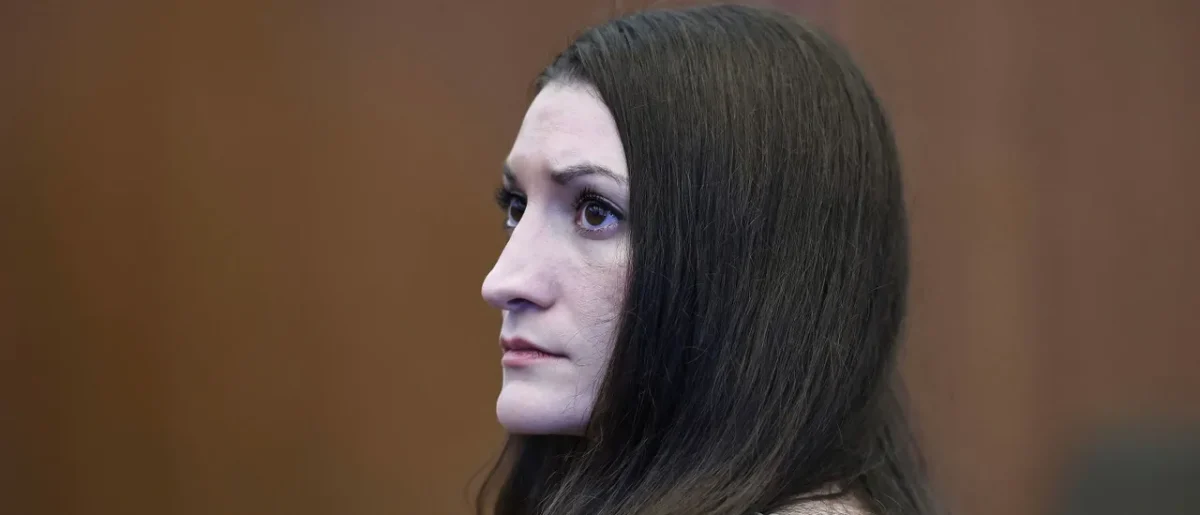
An Illinois woman accused of taking her 2-year-old son’s life allegedly told investigators the Lindsay Clancy case “inspired” her — a chilling claim prosecutors are now using to support first-degree murder charges.
The case has raised urgent questions about the influence of high-profile criminal trials in the social media age, and whether extensive coverage of family violence cases can have unintended consequences. Legal experts and mental health professionals have long debated the potential for what criminologists call “contagion effects” in violent crimes, particularly those involving harm to children.
Corie Walsh is charged with killing her toddler son after police responded to a report of an unresponsive child at the family’s Illinois home.
Officers found a neighbor performing CPR on the two-year-old, who had been discovered hanging in the basement. The child was transported to the hospital and pronounced dead.
The preliminary autopsy listed his cause of death as asphyxia caused by ligature compression of the neck.
According to prosecutors, Walsh told officers she killed her son because he was the “devil” and the “anti-Christ.”
Such statements, while disturbing, often become critical evidence in determining a defendant’s mental state at the time of an alleged crime. In cases involving harm to children by parents, prosecutors and defense attorneys frequently clash over whether religious delusions or other psychotic symptoms indicate severe mental illness or represent a calculated attempt to establish an insanity defense.
Officers found Walsh in a bloody bathtub upstairs with cuts to her wrists and thighs. She was later hospitalized for non-life-threatening injuries. Her husband was out of town with their three other children, who were unharmed.
The fact that other children in the home were not harmed may become a significant point of legal analysis as the case proceeds. In criminal cases where defendants claim mental illness or psychosis, prosecutors often point to selective behavior or planning as evidence of deliberate action rather than uncontrollable impulse.
Prosecutors claim Walsh had become “very interested” in the Lindsay Clancy trial and had been discussing it in a group text just hours before police arrived at the home.
Walsh allegedly said she was “inspired” by the Clancy case.
This alleged statement forms a key element of the prosecution’s theory. If Walsh was following the Clancy trial closely and discussing it immediately before the incident, prosecutors may argue this demonstrates premeditation and awareness rather than a psychotic break. The prosecution will likely use this claim to counter any potential mental health defense.
The parallels are disturbing. Clancy’s three children — ages five, three, and eight months — were found dead in the basement of their Massachusetts home in early 2023. Each child died of asphyxia after Clancy allegedly used exercise bands to strangle them.
Clancy also waited to act when her husband was out of the house. After killing her children, she attempted suicide, cutting her wrists and neck with a knife before jumping out of a second-story window.
The similarities in method, location within the home, timing during a spouse’s absence, and subsequent self-harm are what prosecutors are expected to highlight as they build their case. These commonalities suggest to investigators that Walsh may have studied the Clancy case in detail.
Clancy’s defense claimed she was experiencing postpartum psychosis during the 18-minute window in which she allegedly killed her children and attempted suicide. Her prosecution argued she hallucinated a voice telling her to kill her children and herself.
The Clancy trial became a lightning rod for debates about postpartum mental health, the criminal justice system’s treatment of maternal mental illness, and the capacity for someone experiencing psychosis to form criminal intent. These same questions are now likely to emerge in the Walsh case, though the alleged claim of being “inspired” by another case adds a unique and troubling dimension.
A judge declared a mistrial in the Clancy case Friday after the jury failed to reach a unanimous verdict. After seven days of deliberations, a lone juror remained unconvinced, prompting the judge to declare the mistrial.
The mistrial means prosecutors must decide whether to retry Clancy, a decision that typically considers the strength of evidence, public interest, and the emotional toll on families involved. The timing of the mistrial, coming just as the Walsh case enters the public eye, adds another layer of complexity to an already tragic situation.
The charges remain allegations. The case has not been proven in court.