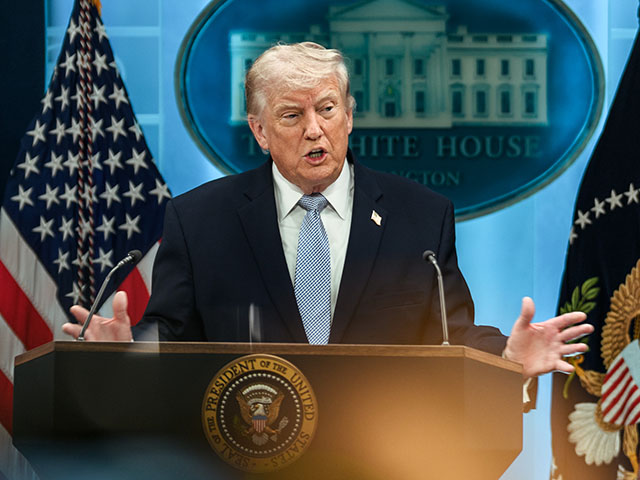
President Donald Trump signed the White House Accord on Super Intelligence Tuesday — a sweeping agreement with America’s biggest tech leaders committing the AI industry to internal controls, external audits, and board-level oversight.
The accord represents a significant shift in how the federal government approaches regulation of rapidly evolving artificial intelligence technology. Rather than imposing top-down legislative mandates, the agreement relies on voluntary commitments from the industry’s most powerful players to police themselves through structured oversight mechanisms.
Trump likened the document to “a constitution” for the future of what he’s officially rebranded from Artificial Intelligence to Super Intelligence.
“They love our country, they love the world,” Trump said of the executives. “And they came together, and they did something … it’s almost like a constitution in a way … and the biggest people in the world signed that, and I signed it as president, and it really is a form of protection.”
The constitutional comparison underscores the administration’s view that this moment requires foundational governance structures as AI systems grow more capable and autonomous. The rebranding to “Super Intelligence” itself signals the White House’s recognition that current technology is advancing beyond what traditional “artificial intelligence” terminology captures.
House Speaker Mike Johnson — who joined Trump at the signing — described the accord as the companies’ commitment to “robust internal controls and layers of internal and external review.”
Johnson’s presence at the signing highlights the bipartisan nature of concerns around AI governance, even as the specific approach remains voluntary rather than statutory. His involvement also suggests potential legislative action may follow if the voluntary framework proves insufficient.
The signing followed a private White House luncheon attended by Trump, Johnson, cabinet officials, and executives including Elon Musk (xAI), Mark Zuckerberg (Meta), Dario Amodei (Anthropic), and Jensen Huang (Nvidia).
The guest list represented the full spectrum of AI development — from Musk’s startup ventures and Meta’s social media integration to Anthropic’s safety-focused research and Nvidia’s chip manufacturing that powers the entire industry. The closed-door nature of the luncheon preceding the public signing suggests significant negotiation occurred over the accord’s specific commitments.
“The super intelligence providers are committed to building trust as they help us build the future, and they can and will do that, and they are ready to put their names on the line to agree to that very commitment.”
Johnson said the document sets forth voluntary standards and expectations for the industry — “robust internal controls and layers of internal and external review.”
“That’s important because you need people to be providing oversight and transparency, and that’s what these leaders are going to do,” Johnson said.
The emphasis on transparency addresses growing public anxiety about AI systems making consequential decisions in opaque ways. External audits, in particular, represent an acknowledgment that self-regulation alone may not satisfy public accountability demands.
Zuckerberg called the internal controls and layered reviews “good steps,” saying the American public and customers “want to know that what we’re building is working in the way that we all intend.”
His characterization of public and customer expectations reflects mounting pressure on tech companies to demonstrate their AI systems are safe, reliable, and aligned with human values before deployment at scale. The focus on “what we all intend” implicitly acknowledges past instances where AI systems have produced unintended or harmful outcomes.
“We drafted a set of principles and commitments around building robust internal controls and detecting if there are any issues with the technology, coupled with multiple layers of auditing and controls, starting with internal risk review, external auditors and evaluators, and agreeing that we’re going to have all of our boards of directors independently review the reports that come from the auditors.”
Zuckerberg added that the accord is “a start” — not the only action the industry will take, but an agreement “the whole industry could come to.”
His framing of the accord as a beginning rather than conclusion suggests this framework may evolve as AI capabilities advance and new risks emerge. The ability to achieve industry-wide consensus, even on voluntary measures, indicates shared recognition among competitors that some form of oversight is inevitable.
Johnson said Congress and the White House would continue guiding AI development “in a safe manner.”
This language leaves open the possibility of future legislation if voluntary measures prove inadequate, maintaining government leverage even as the administration pursues a collaborative rather than adversarial approach.
Trump also signed an executive order Tuesday officially rebranding Artificial Intelligence as Super Intelligence.
The executive order on terminology reflects more than semantics — it signals the administration’s assessment that AI technology has reached or is approaching capabilities that warrant different classification and governance approaches than earlier generations of machine learning systems.
The White House billed the gathering as a major policy milestone — bringing together the world’s most powerful tech leaders under a unified framework as AI capabilities accelerate.
Mike Johnson making a statement while standing with Jensen Huang, Elon Musk, and other tech CEOs pic.twitter.com/csrGy2MkI9
— Acyn (@Acyn) September 29, 2026
— Rapid Response 47 (@RapidResponse47) September 29, 2026