Federal agents stopped eight men from carrying out a drone-and-sniper attack on a White House UFC event in June. The FBI arrested them after a mother in Ohio reported her son’s behavior had turned dark. Prosecutors say the plotters coordinated over Signal, planning to send explosives-rigged drones over the arena, force a panicked evacuation, and then use sniper positions to cut down fleeing “high-value targets.” One suspect typed the plan out like a game strategy: “Position your teams in the purple dots, counter sniper and drones.” The DOJ indictments later expanded to eight defendants.
That arrest represents one save pulled from a haystack that grows bigger every week.
The real danger to this country right now is not any single plot. It is that America no longer reliably knows who is inside its borders, and the men and women tasked with finding out are stretched thin, doxxed, and increasingly obstructed by their own countrymen while they try.
ASSAULTS ON ICE OFFICERS ROSE 1,300 PERCENT OVER THE PAST YEAR — DHS DATA SHOWS VEHICULAR ATTACKS UP 3,200 PERCENT
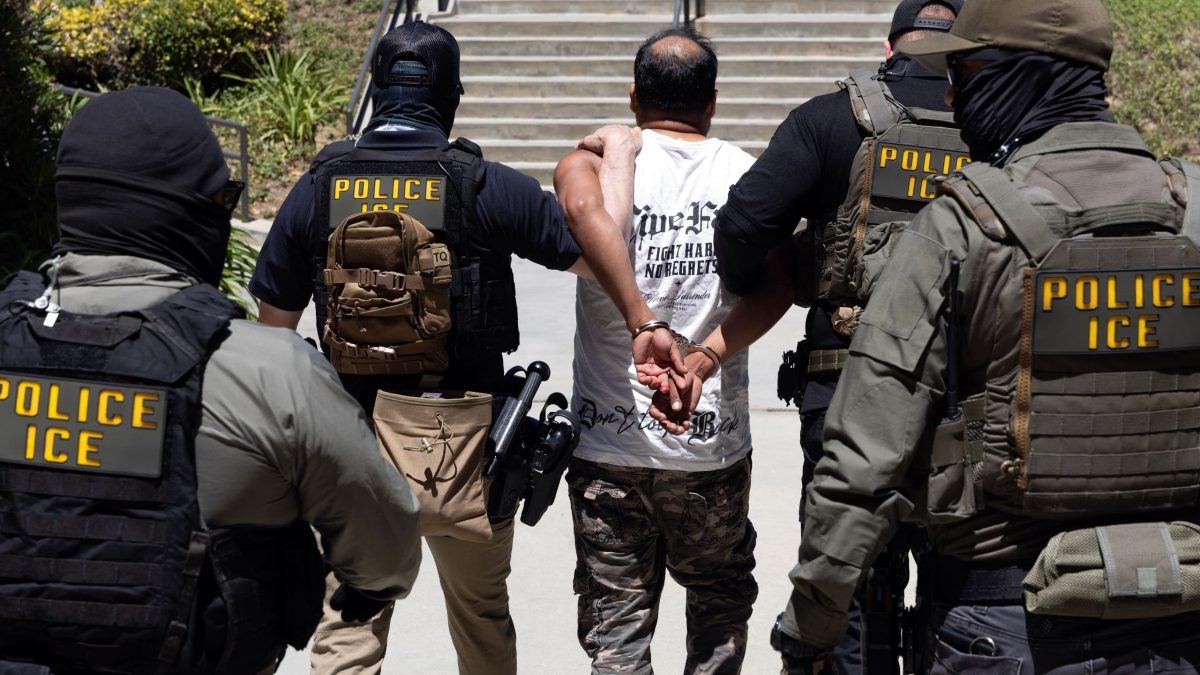
According to Department of Homeland Security data, assaults on ICE officers rose 1,300 percent and vehicular attacks on agents rose 3,200 percent over the past year. More than 180 vehicle attacks have been recorded since January 2025 alone.
In Minneapolis this January, a woman used her car to wedge federal agents between two vehicles while a crowd threw rocks and pulled agents from their cars. Protesters in New York City barricaded streets with garbage to keep agents from making an arrest.
None of that is civil disobedience. It is a bet, made by ordinary Americans who should know better, that following an ICE agent’s car carries no real cost — placed against people doing a legally authorized job under conditions most of us would not last a week inside.
Follow the money. A federal grand jury is examining Neville Roy Singham, an American businessman tied to Chinese state media, for possible violations of the Foreign Agents Registration Act. The House Ways and Means Committee says Singham and his wife, CODEPINK co-founder Jodie Evans, ran more than $20 million through shell companies and donor-advised funds to a single activist hub, The People’s Forum, from 2017 to 2022. The committee says the money reaches allied causes overseas as well as at home.
CODEPINK is one of hundreds of organizations that turned out for this year’s “No Kings” demonstrations alongside Indivisible, a group that has drawn long-running grants from George Soros’s Open Society Foundations.
Cartels do not need to fund a protest movement to profit from the chaos. Their financing model already runs on it. Drug and human trafficking pay for the cartel’s guns, boats, and enforcers, and every hour an ICE agent spends negotiating a mob instead of working a smuggling lead is an hour that revenue stream stays open.
“THE REAL DANGER IS THAT WE NO LONGER RELIABLY KNOW WHO IS INSIDE OUR BORDERS”
ICE agents are the street-level end of the same chain that produced the UFC arrests — the officers who verify the name and make the call on who gets detained. That job has gotten harder because the population they are screening got much larger before anyone finished sorting it.
Homeland Security’s own counterterrorism guide has tracked Tren de Aragua cells operating in at least nineteen states, running armed home invasions, kidnapping, extortion, and human trafficking. One member of Congress called it “MS-13 on steroids.” Cartel enforcers move through the same smuggling corridors as the men, women, and children being trafficked for labor and exploitation.
None of that requires a foreign spy service. It only requires a country that has lost the capacity to tell friend from enemy inside its own borders, because it stopped bothering to check.
Yuri Bezmenov, the Soviet defector who spent the 1980s warning American audiences about ideological subversion, argued that an adversary rarely needs an army when it can flood a country with enough contradictory information that its own institutions cannot agree on what is happening or who is responsible. Analysts call this the attribution trap: enough true fragments, pointing in enough directions, to make a wrong conclusion look reasonable.
Trade Moscow handlers for a Tren de Aragua cell, a trafficking network, and a mother’s 911 call, and you have the exact same trap playing out in Minneapolis, Ohio, and every city where a crowd calls an ICE team the enemy.
Most people who crossed the border illegally came for work, not to join a cartel cell, and treating every landscaper or line cook as a suspected criminal is both wrong and beneath us. But risk management has never worked by assuming the best case. When millions of people entered the country without so much as a name check, the honest answer to “who is here” became “we do not fully know,” and that uncertainty is the actual product an adversary — whether a foreign state, a cartel, or a gang — exploits.
Praise the FBI agents who stopped a massacre at the White House. Then extend that respect down the chain to the ICE officers doing the dangerous work of finding out who is here, and stop pretending that following their vehicles, publishing their names, or surrounding them is a form of protest rather than an assist to the chaos Bezmenov described.
A country that cannot agree that its own law enforcement deserves to do its job without being ambushed has already done half of an adversary’s work for it. The rest gets finished by every cartel enforcer, trafficker, and sleeper cell that slips through while Americans argue about who the real threat is.