
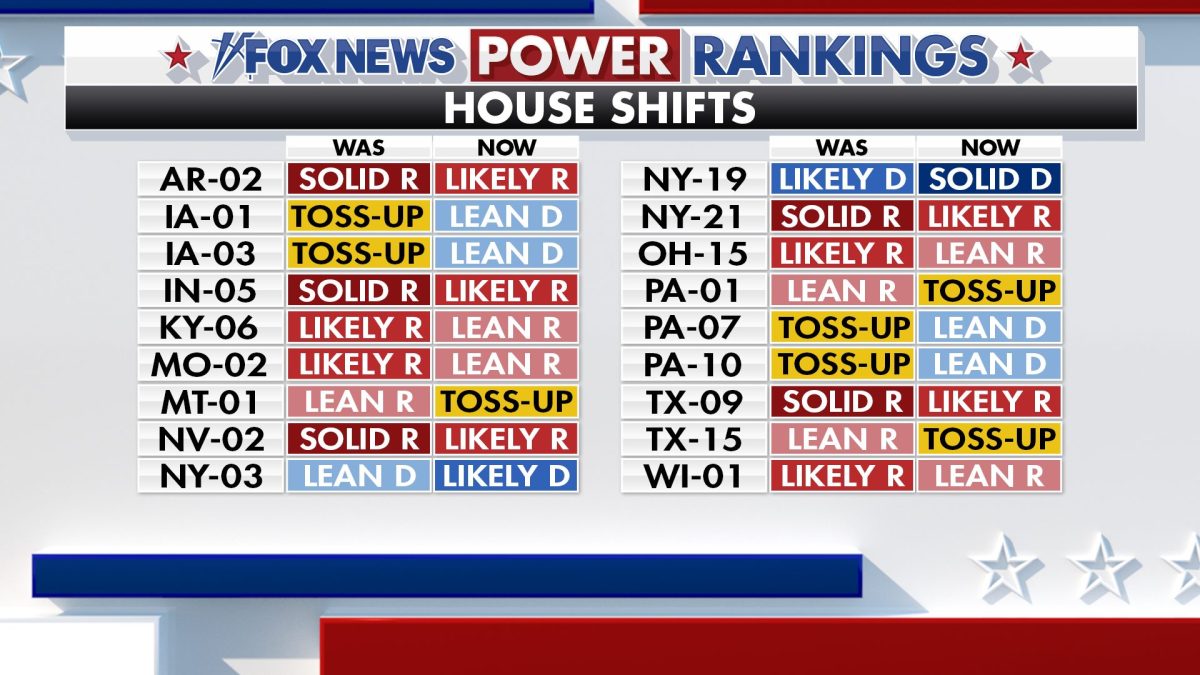
Democrats are on track to seize control of the House with a potential 237-seat majority as generic ballot polling shows a lead wider than the 2018 blue wave, according to the latest Fox News Power Rankings.
The forecast marks a devastating shift for Republicans. At least 20 races moved leftward this week, with Democrats now holding an advantage in at least 219 seats compared to just 198 for the GOP. Eighteen toss-up races remain on the board.
On a good night for Democrats, the party will hold around 237 seats — a gain of 22 from their current position.
The twin drivers behind the collapse: President Trump’s approval rating sits lower than during his first-term 2018 midterms or Biden’s 2022 cycle, and Democrats’ generic ballot advantage has proven both wider and more enduring than in previous cycles.
Republican-led redistricting efforts that were supposed to deliver gains have fallen short of expectations. Meanwhile, Democrats have fielded stronger candidates across competitive districts.
Rural voters turning on Republicans — a surprise dynamic shaping the map.
New York’s 21st District sits above Albany in some of the state’s most rural territory. Trump carried it by 21 points over Harris two years ago. A recent survey shows the Democratic candidate leading the Republican 46% to 42%.
Maine’s 2nd District — which famously voted for Trump three consecutive times, most recently by nine points — is now an open race after Rep. Jared Golden’s retirement. A new poll has the Democrat at 51%, the Republican at 45%.
Even Virginia’s 5th District, stretching across the Southside region with a two-thirds rural population, shows the Republican ahead by just six points in recent polling. The Democratic candidate, Tom Perriello, was recently endorsed by Rep. Alexandria Ocasio-Cortez.
Gas, diesel, and grocery prices are the culprit. Voters across rural America blame Republicans for cost-of-living increases — and GOP candidates have struggled to counter the narrative.
Iowa has experienced the fourth-highest gas price hike in the nation. Kentucky, Ohio, and Texas all rank in the top five states for diesel increases.
If the toss-ups break Republican, the party could end up with around 216 seats — two short of a majority but leaving Democrats with only a two-vote cushion. That would empower a far-left coalition to extract policy concessions from the next House speaker.
The incoming class already includes Democratic Socialists Darializa Avila Chevalier and Claire Valdez, both headed for sure-thing victories.
Some of this week’s shifts came from polling momentum. Democrats’ generic ballot lead pushed Kentucky’s 6th District (Lexington and suburbs) and Texas’ 15th District (Rio Grande Valley and Coastal Bend) away from Republicans.
Other shifts reflect strategic retreat. Republican groups pulled resources from races like New York’s 19th District, where Democratic Rep. Josh Riley lost by fewer than 5,000 votes four years ago. With GOP money redirected to more winnable contests, the district now rates Solid D.
Pennsylvania saw three districts shift left, thanks in part to Governor Josh Shapiro’s coattails. Iowa’s 1st and 3rd Districts — containing the state’s biggest cities — also moved toward Democrats on the strength of statewide races.
Senate stays in play — Minnesota now a battleground.
The Senate forecast remains a 47-47 toss-up with six states determining control. Democrats have plentiful paths to 51 seats. Republicans keep pouring money into the six toss-ups plus Kansas, but the spending hasn’t moved the needle much.
This week, a ninth state joins the battleground list: Minnesota.
Former NFL sideline reporter Michele Tafoya, recruited by Republicans, has navigated her first campaign by focusing on fraud, crime, and cultural issues that animate GOP voters. She faces Minnesota Lieutenant Governor Peggy Flanagan, whose progressive politics and proximity to a massive fraud scandal may be giving voters pause.
A new gold-standard survey shows 47% of likely voters support Flanagan, while 43% back Tafoya. Another 9% remain undecided.
Republicans are fully united behind Tafoya. Ninety percent of Democrats say they’ll support Flanagan. Independents are unsettled: 38% back Tafoya, 32% support Flanagan, and 29% haven’t decided.
Minnesota’s voter profile suggests some left-leaning voters are currently in the “independent” column and may break for Flanagan on election day. Her spot on the ballot alongside Amy Klobuchar, the Democrats’ gubernatorial candidate and electoral over-performer, could push her over the line.
Minnesota moves from Likely D to Lean D in the Power Rankings.