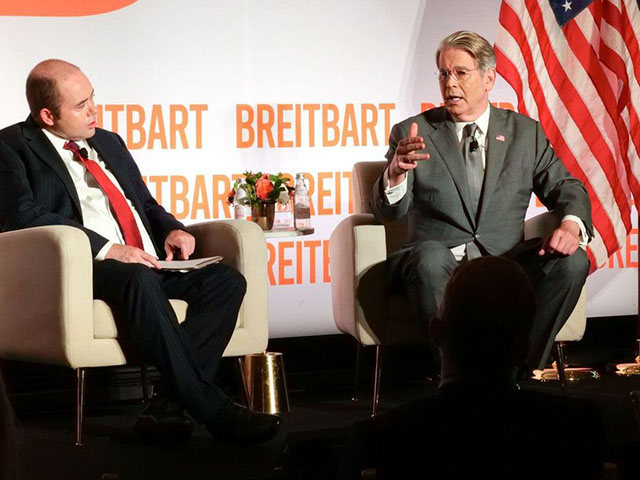
The U.S. bond market under President Donald Trump is the “best performing in the world” and inflation expectations are “flat to down,” Treasury Secretary Scott Bessent declared Tuesday at a Breitbart News policy event.
The Treasury chief’s assessment directly counters Wall Street fears about U.S. credit quality — and he has the data to prove it.
The comments come at a critical juncture for the Trump administration’s economic agenda, as bond markets have become a central battleground for competing narratives about fiscal sustainability and monetary policy independence. Treasury markets, which serve as the foundation for global borrowing costs and reflect international confidence in U.S. creditworthiness, have faced increased scrutiny amid concerns about deficit spending and the Federal Reserve’s policy trajectory.
Breitbart News Finance and Economics Editor John Carney pressed Bessent on market rumors that the Treasury Department’s recent bond repurchases amounted to quantitative easing — the same kind of money-printing the Federal Reserve did during the pandemic.
The comparison to pandemic-era Fed policy is significant because quantitative easing remains controversial among fiscal conservatives and market analysts who blame it for fueling inflation. Any perception that Treasury was engaging in similar bond-buying operations risked triggering concerns about coordination between fiscal and monetary policy — a boundary that traditionally remains sacrosanct in American economic governance.
“I think a lot of people got it wrong. They said, ‘Oh, the Treasury Secretary is trying to do QE. He is interfering with what the Fed is doing.'”
Bessent shot down the narrative. The repurchase program isn’t QE, he explained — it’s a market-making operation designed to restore liquidity to older bonds that have become harder to trade.
The distinction matters because illiquid bond markets can create pricing distortions that raise borrowing costs for the government and reduce market efficiency. When older Treasury securities become difficult to trade, investors demand higher yields as compensation for the liquidity risk, which can artificially widen spreads and distort the yield curve. By purchasing these less-liquid older bonds, Treasury aims to smooth market functioning without expanding the monetary base — a key difference from Federal Reserve quantitative easing.
“We buy those, the older bonds, and then they re-leverage and buy new bonds,” Bessent said, describing it as a “regenerative process.”
But the Treasury Secretary had a second motive: breaking the media fever cycle.
“When you’re speculating, you want to speed things up. You want to make as much money as you can, as quickly as you can. And obviously, the financial press is just a bunch of lemmings,” Bessent said.
“They get a hold of a narrative, and I wanted things to become more fact-based.”
Bessent’s criticism of financial media reflects growing tensions between the administration and market commentators who have questioned the sustainability of Trump’s fiscal policies. The Treasury Secretary’s pointed remarks suggest frustration with what he views as narrative-driven coverage that amplifies speculative concerns rather than examining underlying market fundamentals.
The facts, Bessent argued, tell a very different story than the one Wall Street commentators have been pushing.
“The U.S. bond market, since President Donald Trump came in, is the best performing in the world.”
Inflation expectations are flat to down over the next five years, Bessent said — contradicting claims that Trump’s policies would reignite price spirals.
Market-based inflation expectations, typically measured through Treasury Inflation-Protected Securities (TIPS) breakeven rates, provide real-time insight into investor sentiment about future price stability. If markets genuinely feared that fiscal stimulus or trade policies would trigger renewed inflation, these forward-looking indicators would be rising sharply. Instead, Bessent points to stable or declining expectations as vindication of the administration’s approach.
And if investors were genuinely worried about U.S. creditworthiness, they’d be dumping Treasuries and buying German bonds instead.
The opposite is happening.
“We’re the best performing,” Bessent said.
The comparison to German bunds is particularly telling, as they traditionally serve as the primary alternative safe-haven asset to U.S. Treasuries. Capital flows between these markets reflect global investor assessments of relative credit risk and economic stability. Strong Treasury performance suggests that despite headline concerns about U.S. fiscal policy, international investors continue to view American debt as the world’s premier safe asset.
Bessent described his role as correcting market disequilibrium — not setting prices, but nudging markets back toward balance when speculation runs too hot or too cold.
“When there’s a disequilibrium, my job is to try to push things back toward the equilibrium,” he said.
This philosophy of tactical intervention represents a more active approach to Treasury market stewardship than some previous administrations have taken, positioning the Secretary as both market participant and market stabilizer during periods of excessive volatility or mispricing.
The Treasury Secretary’s defense of Trump’s economic record comes as global markets face volatility and media outlets question whether the administration’s fiscal policies are sustainable.
Bessent’s message: the data says otherwise.
Breitbart News Finance and Economics Editor John Carney (left) and Breitbart News Washington Bureau Chief Matthew Boyle (center) interview Treasury Secretary Scott Bessent (right) at the Breitbart News “State of the Economy” policy discussion on Tuesday, September 8, 2026, in Washington, DC.