
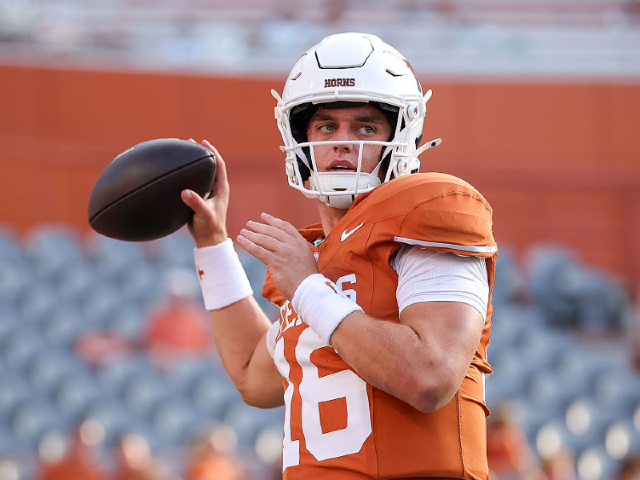
Arch Manning laughed at an AI meme during a Monday press conference — and female sports journalists immediately erupted in outrage.
The Texas quarterback was asked whether he’d seen any viral memes following his team’s three-score comeback against Ohio State on Saturday night. Manning laughed and said yes — specifically recalling an AI-edited video showing his head coach, Steve Sarkisian, slapping ESPN sideline reporter Holly Rowe.
The question itself reflected how deeply social media and meme culture have become embedded in college football, where viral moments now often overshadow the games themselves. Manning, a 21-year-old quarterback who has grown up in the social media era, appeared comfortable discussing internet culture alongside traditional football topics.
“I’ve seen a few AI edits and stuff, but that’s about it. I saw AI edits of Sark’s interview,” Manning said, drawing laughs from the assembled reporters.
“Have y’all seen that one? That’s a good one,” Manning continued while laughing. “Of him slapping Holly Rowe? That’s hilarious.”
“HAVE Y’ALL SEEN THAT ONE? THAT’S A GOOD ONE. OF HIM SLAPPING HOLLY ROWE? THAT’S HILARIOUS.” — ARCH MANNING
The meme followed Sarkisian’s bizarre post-game interaction with Rowe, where he abruptly blew off the interview, gave the “Hook em Horns” sign, and ran off to celebrate — leaving an exasperated Rowe fuming as she stormed off.
That interaction sparked a flurry of AI memes, including the video Manning referenced showing Sarkisian slapping Rowe.
The incident highlighted the growing tension between traditional sports journalism and the increasingly casual, meme-driven environment that younger athletes and fans inhabit online. What Manning and others in the room appeared to view as harmless internet humor quickly became a flashpoint for larger conversations about respect, professionalism, and the normalization of violence against women — even in fictional, digitally-altered contexts.
Manning and the reporters in the room got a kick out of it. Female sports journalists did not.
The swift backlash from established women in sports media revealed a generational and cultural divide over what constitutes acceptable humor in professional settings. For many female journalists who have spent years fighting for credibility and respect in male-dominated sports environments, the laughter surrounding a video depicting violence against a woman colleague represented more than just a joke gone wrong.
Apple TV MLB sideline reporter Tricia Whitaker called the video “despicable.”
“Imagine Holly Rowe’s face in that despicable AI video was your daughter’s. Your wife’s. Your sister’s. Still funny? This is gross on so many levels,” Whitaker wrote.
“And no, this isn’t people being ‘too sensitive’ or ‘easily offended.’ Joking about this in a room full of media members and seeing everyone laugh like this? Shame on you.”
Whitaker’s response anticipated the predictable counterargument that critics were overreacting, attempting to frame the issue as one of principle rather than sensitivity. Her invocation of family members was designed to personalize the impact and force those defending the humor to consider how they would feel if someone they loved were depicted in similar fashion.
NFL Network and ESPN reporter Stacy Dales piled on.
“Holly is an incredible journalist. If I were in her shoes, I’d cringe. But also, why is this normalized? It’s really not funny. Actually, there is nothing funny here,” Dales wrote.
Dales’ comment emphasized the professional reputation of Rowe, a veteran broadcaster widely respected in the industry, and questioned the broader cultural acceptance of such content. Her focus on normalization suggested concern that today’s AI-generated joke could desensitize people to real-world misconduct tomorrow.
NBC Sports college football insider Nicole Auerbach targeted the male reporters in the room: “the laughter from all the men in the room … so, so gross.”
Auerbach’s criticism shifted focus from Manning himself to the enablers — the professional journalists whose laughter validated and encouraged his comments. Her observation raised questions about the complicity of media members who are supposed to maintain professional standards.
Former ESPN host Linda Cohn called the laughing reporters “moronic hyenas.”
“To the moronic hyenas (likely grown men) laughing at the juvenile and irresponsible comment by Arch Manning, what if Holly was your sister, wife, mother or daughter?!?! Would you be laughing then?” Cohn wrote.
Cohn’s visceral language reflected the depth of frustration felt by many women who have worked in sports media for decades. Her attack on the reporters, rather than solely on Manning, underscored a belief that the real problem extended beyond one young athlete’s poor judgment to a systemic culture that tolerates and encourages such behavior.
Fan reaction was more mixed — though plenty of offended comments could be found among them as well.
The divide in fan responses mirrored broader cultural battles over comedy, cancel culture, and generational attitudes toward what constitutes harmful content. The controversy illustrated how AI-generated content, while technically fictional, carries real consequences in terms of workplace culture and public perception.
Manning has not yet publicly responded to the criticism.
You’re all welcome. Hookem. pic.twitter.com/7sRH9jQpIm
— Hookem 🤘 (@hookem) September 14, 2026
“I saw the AI Edit of (Sark) slapping Holly Rowe.”
I asked Arch Manning if he’d seen any edits on TikTok or Twitter after the game, and his answer is gold. pic.twitter.com/70FnNCVEHb
— Evan Vieth (@EvanVieth) September 14, 2026