
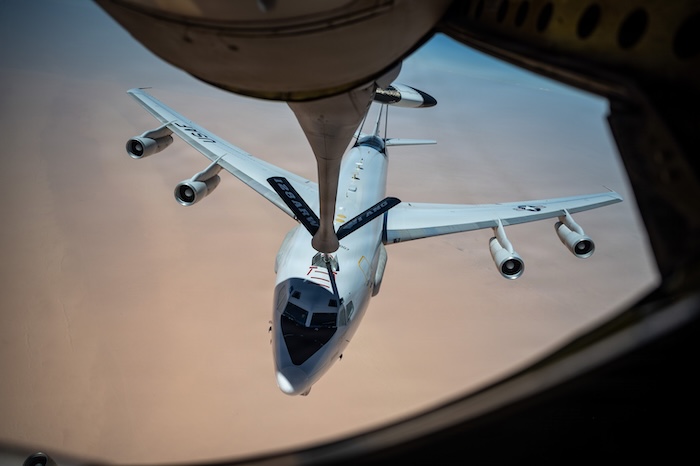
The Air Force is scrambling to repair or replace at least 42 aircraft lost or damaged during Operation Epic Fury — the U.S. war in Iran — while its maintenance and sustainment infrastructure was already strained to the breaking point before the first shot was fired.
At least four F-15E fighter aircraft were lost. Three were accidentally shot down by Kuwait in a friendly-fire incident. One was shot down by Iran, triggering a desperate search-and-rescue mission for the pilots. The Air Force also lost one A-10 Thunderbolt II, suffered one damaged F-35A Lightning II, lost an E-3 Sentry airborne early warning aircraft, lost about two dozen MQ-9 Reaper drones, and saw seven KC-135 Stratotanker aerial refueling aircraft destroyed or damaged, according to a Congressional Research Service report from May.
That total has climbed since then — an Army Apache helicopter was downed by an Iranian drone this month, and a B-52 Stratofortress crashed at Edwards Air Force Base in California, killing the crew of eight.
“It’s going to strain an already burdened maintenance and repair infrastructure within the Air Force. These are organizations that already are struggling with not enough spare parts, not enough people, challenges completing repairs on time, challenges with the infrastructure they have to complete those repairs. So it’s going to make an already difficult situation even harder.”
Diana Maurer, director of the Government Accountability Office’s Defense Capabilities and Management team, told the Washington Examiner the Air Force was already facing a crisis before the war — spare-parts shortages, staffing gaps, repair backlogs at depots.
Retired Lt. Gen. David A. Deptula, now dean of AFA’s Mitchell Institute for Aerospace Studies, said the hardest aircraft to replace is the E-3 Sentry, which coordinates theater air operations. Only 16 existed in the entire fleet before one was destroyed on the ground at Prince Sultan Air Base in Saudi Arabia.
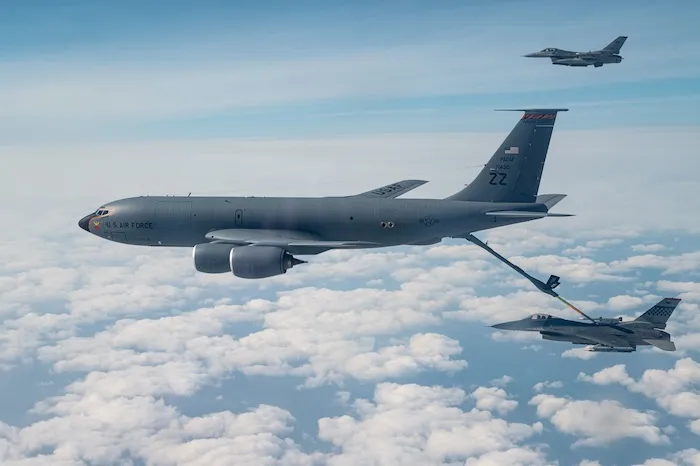
Deptula told the Washington Examiner only two crewed combat aircraft were lost in combat operations over Iran — one F-15E and one A-10. The rest of the losses over Iran were uninhabited MQ-9 drones flying without defensive systems in high-threat airspace. The remaining losses were due to friendly fire, a midair crash, and attacks against U.S. aircraft on the ground.
Two KC-135 Stratotankers went down over Iraqi airspace. One made an emergency landing. The other crashed, killing six troops on board. That was the only KC-135 destroyed outright. Air Force Secretary Troy Meink told lawmakers earlier this month the other six are believed salvageable.
Air Force Chief of Staff Kenneth Wilsbach said some of the six are already flying after repairs. The ones with significant damage will take a year or two to fix.
The Air Force is still flying the KC-135 aerial refueler — first deployed 70 years ago in 1956 — because its intended successor, the KC-46A Pegasus, has suffered continued problems. The latest budget proposal requests $3.9 billion to buy 15 KC-46A Pegasus tankers, an $800 million increase over fiscal 2026.
Meink told lawmakers that’s the max rate Boeing can produce the aircraft. Vice Chief of Staff John D. Lamontagne said the Air Force won’t finalize a deal for another 75 KC-46 refuelers until Boeing fixes deficiencies with the Remote Vision System, boom telescoping actuator, and fuel system leaks.
“Today, our airmen are meeting the mission, but are always doing so while managing significant strain. We are flying aircraft that, in many cases, are older than airmen who maintain them. We are operating at a high operations tempo across multiple theaters, and doing so while preparing to be ready for any future conflict.”
Wilsbach said the service is still flying the same KC-135s he flew as a young second lieutenant. He also defended the MQ-9 Reaper drone as a tremendous capability used for extremely high-risk missions the Air Force would never put a manned platform into. Despite the losses, he said the service is not in a crisis with the MQ-9 at the moment.
Retired Air Force Lt. Gen. Tom Miller, who served as deputy chief of staff for logistics, compared Air Force maintainers to a NASCAR pit crew — constantly practicing so they can fix the vehicle as quickly as possible during the race.
In fiscal 2019, 31% of aircraft maintenance ran into delays based on original target dates. That number jumped to 73% in fiscal 2024, according to a recent GAO report. Officials said a major factor was unplanned work not factored into original time frames.
The White House submitted a supplemental budget proposal to Congress on Wednesday calling for $67 billion for the Pentagon to cover the cost of the Iran war. The breakdown includes $17.3 billion for operational costs, without specifying how much would go to aircraft maintenance and repairs.
Both the House and Senate included a “right to repair” provision in the defense bill this year, giving the services more leeway to repair their own weapons and equipment instead of relying on defense contractors. Rep. Pat Harrigan, a former Green Beret and member of the House Armed Services Committee, said the provision is a readiness requirement, not a nice-to-have.