
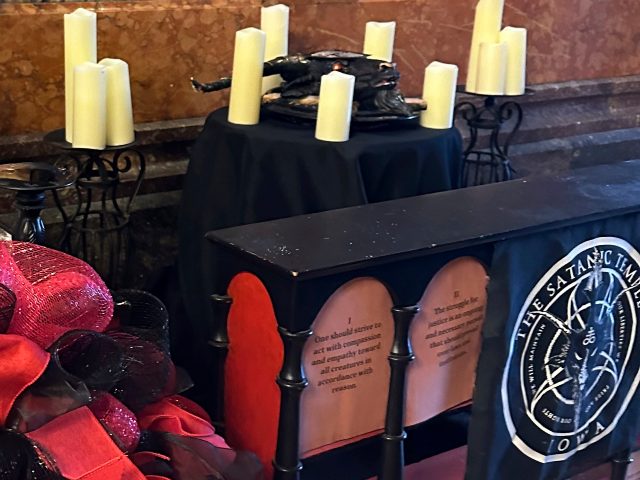
The American Civil Liberties Union of Iowa is joining forces with the Satanic Temple to sue state officials over denial of a proposed holiday event in the Iowa Capitol rotunda.
The lawsuit targets Iowa’s Department of Administrative Services Director Mark Campbell and forum Director Adam Steen, alleging they violated the temple’s rights by denying the event request.
The legal action raises questions about how state governments navigate the increasingly contentious territory of public forum access and religious expression in government buildings. Capitol rotundas and public spaces have traditionally been open to citizen groups under forum access policies, which are designed to ensure equal treatment regardless of viewpoint. When government officials deny access to one group while permitting others, constitutional questions of viewpoint discrimination can arise.
The proposed event would feature carol singing, crafts, and a Krampus costume contest — Krampus being a half-goat, half-demon figure from European folklore that punishes misbehaving children at Christmas.
The Krampus tradition, which originates from Alpine regions of Europe, has seen a cultural resurgence in recent years in the United States, with various communities hosting Krampus-themed events during the holiday season. The folklore figure represents the darker counterpart to Saint Nicholas in Central European Christmas traditions.
“The lawsuit arises from state officials repeatedly denying the group permission to have a family-friendly winter holiday event in the Iowa Capitol rotunda on the same basis as other religious and civic groups.”
Matt Kezhaya, general counsel for The Satanic Temple, claimed officials were concerned about the costume contest aspect.
“The state said that we were going to beat children with sticks because we were going to have a costume contest which involved people holding sticks,” Kezhaya stated. “The local congregation of TST Iowa was very emphatic that wasn’t going to happen. For reasons not subject of judicial admissions, they just would not budge from that position.”
The dispute highlights the challenge government officials face when evaluating event proposals for security and appropriateness while avoiding content-based discrimination. State officials must balance legitimate safety concerns with constitutional requirements to provide equal access to public forums regardless of the popularity or controversy surrounding particular viewpoints.
The Satanic Temple has a recent history of targeting Iowa’s Capitol. In December 2023, the group set up a holiday display honoring the occult deity Baphomet inside the Iowa Statehouse.
That display became a flashpoint in the broader national debate over religious pluralism in government spaces. The incident drew widespread attention and sparked conversations about the limits of religious accommodation in public buildings, with some arguing that equal access principles require inclusion of all faith perspectives, while others contend that certain expressions cross beyond the bounds of community standards.
Christian U.S. Navy veteran Michael Cassidy was charged with a hate crime after beheading that statue in what he described as an effort to “awaken Christians to the anti-Christian acts promoted by our government.”
Cassidy, who turned himself in to officers at the building, said Christians shouldn’t “submissively accept the legitimization of Satan.”
“None of the founders would have considered government sanction of Satanic altars inside Capitol buildings as protected by the First Amendment. Anti-Christian values have steadily been mainstreamed more and more in recent decades, and Christians have largely acted like the proverbial frog in the boiling pot of water.”
His actions and subsequent legal consequences reflect the deep divisions over how First Amendment protections should be applied in practice. The hate crime charges against Cassidy raised additional questions about whether destruction of religious displays constitutes bias-motivated criminal conduct, and whether such prosecutorial decisions are applied consistently across different religious traditions.
The ACLU has shown a pattern of targeting religious expression on public property. The organization recently joined a legal fight to block statues of Catholic saints in Massachusetts.
The civil liberties organization has increasingly involved itself in cases involving religious symbols and displays on government property, arguing that such litigation protects the separation of church and state. Critics, however, contend that the ACLU’s selective advocacy reveals an ideological bias against traditional religious expression while championing controversial alternatives.
The Satanic Temple, meanwhile, openly embraces pro-abortion activism. The group has opened abortion clinics and promotes what it calls “abortion rituals” — including one clinic launched on President Trump’s birthday in Maine.
The organization describes itself as a non-theistic religious group that uses Satanic imagery to promote secularism and challenge what it views as religious overreach in public policy. This approach has made the temple a lightning rod in culture war battles, with supporters viewing it as defending pluralism and critics seeing it as deliberately provocative.
Iowa Christians are now facing another round of legal pressure to accept Satanic displays alongside traditional Christmas celebrations in their state Capitol.
The outcome of this lawsuit could have implications beyond Iowa, potentially setting precedents for how other states handle similar requests for public forum access during holiday seasons. As communities across America grapple with increasing religious diversity and competing visions of pluralism, government officials find themselves navigating complex constitutional terrain with significant cultural and political ramifications.
The Satanic Temple has set up an altar at the Iowa State Capitol building…..
What's your thoughts on this..? #WeWantAnswers pic.twitter.com/wSIXGbT3kf
— Isaac’s Army (@ReturnOfKappy) December 12, 2023
BREAKING: @RepubSentinel can reveal that Michael Cassidy, a Christian and former military officer, tore down and beheaded the Satan altar in the Iowa Capitol:https://t.co/rIYIdZOzee pic.twitter.com/tZDsmKM5Pm
— The Sentinel (@RepubSentinel) December 14, 2023