President Trump just delivered $64 billion in savings to Medicaid programs across all 50 states, Washington DC, and Puerto Rico — forcing pharmaceutical companies to extend the same rock-bottom prices he negotiated for federal programs to state budgets drowning in health care costs.
The move represents one of the most significant federal interventions in state-level healthcare spending in recent history, addressing a longstanding challenge that has strained state budgets for decades. Medicaid, which provides health coverage to low-income Americans, is jointly funded by states and the federal government, with prescription drug costs representing one of the fastest-growing components of state healthcare expenditures. Many states have faced difficult choices between maintaining Medicaid coverage levels and funding other critical programs like education and infrastructure.
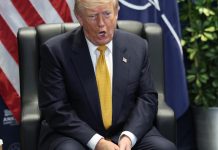
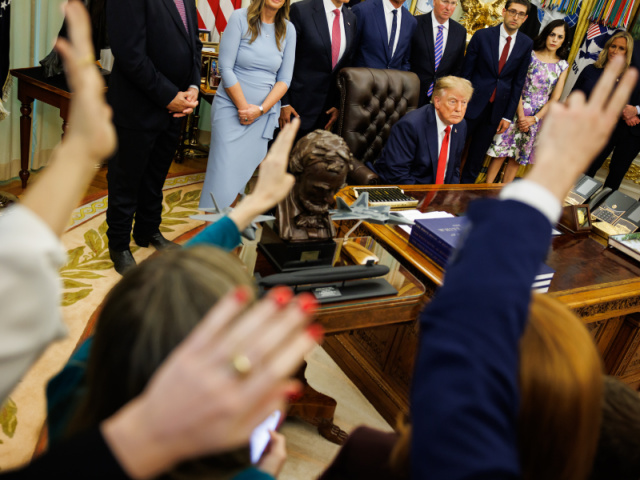
Trump announced the action in the Oval Office Friday.
“This will save states billions and billions of dollars per year on drugs and allow them to invest those savings in providing better health care and higher quality service for the American people.”
State Medicaid programs will receive rebates from pharmaceutical companies through the GENEROUS Medicaid Payment Model, according to the White House. The rebates ensure the final price to Medicaid does not exceed the most-favored-nation (MFN) price on expensive brand-name drugs.
The most-favored-nation pricing concept has been a cornerstone of Trump’s pharmaceutical pricing strategy, leveraging the principle that American taxpayers should not pay more for medications than patients in other developed nations. This approach has been controversial in pharmaceutical industry circles but has gained traction as a method to address the disparity in drug prices between the United States and countries with nationalized healthcare systems. By extending this framework from federal programs to state Medicaid operations, the administration is effectively nationalizing the pricing leverage across the entire public healthcare apparatus.
Since late September 2025, Trump has reached deals with 26 pharmaceutical companies to lower prescription drug prices. The list includes Eli Lilly, Novo Nordisk, AstraZeneca, Merck, Johnson & Johnson, Pfizer, Gilead Sciences, Regeneron, Sanofi, AbbVie, and Amgen.
These companies represent the dominant players in the American pharmaceutical market, manufacturing many of the most expensive medications that consume significant portions of Medicaid budgets. The participation of these major manufacturers suggests the administration was able to create sufficient incentive or pressure to bring the entire industry to the negotiating table, rather than facing a fragmented response that could have undermined the program’s effectiveness.
Trump told reporters the Council of Economic Advisers estimates the most-favored-nation deals being extended to states will save Medicaid over $64 billion.
He added he thinks savings “could be $100 billion.”
“Every state will now have the ability to use those extra billions of dollars to invest in other healthcare improvements or something else,” Trump said.
The potential for states to redirect these savings addresses a critical flexibility issue in state budgeting. Unlike federal categorical grants that must be spent on specific purposes, these savings would free up general fund dollars that state legislatures can allocate according to their priorities, whether that means expanding healthcare access, addressing workforce shortages in medical fields, or reducing budget deficits.
Centers for Medicare and Medicaid Services Administrator Dr. Mehmet Oz said the program is “rescuing state budgets.” He stressed that all states — including ones run by Democrats — are taking the deal.
“It is such a good deal that every state realized they need to take it.”
The bipartisan participation is particularly notable given the polarized political environment, suggesting that the fiscal benefits of the program transcend partisan concerns. States facing budget pressures have limited options for generating immediate savings of this magnitude, making the pharmaceutical rebates an attractive proposition regardless of political leadership or policy preferences on other healthcare issues.
The announcement marks a major expansion of Trump’s pharmaceutical pricing strategy, delivering the same leverage he used to force drug companies into federal deals directly to state Medicaid budgets.
.@POTUS: "Thank you all for being here today as we take historic action to officially extend the benefits of our Most Favored Nation agreements on prescription drug prices to state Medicaid programs all across the nation." pic.twitter.com/rWxdU6rs6i
— Rapid Response 47 (@RapidResponse47) September 18, 2026
.@POTUS: "@CEA47 estimates that the Most Favored Nation deals that we're extending to states today will save Medicaid over $64 billion… Every state will now have the ability to use those extra billions of dollars to invest in other healthcare improvements." https://t.co/0MZl0zhTsL pic.twitter.com/XE10Syxh3j
— Rapid Response 47 (@RapidResponse47) September 18, 2026