
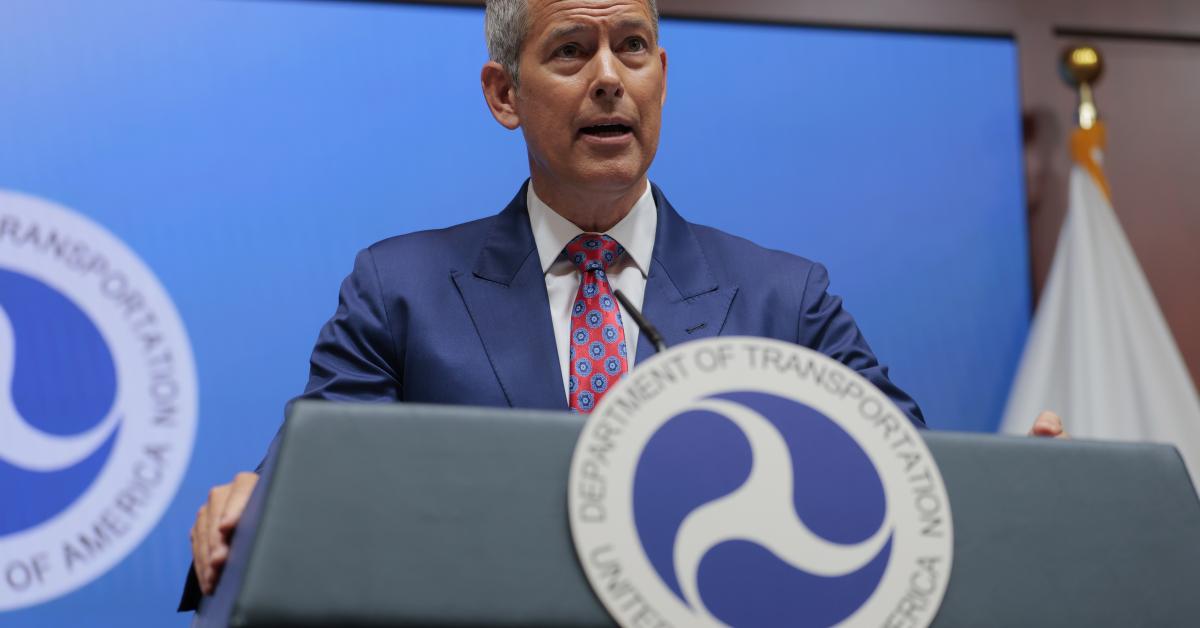
Transportation Secretary Sean Duffy just pulled the plug on one of the most wasteful infrastructure projects in American history — and redirected $2 billion straight into upgrading Amtrak trains and closing dangerous rail crossings nationwide.
The decision marks a dramatic shift in federal transportation policy, ending more than a decade of federal investment in a project that has come to symbolize the challenges of large-scale infrastructure development in the United States. It also signals the Trump administration’s willingness to make politically difficult decisions about where limited federal dollars should flow.
California’s high-speed rail project, championed for years by Gov. Gavin Newsom, ballooned from a $33 billion initial cost estimate to a staggering $231 billion price tag. More than a decade later, not a single mile of track has been laid.
The project was originally approved by California voters in 2008 through Proposition 1A, which authorized $9 billion in general obligation bonds. At the time, proponents promised a transformative transportation system that would revolutionize travel between California’s major metropolitan areas. The vision was compelling: passengers zipping between Los Angeles and San Francisco in under three hours, reducing highway congestion and carbon emissions while creating thousands of jobs.
But the reality proved far more complicated. The project faced continuous legal challenges, environmental reviews, land acquisition disputes, and engineering complexities that repeatedly delayed construction and inflated costs. What began as an ambitious but seemingly achievable goal gradually transformed into what critics now call a cautionary tale of governmental overreach and mismanagement.
Duffy announced Friday that $5.3 billion in new Federal Railroad Administration investments will flow to projects that actually deliver results — and nearly half of that funding comes from savings generated by ending federal support for California’s failed venture.
“I would love to see America have high-speed rail. I’m an advocate of it and for it. But when California has an initial cost estimate of $33 billion, but over the course of more than a decade, they don’t lay one track. And by the way, the cost projection now for that rail is $231 billion. Listen, we’re not going to invest in projects that don’t deliver for the American people.”
That’s the Trump administration’s new infrastructure philosophy in action: put taxpayer dollars where they produce results, not where they vanish into bureaucratic black holes.
The approach represents a fundamental rethinking of how the federal government evaluates infrastructure investments. Rather than focusing solely on the ambition or potential of proposed projects, the administration is prioritizing demonstrated progress and realistic timelines. This performance-based model stands in stark contrast to previous federal funding approaches that often rewarded projects based on political considerations or theoretical benefits rather than concrete deliverables.
The redirected funding will close over 30 train crossings and upgrade more than a thousand with new safety infrastructure and technology. Duffy told Just the News that vehicle-train collisions at crossings are one of the most dangerous rail safety hazards — eliminating and upgrading these crossings will save lives.
These grade crossing improvements address an urgent public safety crisis that has persisted for decades across America’s rail network. Unlike the visionary but unrealized promise of high-speed rail, crossing upgrades deliver immediate, measurable benefits to communities nationwide. The contrast underscores Duffy’s central argument: that practical improvements serving Americans today should take precedence over perpetually delayed mega-projects.
The package also includes purchasing 43 Made-in-America trainsets to replace Amtrak’s aging fleet and overhauling 41 locomotives currently serving Amtrak’s Midwest and Pacific routes.
These investments in existing rail infrastructure will modernize service on routes that millions of Americans already depend on for daily transportation. The emphasis on domestic manufacturing also addresses long-standing concerns about supply chain resilience and American industrial capacity, creating jobs while upgrading transportation assets.
Duffy explained the shift reflects a broader rethinking of how Washington spends on infrastructure.
“Our infrastructure is rated at about a C-minus, and we should have A infrastructure in America.”
California’s high-speed rail disaster became a symbol of progressive government incompetence — endless cost overruns, years of delays, and zero tangible progress. Newsom promised voters a sleek bullet train connecting Los Angeles and San Francisco. Instead, they got a fiscal sinkhole that consumed billions with nothing to show.
The failure carries lessons that extend far beyond California’s borders. It demonstrates how even well-intentioned infrastructure initiatives can collapse under the weight of regulatory complexity, political interference, and unrealistic planning. For other states considering similar ambitious projects, California’s experience now serves as a sobering case study in the gap between aspirational goals and executable plans.
The Trump DOT is cutting the cord.
Real projects. Real deliverables. Real accountability. That’s the new standard — and California just learned the hard way what happens when you fail it.