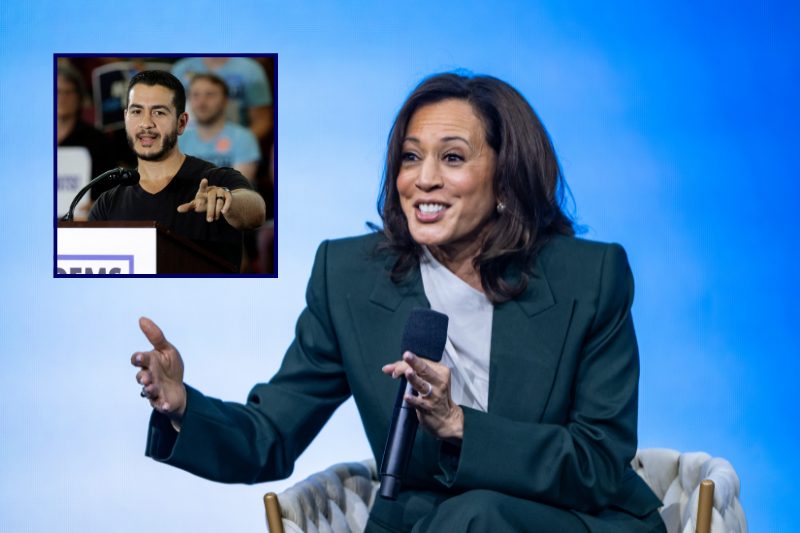
Kamala Harris endorsed Abdul El-Sayed, the progressive Democrat nominee in Michigan’s U.S. Senate race, signaling the Left’s embrace of a candidate whose primary became a proxy for the party’s ongoing civil war between centrists and Democratic Socialists.
The endorsement from Harris, who as vice president has carefully navigated the Democratic Party’s ideological divides, represents a significant moment in the broader debate over the party’s direction. Her decision to back El-Sayed over the moderate alternative reinforces a growing willingness among national Democrats to rally behind progressive candidates in competitive general election races, even when those candidates emerge from contentious primaries that exposed deep fissures within the party coalition.
El-Sayed, who narrowly defeated centrist Representative Haley Stevens in this week’s primary, faces Republican Mike Rogers in November.
The primary battle itself was hard-fought and at times bitter, with both candidates making the case that they represented the best path forward for Democrats seeking to reclaim Senate control. Stevens argued throughout the race that her centrist positioning and proven electoral track record in her congressional district made her the safer bet in a state that Trump carried just two years ago. El-Sayed, meanwhile, contended that an energized progressive base and a bold economic message would be necessary to turn out the Democratic voters needed for victory in a midterm environment.
“Dr. Abdul El-Sayed understands that the power is with the people, and that the stakes couldn’t be higher in this election,” Harris said in a Friday statement. “While Michiganders struggle to afford everyday essentials — housing, gas, groceries, health care, and child care — Trump and Republicans in Congress are giving away $1 trillion in tax breaks to the wealthy and powerful.”
Harris lamented what she called “crises facing America’s working families,” vowing to help El-Sayed “ensure we win a Democratic Senate majority in November.”
The vice president’s emphasis on kitchen-table economic issues in her endorsement statement reflects a deliberate effort to frame El-Sayed’s progressivism not as ideological extremism but as practical advocacy for working-class families. This approach mirrors the broader Democratic messaging strategy heading into the midterms, which seeks to pivot from cultural controversies to pocketbook concerns that pollsters suggest resonate most strongly with swing voters.
El-Sayed, the child of Egyptian immigrants who lost the 2018 Michigan gubernatorial primary to Gretchen Whitmer, racked up endorsements from the party’s progressive wing: Bernie Sanders, Elizabeth Warren, Alexandria Ocasio-Cortez, Rashida Tlaib, and Chris Van Hollen.
His 2018 gubernatorial campaign established El-Sayed as a prominent voice in progressive politics and built a fundraising and volunteer infrastructure that proved valuable in this Senate primary. That earlier race also demonstrated both his appeal to younger, more liberal voters and the challenges he faces in winning over moderate Democrats and independent voters who comprise a critical segment of Michigan’s electorate.
Stevens, by contrast, drew support from retiring incumbent Senator Gary Peters, former Senator Debbie Stabenow, and former House Speaker Nancy Pelosi — the centrist establishment bench.
The endorsement lineups on both sides illustrated the persistent divide within the Democratic Party between those who believe the path to victory runs through mobilizing the progressive base and those who argue that appealing to moderate swing voters in suburban and rural areas remains essential. This tension has played out in Democratic primaries across the country and shows no signs of abating as the party seeks to define its identity in the Trump era.
The candidate hailed Harris’s backing on social media, framing the race as part of a broader fight against Trump.
Vice President @KamalaHarris understands the key role control of the US Senate plays in lowering prices for Michiganders and holding Trump accountable. To achieve a Senate majority in 2026, we need to win Michigan, and that means beating Mike Rogers. Trump and his allies prey on… pic.twitter.com/su28YGoC80
— Dr. Abdul El-Sayed (@AbdulElSayed) August 7, 2026
“Trump and his allies prey on our divisions—which is why it’s so important to bring communities together right now,” El-Sayed wrote. “Her support in this race is critical to building an unstoppable coalition against Rogers, Trump, and their assault on our rights and democracy.”
He called Rogers “Trump’s minion.”
The sharp rhetoric directed at both Rogers and Trump reflects El-Sayed’s strategy of nationalizing the race and tying his Republican opponent directly to the former president, whose popularity in Michigan remains a subject of intense debate among political strategists. While Trump carried the state in 2024, his margin was relatively narrow, suggesting vulnerability that Democrats hope to exploit.
Republicans currently hold 53 Senate seats. Democrats control 43, plus two Independents who caucus with them. Democrats need to flip four seats to claim a majority in the final two years of Trump’s presidency.
The mathematical challenge facing Democrats is steep but not insurmountable, and party leaders have identified Michigan as one of their most promising pickup opportunities. Control of the Senate would give Democrats significant leverage to block Trump’s legislative agenda and judicial appointments, raising the stakes of races like this one considerably.
Trump won Michigan in 2024, but Rogers lost the state’s open Senate race that year to Democrat Elissa Slotkin.
Rogers’s previous statewide defeat raises questions about his viability as a candidate, though Republicans argue that the political environment has shifted in their favor since that loss. His name recognition and fundraising capacity remain formidable advantages in what is expected to be one of the most expensive Senate races in the country.
The Michigan contest is one of the most closely watched battlegrounds as both parties eye control of the upper chamber heading into 2026 midterms.