
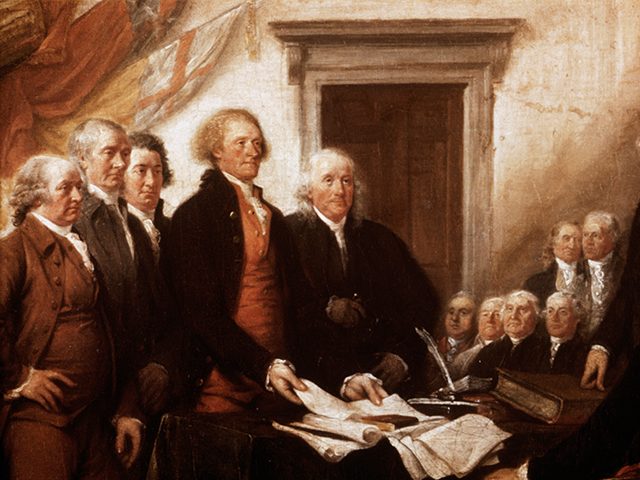
The Declaration of Independence wasn’t just a political statement against King George. It was an economic revolt — and the Founders’ grievances against Britain sound shockingly familiar to the battles conservatives fight today.
The rising rhetoric and relentless reasoning of the Declaration of Independence retain as much power to inspire as they had back in July of 1776. The audacity of the argument for American independence based on the deepest principles — and the almost miraculous brevity in which Thomas Jefferson set them forth — have made it one of the most celebrated political statements in history.
But the Declaration did more than set forth philosophic principles of political democracy.
It also enumerated the trespasses of the British government that necessitated the dissolution of its political bonds to the American colonies — the particular grievances that justified the revolution. The list of injuries and usurpations gets far less attention, but understanding it is crucial to understanding the meaning of America.
Among the 27 particular grievances, four of them were broadly economic in nature.
The founding fathers complained that Britain had kept them economically dependent by denying the colonies control of migration, land settlement, trade, and taxation. They complained that British government officials were living off their labor and harassing their businesses.
“He has endeavoured to prevent the Population of these States… obstructing the Laws for Naturalization of Foreigners”
“He has erected a multitude of new Offices, and sent hither swarms of Officers to harass our people… to eat out their substance”
“For cutting off our Trade with all parts of the world”
“For imposing Taxes on us without our Consent”
These economic causes that animated the Founders — control of taxes, control of immigration policy, control of trade policy, limiting the growth of government — echo through our politics today.
The July 4th Declaration not only makes the economic case for political independence but also the political case for economic independence.
What these complaints show us is that the American colonists had learned that they could not depend on a far-off power for reasonable economic policies that would encourage prosperity and growth but would have to look out for themselves.
They had to stop being colonists in the Americas and become Americans.
It was a declaration of economic sovereignty as well as political sovereignty. The Declaration was our announcement that from now on, when it came to the governments and the economies of the American states, America would come first.
Just as the British did not welcome this announcement of sovereignty in 1776, the U.S. today faces international resistance to our independence. Many around the world — and quite a few at home, unfortunately — regard our kind of patriotic independence as fundamentally illegitimate or just old-fashioned.
They seek a kind of recolonization of the U.S., demanding that we submit to an international rules-based order which would render us economically dependent on foreign production and deprive us of control over our borders.
They aren’t sending Red Coats to shoot us, but the message is the same demand for submission of our interests and liberties.
The central injury — the fourteenth of 27 — is telling. It is the complaint that the British have been quartering large bodies of armed troops among us. To the founding generation, quartering meant billeting soldiers among civilians, forcing a civil community to house, supply, and live under the presence of troops.
It was an invasion of the property rights of Americans and a forcible reminder that we lacked sovereignty.
Why was this at the heart of the list? Because our forefathers understood that if we were going to rise above colonial dependence, we needed to be free from the mechanisms of foreign control.
There is also something even more profound and more fundamental that we can glimpse while reviewing the forgotten back half of the Declaration. The list of injuries and usurpations is itself a statement that the bounties of the American economy do not belong to the xenoarchists — those who would rule us from abroad.
Our government and our economy should be arranged so that our lives and our fortunes are most our own. And the reason for that, as the Declaration explains, is that we are not a race made for service to our betters but men and women created equal to their princes and principalities.
Herman Melville alluded to this in Moby Dick, when his narrator explained why his book would ascribe to the meanest mariners, renegades, and castaways qualities both high and dark.
“But this august dignity I treat of, is not the dignity of kings and robes, but that abounding dignity which has no robed investiture. Thou shalt see it shining in the arm that wields a pick or drives a spike; that democratic dignity which, on all hands, radiates without end from God Himself!”
It’s a tune we’ve never really stopped humming as we Americans march through history.
Tom Joad says in John Steinbeck’s The Grapes of Wrath: “I been a-wonderin’ why we can’t do that all over. Throw out the cops that ain’t our people. All work together for our own thing.”
On Independence Day, we are called to remember that the cause of throwing out and keeping out the cops that aren’t our people is never done.
Every generation has to do that all over.
The Declaration of Independence was not merely a political revolt against monarchy or a statement of political principle. It was an economic revolt against imperial dependency. The colonists objected to being denied control over the basic conditions of prosperity: migration and settlement, land development, export markets, taxation, and the administrative burden of imperial rule.
We decided that our country of renegades and castaways deserved its equal place among the nations of the earth.
In modern terms, the Declaration’s economics were America First economics: the right of Americans to govern the American economy for their own flourishing.