
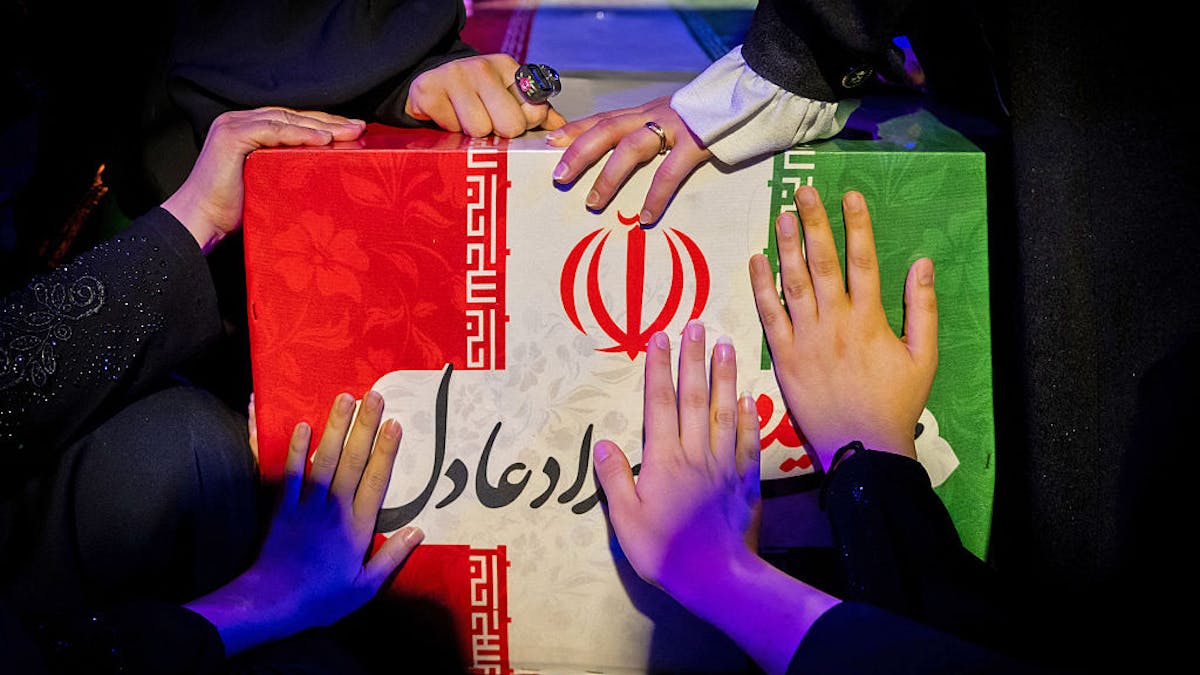
The Iranian regime is staging a massive funeral for former Supreme Leader Ali Khamenei — and using the moment to openly threaten President Donald Trump’s life.
Members of Iran’s Assembly of Experts declared over the weekend that anyone who gains access to Trump is obligated to “send them to hell,” according to Daily Wire reporting. Israeli Prime Minister Benjamin Netanyahu was also named in the death threat.
“Anyone who gains access to the two leaders is obligated to ‘send them to hell.'”
The assassination directive came as Iranian authorities prepare for what they claim will be one of the most widely attended funerals in history. The regime is rallying mourners under the slogan “We Must Rise” in ceremonies spanning Iran and Iraq over several days beginning Friday.
Iranian President Masoud Pezeshkian urged citizens “of every ethnicity, religion, preference and political tendency” to attend, explicitly linking turnout to the image Iran hopes to project internationally.
“Your widespread presence will be a decisive response to the logic of terrorism, violence, and bullying, and a clear message to the world that the Iranian nation stands united and in solidarity in defending its independence and dignity,” Pezeshkian said Thursday.
Iran’s parliament speaker, Mohammad Bagher Ghalibaf, framed funeral attendance as an act of revenge for Khamenei’s death.
“The nation’s call for vengeance must ring in the ears of the whole world,” Ghalibaf said.
After lying in state in Tehran, Khamenei’s body will be taken to the Shiite holy cities of Najaf and Karbala before returning to Iran for ceremonies in Qom and a July 9 burial at the Imam Reza Shrine in Mashhad. Iranian authorities estimate turnout could reach tens of millions.
The scale reflects the regime’s desire to demonstrate popular support following its massacre of thousands of anti-regime protesters and the war that claimed the former leader’s life.
One major question remains whether Iran’s current supreme leader, Mojtaba Khamenei, will appear publicly during the ceremonies. The son of Ali Khamenei reportedly suffered injuries in the attack that killed his father and has not been seen publicly since assuming power.
The attack also reportedly killed Mojtaba Khamenei’s wife, Zahra Haddad-Adel, along with Ali Khamenei’s wife, a daughter, a son-in-law, and a grandchild.
The government is undertaking an enormous logistical operation to accommodate the expected crowds. Officials have established massive parking areas outside Tehran, arranged buses to transport mourners into the capital, and opened military barracks and schools to house visitors arriving from across the country, according to The New York Times.
Foreign delegations from more than 30 countries are expected to attend, though the list of sitting world leaders appears limited. Pakistani Prime Minister Shehbaz Sharif and Tajikistani President Emomali Rahmon are expected to be among the highest-profile attendees, according to The Jerusalem Post. China announced that senior lawmaker He Wei will attend, while India said it would send its deputy foreign minister and a state governor.
Former Russian president Dmitry Medvedev will attend as a special envoy for Russian President Vladimir Putin, according to the Moscow Times.
The expected crowds have drawn comparisons to the 1989 funeral of Ayatollah Ruhollah Khomeini, the founder of the Islamic Republic. An estimated 10 million people attended the funeral, making it one of the largest public gatherings in modern history.
That funeral reportedly descended into chaos as mourners surged toward Khomeini’s coffin, causing his body to fall from it. Security forces fired warning shots to disperse the crowd, and at least eight people were killed in the crush.
The 2020 funeral of Qasem Soleimani also drew millions before a stampede killed dozens of mourners.
Khamenei will be buried inside the Imam Reza Shrine in Mashhad rather than in a dedicated mausoleum. The timing is also unusual, as Islamic tradition generally calls for burial as soon as possible after death. The more than four-month gap between his death and burial reflects the turmoil that followed the war and the challenges Iran faced in organizing a funeral during wartime.
Even as indirect negotiations continue, Iranian officials have used the lead-up to the funeral to issue fresh threats. Ali Abdollahi, commander of Iran’s Khatam al-Anbiya Central Headquarters, warned of a “harsh retaliation” against any attack.
Iran’s Assembly of Experts now appears to be openly calling for the assassination of the sitting U.S. president.