
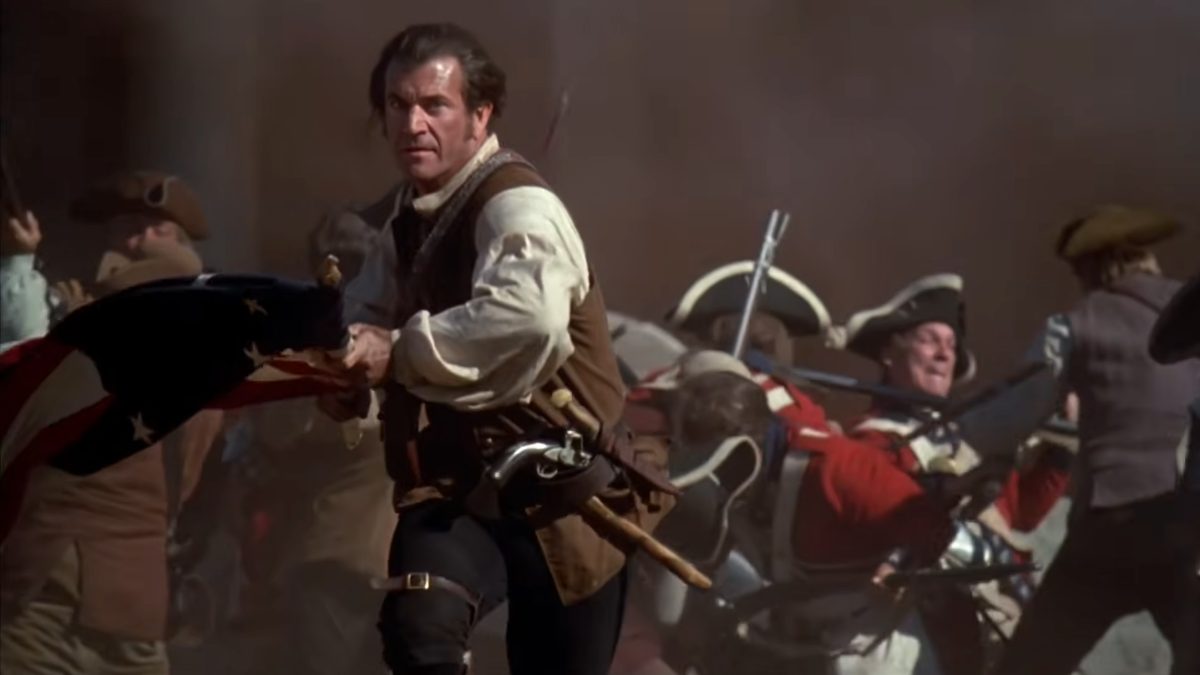
As America celebrates its 250th birthday, patriots looking for the right film to mark the moment have one clear choice: The Patriot.
The 2000 Mel Gibson film remains the best modern depiction of America’s Revolutionary War — and despite a quarter-century of criticism over historical liberties, recent scholarship confirms the movie got far more right than Hollywood’s critics want to admit.
The Patriot fills a glaring gap in American cinema. Unlike the Civil War, which inspired countless major films, the Revolutionary War has been largely ignored by Hollywood. The battles were smaller — Bunker Hill involved fewer than 6,000 soldiers total, with about 1,500 casualties. Gettysburg, by contrast, involved more than 150,000 soldiers and 50,000 casualties.
The Revolution’s signature moments were political events — the Declaration of Independence, French diplomatic alliances — not the kind of spectacle that fills theater seats.
So Roland Emmerich’s film focused on something more visceral: guerrilla warfare. Gibson’s character is a composite of several real Revolutionary fighters, including Francis Marion (the “Swamp Fox”), Thomas Sumter, Daniel Morgan, and Andrew Pickens.
The $110 million film grossed $215 million and earned three Academy Award nominations.
Critics immediately attacked the film for portraying British troops as war criminals. The villain, Colonel William Tavington — based on the real-life Banastre Tarleton — orders rebel wounded executed, shoots a child in the back, and burns colonial civilians alive in a church.
There’s no historical record of that church-burning. But Alan Pell Crawford’s recent book This Fierce People: The Untold Story of America’s Revolutionary War in the South confirms that Tarleton himself was brutal and merciless. He executed surrendering colonists on multiple occasions, refused to punish soldiers who raped local women, and destroyed civilians’ homes — including Thomas Sumter’s.
British politician Horace Walpole, who knew Tarleton as a student, wrote: “Tarleton boasts of having butchered more men and lain with more women than anybody.”
The film shows how Americans actually won the war — not by defeating the British in pitched battle, but by refusing to surrender. Guerrilla warfare in the South kept the British frustrated for years. Francis Marion really did operate from a hideout called Snow’s Island, high ground in the middle of a South Carolina swamp.
The Patriot tells a distinctly American story. A man who would prefer not to fight is given just cause when the British destroy his home, confiscate his livestock, and kill one of his children. Countless American colonists faced that same choice during the eight-year conflict, as British and Hessian troops routinely mistreated them.
The film prioritizes God and family. It’s about people who yearned for self-government. And despite some historical implausibility, it’s even a story about freedom being extended to black Americans.
“Whatever its embellishments and inaccuracies, these are noble aspirations indeed.”
The Patriot stands up 25 years later and contains more historical truth than its detractors admit. This summer, above all others, it’s worth a revisit.