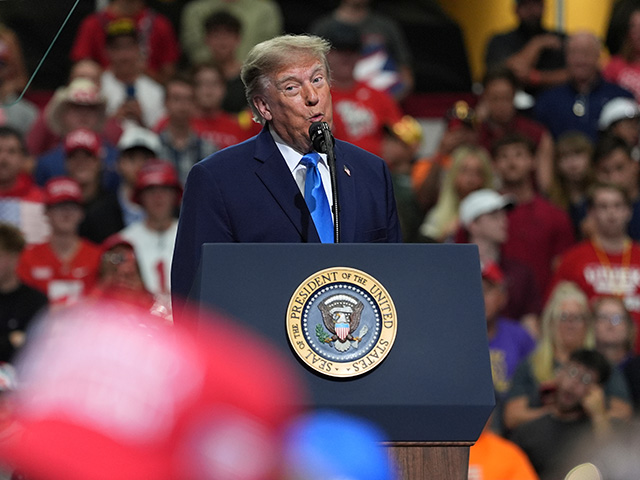
President Donald Trump fired up Republicans at a Saturday rally in Ohio with a profane promise about the upcoming midterms — if patriots show up to vote, the legacy media and Democrat pollsters are in for a rude awakening.
The rally comes at a critical juncture for Republican candidates across the country, as both parties pour resources into what many political analysts are calling one of the most consequential midterm elections in recent history. Trump’s appearance in Ohio signals the state’s continued importance to GOP electoral strategy, particularly as Republicans work to maintain and expand their influence in traditional battleground territory.
“They’re in for a big surprise,” Trump said, gesturing toward the press section at the back of the venue. “You gotta — it’s very simple, you got to get out and vote. You got to get out. You got to vote for these guys.”
“If you do that, we’re gonna win big and we’re going to shove it up their ass.”
The crowd erupted. Trump wasn’t countering poll numbers — he was ignoring them entirely, betting instead on the ground game the mainstream press refuses to see.
This approach reflects a broader Republican strategy that has taken shape since Trump’s rise in politics — one that openly questions the reliability of traditional polling methodologies and emphasizes grassroots enthusiasm over survey data. The former president has long maintained that mainstream polls systematically undercount his supporters, a claim that gained traction after polling misses in previous election cycles surprised political observers.
The Ohio rally just north of Dayton was part of Trump’s month-long campaign blitz — rallies in battleground states to fire up GOP candidates facing tough midterm races. While the Hill and other legacy outlets obsess over his approval rating (38.5 percent, according to Decision Desk HQ), Trump’s betting on a different metric: packed arenas and voters the pollsters never call.
The contrast between crowd size and polling data has become a recurring theme in Trump’s political messaging. His campaign events consistently draw thousands of supporters, creating a visible disconnect between the energy on the ground and the numbers reported in national surveys. This discrepancy fuels the argument among conservative activists that traditional polling fails to capture the true sentiment of the American electorate, particularly in rural and working-class communities where Trump’s support runs deepest.
The Hill framed the midterms as a “challenging road ahead” for Republicans, citing Iran war fatigue, economic concerns, and fresh polling showing Democrats competitive in Senate battlegrounds and “right-leaning” states. A Quinnipiac University poll found 51 percent of registered voters want Democrats to take the House, with only 39 percent backing Republicans.
That same poll found nearly two-thirds of respondents critical of Trump’s handling of the economy and foreign policy.
These polling figures paint a picture that stands in stark contrast to the atmosphere at Trump rallies, where supporters express unwavering confidence in Republican prospects. The disconnect raises fundamental questions about political forecasting in an era of deep partisan division, where voters increasingly consume news from ideologically aligned sources and may be less likely to participate in traditional polling or provide candid responses to pollsters they view as part of a hostile media establishment.
Trump’s response? Show up anyway. The former president has spent two years telling Republicans the polls are rigged, the media lies, and the only number that matters is Election Day turnout.
This message of skepticism toward institutional data sources resonates with a Republican base that has grown increasingly distrustful of mainstream media and polling organizations. By framing the election as a contest between ordinary voters and an out-of-touch political establishment, Trump aims to motivate supporters who might otherwise be discouraged by unfavorable polling numbers. The strategy relies on converting enthusiasm into actual votes, transforming rally attendance into ballot box results.
Senate candidate Bernie Moreno, who appeared at the rally, hammered Democrats on voter ID laws — calling nationwide no-ID voting the left’s “dream.”
Moreno’s focus on election integrity reflects another pillar of the Republican midterm message, as concerns about voting procedures remain a powerful mobilizing force for conservative voters. The issue has become intertwined with broader debates about election security and access, with Republicans arguing that commonsense safeguards are necessary while Democrats characterize such measures as voter suppression.
If Trump’s right about turnout, the legacy media won’t just be surprised. They’ll be scrambling to explain how they missed it again.
The stakes of this bet are significant. A Republican performance that exceeds polling expectations would validate Trump’s longstanding criticism of survey research and media coverage, potentially reshaping how campaigns and journalists approach future elections. Conversely, results that align with current polling would undermine the turnout-over-surveys theory that has become central to Trump’s political brand. Either outcome will likely influence Republican strategy heading into the next presidential cycle.
Trump "You gotta vote for these guys. Just get out and vote. If you do that, we’re gonna win big."
And we’re gonna SHOVE IT UP THEIR ASS, okay pic.twitter.com/WdBQIJrdXM
— D. Scott @eclipsethis2003 (@eclipsethis2003) October 4, 2026