
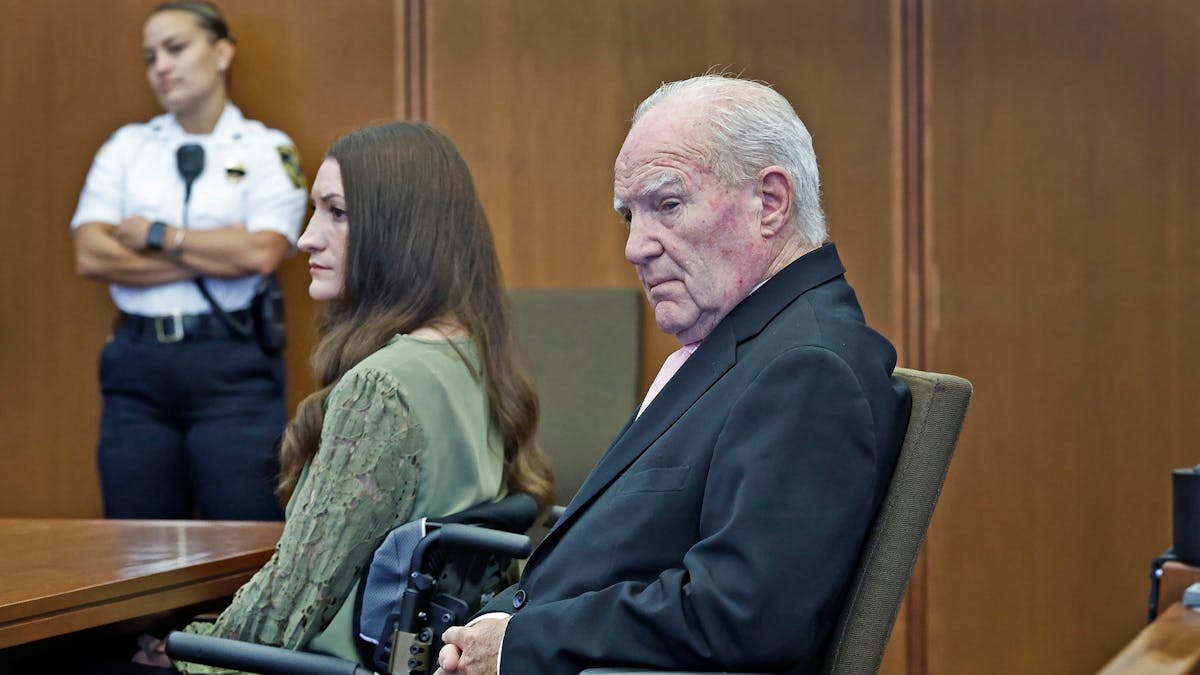
A tense courtroom showdown erupted Friday in the Lindsay Clancy case after Judge William Sullivan denied a defense request to remove the lone holdout juror, sparking a fiery exchange over reasonable doubt instructions.
Defense attorney Kevin Reddington pressed Sullivan to be more forceful in reminding jurors of the reasonable doubt standard, arguing that the judge’s instructions Thursday had been too soft.
“I would ask that you not just give them, as I described it yesterday, a soft inquiry where you listen to my instructions. I would ask that you specifically direct their attention to proof beyond a reasonable doubt and re-instruct them on that forcefully.”
Sullivan snapped back: “I think I did that yesterday, didn’t I?”
Reddington kept arguing that Sullivan’s reasonable doubt instructions lacked force, provoking an irritated response from the judge.
“What do you want me to do? Get a brass band? I read the instruction as written by the [Massachusetts Supreme Judicial Court]. The fact that I perhaps didn’t give it my full inflection, I’m sorry about that. I’m not an actor. I’ve just given the instructions,” Sullivan said.
When Reddington pressed further, Sullivan defended himself: “But just in case the record is clear, I am specifically not glossing over this issue. I have thought about this issue long and hard. I know the defendant objects, but the characterization that I’m glossing over it. Trust me, that’s not the situation. And I’ll try and give this with more pizzazz than I gave yesterday, I suppose.”
The heated exchange erupted moments after Sullivan rejected Reddington’s bid to remove the lone holdout juror. Reddington suggested the holdout is a man. The defense revealed in open court that two notes alleged the juror was refusing to follow the law.
The judge brought the jury back into the courtroom and ordered the panel to resume deliberations.
“You should consider all of my instructions as a whole. You may not ignore any instruction and give special attention to any one instruction. You must follow the law as I give it to you, whether you agree with it or not,” Sullivan told the panel.
The holdout juror was singled out Thursday after the foreperson sent Sullivan a note alleging that one juror was refusing to follow the judge’s instructions on reasonable doubt. The panel of nine women and three men remained deadlocked after more than 35 hours of deliberations.
The surprise note sent the courtroom into a scramble and sparked a heated sidebar involving Sullivan, the defense, and the prosecution.
In an unusual moment, Reddington wheeled Clancy over to the sidebar so she could hear the discussion.
“She has a right to know what’s going on,” Reddington said. “If it’s not going to be in open court, the judge said I could bring her up so she could hear.”
Sullivan then brought the jurors into the courtroom one by one and asked whether they could follow his instructions. He explained the meaning of reasonable doubt before ordering them to return to deliberations.
“I want to remind you that you are required to follow my instructions on the law as I gave them to you,” Sullivan told the jury. “Proof beyond a reasonable doubt does not mean proof beyond all possible doubt.”
Reddington asked Sullivan to remove the juror accused of disregarding the instructions and replace that juror with an alternate. Sullivan denied the request, saying he could not determine which side of the jury room dispute was correct.
“I don’t feel that it is proper for me to side with one side or the other of the deliberations,” Sullivan said. “I don’t feel it’s appropriate for me to say I agree with one juror or the 11.”
Prosecutor Jennifer Sprague also opposed removing the juror, arguing that Sullivan had responded appropriately by questioning each member of the panel.
The dispute is particularly consequential because Massachusetts places an unusual burden on the prosecution when a defendant raises an insanity defense. Under Massachusetts law, the state must prove beyond a reasonable doubt that the defendant was sane and criminally responsible at the time of the crime.
Clancy’s defense team argues that postpartum psychosis left her unable to appreciate the wrongfulness of her actions.
It remains unclear how the jury is divided or which verdict the 11 jurors have reportedly selected. That information will not be released unless the jury reaches a verdict or the court declares a mistrial.
“A note that the judge already has says there are 11 jurors that have made a decision and one juror will not apply reasonable doubt.”
Asked about the possibility of a mistrial, Reddington dismissed the idea.
“I don’t want a mistrial. Why would I want a mistrial? I kicked the sh*t out of their case,” he told reporters.
Clancy, a former labor and delivery nurse, has admitted to strangling her three children with exercise bands in 2023 inside the family’s Duxbury, Massachusetts, home. Her defense team argues that the medical system failed her and that postpartum psychosis left her not criminally responsible for her actions.
The jury is weighing several possible outcomes, including first-degree conviction, second-degree conviction, manslaughter, not guilty by reason of insanity, or acquittal.
If convicted of first-degree charges, Clancy faces life in prison without the possibility of parole. In the event of a mistrial or insanity-based acquittal, Clancy is expected to remain in a state-run psychiatric hospital for the foreseeable future. A mistrial would leave the criminal case unresolved and could result in another trial.
The charges remain allegations. The case has not been proven in court.
"She has a right to know what's going on."
Lindsay Clancy's defense attorney Kevin Reddington explains why he brought her up to the sidebar during today's proceedings, which ended in another day without a verdict. pic.twitter.com/UVfbSU9JyO
— Fox News (@FoxNews) September 3, 2026
NEW: Lindsay Clancy's defense attorney Kevin Reddington alleges the note the jury handed the judge discusses a lone holdout "that will not apply reasonable doubt." pic.twitter.com/T4U6boPscS
— Fox News (@FoxNews) September 3, 2026