
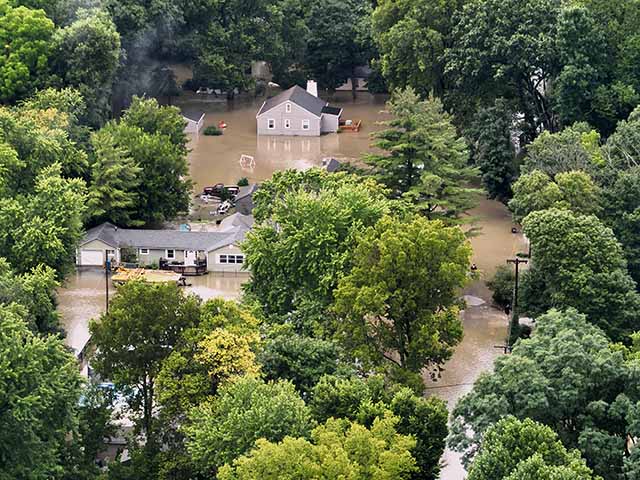
Six people are confirmed lost and many more remain missing as torrential rains spawned what authorities are calling “once-in-a-lifetime floods” across central Indiana.
Entire towns were swallowed by murky water as rising rivers exceeded their banks. The scale of the inundation caught many residents off guard, with water levels rising rapidly in areas that had never experienced significant flooding before. Residents took to kayaks and small boats to rescue neighbors or escape the surging waters.
The White River — a 362-mile waterway running directly through Indianapolis — just kept rising Saturday in the wake of heavy rains. The river serves as a major tributary system for central Indiana, draining much of the metropolitan area and surrounding communities before eventually flowing into the Wabash River. A number of rivers reached record levels as more than a dozen counties declared local disasters.
Much of the damage concentrated along the river from Hamilton County into northern Indianapolis suburbs. The geography of the region, with relatively flat terrain and numerous smaller tributaries feeding into the White River, created conditions where water had nowhere to go as the deluge continued.
“The most severe flooding has occurred along the White River corridor, particularly in and around Indianapolis, Noblesville, Anderson, Ravenswood and Nora.”
President Donald Trump acted quickly on news of the deluge, approving an emergency declaration for the state. The move makes federal disaster assistance available to residents and municipalities. This federal support will be critical for both immediate rescue and recovery operations, as well as longer-term rebuilding efforts that could take months or even years to complete.
Indianapolis Mayor Joe Hogsett said the city was experiencing its most severe flooding in more than 30 years. That timeline points back to major flooding events in the mid-1990s, though the current situation appears to exceed even those historical benchmarks in terms of both water levels and geographic scope.
Residents from hundreds of homes in neighborhoods between the river and parallel canals were evacuated Saturday as 911 dispatchers received scores of calls for help. Emergency services were stretched thin as calls continued to pour in throughout the day, with first responders working around the clock to reach those stranded by the rapidly rising waters.
The Indianapolis Fire Department reported rescues of 95 people and 45 pets as of late afternoon Saturday. Those numbers were expected to climb as rescue operations continued into the evening hours and as floodwaters revealed additional areas where residents remained trapped or isolated.
Among the confirmed losses: a four-year-old boy who perished when a tree fell on his home. A 58-year-old woman was swept away after driving into floodwaters. A 19-year-old man was found lost after jumping into a river Wednesday. The tragic deaths underscore the dangers posed by both the flooding itself and the secondary hazards created by extreme weather conditions, including weakened trees and swift-moving currents in areas normally safe for travel.
Marion County Director of Emergency Management Jacob Spencer called the event a “once-in-a-lifetime flooding.” Such characterizations from emergency officials highlight the extraordinary nature of the meteorological conditions that produced the disaster.
“This is an unprecedented event, and unfortunately we’re setting some new records.”
The National Weather Service reported that more than 11 inches of rain fell over a two-day period in some areas. That volume of precipitation in such a compressed timeframe overwhelmed drainage systems designed for typical weather patterns, turning streets into rivers and low-lying areas into temporary lakes.
The White River crested at more than 24 feet in Anderson and Noblesville — surpassing records set in 1913. Breaking records that stood for more than a century demonstrates the severity of this weather event and raises questions about infrastructure resilience and flood management planning in an era of increasingly extreme weather.
While some floodwaters were receding north of Indianapolis, flash-flood watches and warnings continued late into Saturday across a swath of central Indiana. Authorities warned that even as water levels dropped in some areas, the danger remained far from over, with saturated ground conditions and continued rainfall potential creating ongoing risks for additional flooding.
This situation is quite unfortunate. People here mentioned at 6 am that nothing was happening, but a few hours later, the area was flooded. I am currently located on Keystone and 80th Street. pic.twitter.com/le1AWWy18p
— WI-JO-® (@wijors) August 15, 2026
Indiana whitewater river flood yesterday 😬🙏 pic.twitter.com/ltdUwriWjU
— The Rubber Chicken🇨🇦 (@Gunblaze1969) August 14, 2026