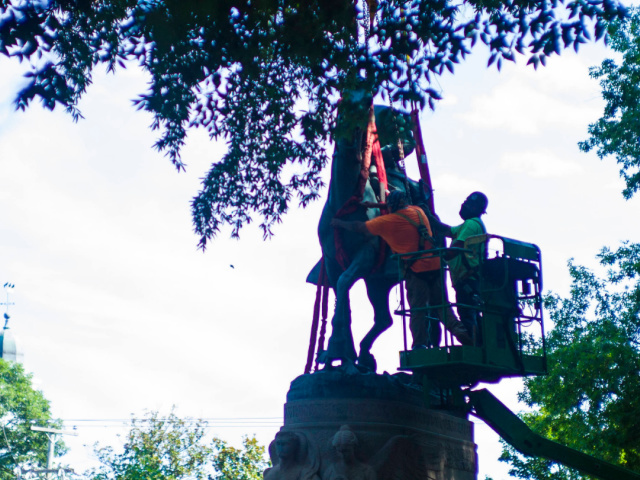
Virginia Democrats removed three Confederate statues from the state Capitol grounds Friday — not through legislation, but through a quiet $1.8 million budget line item buried in the fiscal 2027-28 spending bill.
The removal marks the latest chapter in a national reckoning over Confederate monuments that has intensified since 2015, when a white supremacist murdered nine Black churchgoers in Charleston, South Carolina, and gained further momentum following the 2017 “Unite the Right” rally in Charlottesville, Virginia. What makes this removal particularly notable is not just the monuments themselves, but the procedural method Democrats used to circumvent the traditional legislative process after a direct approach failed to gain sufficient support.
Workers took down statues of Confederate Gen. Thomas “Stonewall” Jackson, Confederate Army surgeon Dr. Hunter Holmes McGuire, and Confederate Gen. William “Extra Billy” Smith from Capitol Square. The Jackson statue had stood on the grounds since 1875.
The longevity of these monuments reflects the “Lost Cause” narrative that swept the South in the decades following Reconstruction, when Confederate statues were erected not merely to commemorate history but to assert a particular vision of Southern heritage during periods of racial tension. The Jackson statue in particular had become one of the most prominent Confederate monuments in Virginia’s capital, making its removal symbolically significant for both supporters and opponents of such memorials.
Budget Item 71 #1C directed the Department of General Services to remove every Confederate monument and memorial on the square, a spokesperson for the agency confirmed. The money came with it — lawmakers slipped $1.8 million into the budget, which took effect July 1.
The use of a budget line item to accomplish what standalone legislation could not represents a legislative maneuver that has drawn attention from political observers. By embedding the removal directive within the broader spending bill, Democrats effectively made the statue removal part of a larger fiscal package that required passage to keep government operations funded, rather than allowing it to be debated and voted on as a separate measure focused solely on Confederate monuments.
“This doesn’t change the history of the Civil War. It changes who we choose to venerate on the Capitol lawn.” — Former state Sen. Adam Ebbin (D-Alexandria)
The statues came down months after a standalone removal bill failed. Former state Sen. Adam Ebbin introduced SB636 during the 2026 session. It cleared the Senate on a party-line vote, then stalled in the House Appropriations Committee before Democrats folded the language into the budget.
The failure of the standalone bill highlights the continued political divisions over Confederate monuments in Virginia, a state that served as the capital of the Confederacy and was home to more Civil War battles than any other state. While Democrats have increasingly pushed for removal of such monuments, arguing they represent a painful legacy of slavery and oppression, some Republicans and heritage groups have maintained that the statues represent historical remembrance rather than endorsement of the Confederacy’s cause.
Ebbin, who left the legislature to join Gov. Abigail Spanberger’s administration, defended the removal as changing who the state honors rather than the historical record.
State Sen. Mike Jones (D-Richmond) credited Spanberger’s administration with finishing a push he dated to 2018.
“I’m glad that our current administration, Governor Spanberger, that they’re ensuring that we continue what we began some years ago,” Jones said.
The 2018 timeline Jones referenced points to the period following the Charlottesville rally, when Virginia’s political landscape began shifting more dramatically on the monument question. The state legislature passed a law in 2020 granting localities authority to remove Confederate monuments, leading to the removal of numerous statues across Virginia, including the iconic Robert E. Lee statue on Richmond’s Monument Avenue. However, state property remained under different rules, requiring state-level action for removals from Capitol grounds.
Spanberger campaigned as a moderate before signing 10 executive orders on her first day in office. In April, the former congresswoman signed legislation stripping tax exemptions from Confederate-linked organizations and ending renewal of specialty license plates featuring Robert E. Lee.
These actions reflect a broader legislative agenda addressing Confederate symbolism beyond just physical monuments, targeting the institutional and financial support structures that have maintained Confederate heritage organizations. The moves have positioned Spanberger further left than her moderate campaign image suggested to some observers, though supporters argue she is simply fulfilling long-standing Democratic priorities in a state that has trended increasingly blue in recent election cycles.
The budget language directed that the statues be given to the Shenandoah Valley Battlefields Foundation, whose chief executive said they would be moved to battlefield sites in the Shenandoah Valley.
“Preservation is more about the future than the past, and ensuring the preservation of the Capitol Square monuments is a part of that clear vision,” CEO David Walker said.
The transfer to battlefield sites represents what some view as a compromise solution in monument debates — removing statues from places of civic honor while preserving them in historical and educational contexts where the Civil War is already the primary focus. This approach differs from other monument removals where statues were simply placed in storage or destroyed.
Rep. Ayanna Pressley (D-MA) said last week at a Boston campaign event that “the Confederacy is still alive and well” and that “that’s all MAGA is.”
The Department of General Services said the three pedestals could take up to a week to remove and that no replacements are planned.
The absence of planned replacements leaves open questions about how Capitol Square will evolve and whether the now-empty spaces will eventually feature monuments to other figures from Virginia’s complex history, potentially including those who fought for civil rights or represented previously marginalized communities.
A statue of Stonewall Jackson was removed from Virginia’s Capitol Square today: pic.twitter.com/PPKsLamNI0
— TheBlaze (@theblaze) August 29, 2026