
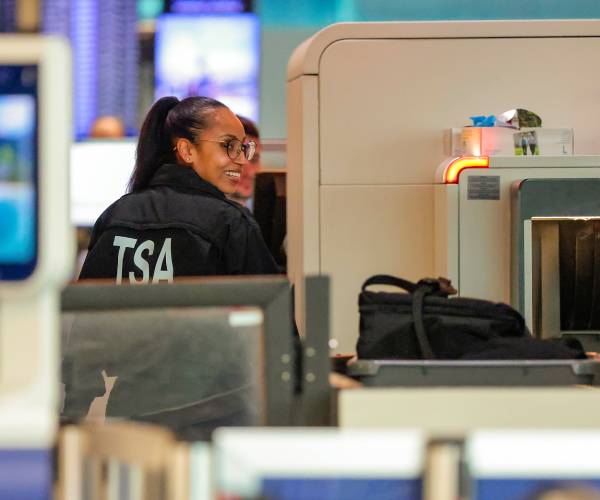
The Transportation Security Administration launched TSA Gold+, an opt-in public-private partnership letting private contractors run both the workforce and the screening technology at airport checkpoints — the most aggressive privatization push in the agency’s history.
The move has drawn sharp pushback from the union representing TSA officers.
TSA announced the program in a May 14 internal memo and posted a pre-solicitation notice the next day on SAM.gov, the federal contracting database, before hosting an industry day at its Springfield, Va., headquarters on May 21.
The agency framed Gold+ as the next evolution of its existing Screening Partnership Program, under which private firms already staff checkpoints at roughly 20 U.S. airports, including San Francisco International and Kansas City International.
Under the SPP, TSA owns the screening machines. Under Gold+, contractors would also own and operate the equipment, while TSA would retain regulatory oversight and set outcome-based security standards.
“TSA would, in theory, provide oversight. In practice, the federal government would be ceding direct operational control of the most sensitive technology in the aviation security enterprise to private vendors.”
The agency is selling the model as a hedge against the budget paralysis that gutted checkpoint staffing over the past 16 months.
Two government shutdowns in fiscal 2025 and 2026 left TSA officers working without reliable pay for nearly four months combined, and more than 1,000 officers have left the agency since February, according to the House Homeland Security Committee.
Acting TSA Administrator Ha Nguyen McNeill signaled at an April 16 hearing that the agency was considering expanding the use of private screeners to mitigate the impact of future funding lapses.
That argument met its sharpest challenge at a May 20 hearing convened by Rep. Andrew Garbarino, R-N.Y., chair of the House Committee on Homeland Security.
Everett Kelley, national president of the American Federation of Government Employees, which represents about 45,000 transportation security officers, told the committee that Gold+ would shift the most sensitive equipment in the aviation security system out of federal hands.
Kelley also rejected the shutdown-resilience argument outright, noting that private screening firms draw from the same DHS appropriation that funds federal officers.
“Private contractors face the same risks from funding lapses as the federal agencies that pay them,” he said. “The solution to a political failure is not to outsource a core domestic and national security function.”
Trump’s fiscal 2027 budget proposal would compound the change by eliminating 8,400 TSO positions, mandating participation in the SPP at all small and non-hub airports, and expanding private screening from about 20 airports to roughly 220.
TSA accepted industry feedback on a draft Performance Work Statement through May 25 and has not announced a formal solicitation date or named participating airports, though the agency’s internal memo said “a handful” had expressed interest.
As of Saturday, TSA had not responded to requests for additional information.