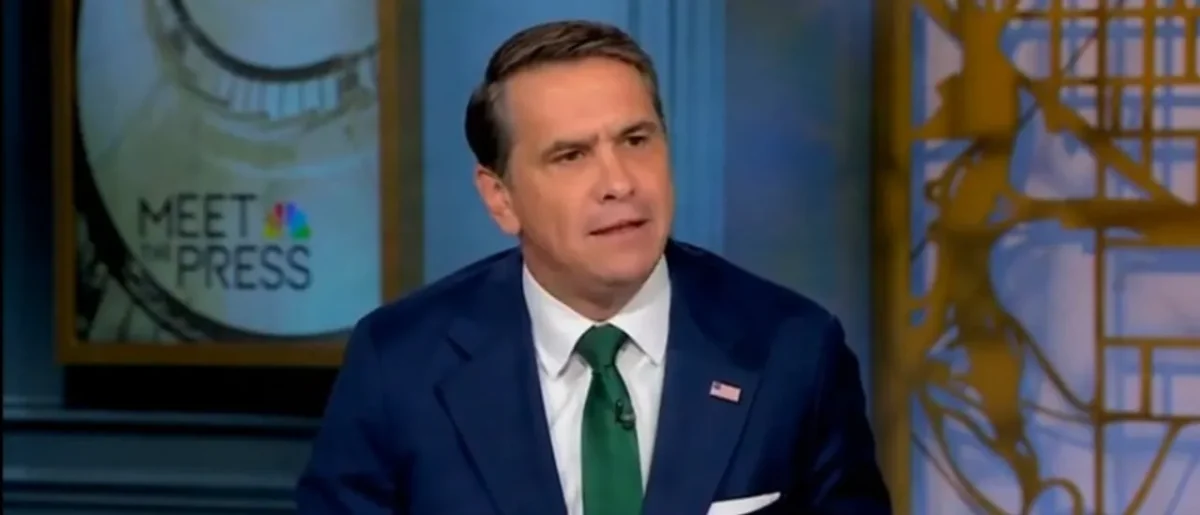
Attorney General Todd Blanche refused Sunday to take a loyalty pledge—to the media.
In his first major interview since Senate confirmation, Blanche told NBC’s Kristen Welker he won’t promise to ignore President Trump’s directives at the Department of Justice. The exchange came during “Meet the Press,” where Welker pressed the newly minted AG to commit that DOJ “will always act independently of the White House.”
The question of DOJ independence has been debated for decades, with different administrations interpreting the relationship between the attorney general and the president in varying ways. While the Justice Department maintains prosecutorial independence in individual cases, it remains part of the executive branch and answers to the president on broader policy matters—a distinction that often gets lost in political debate.
Blanche didn’t bite.
“No, I’m not going to pledge that. And no attorney general should ever pledge that,” Blanche said.
“IF PRESIDENT TRUMP SAYS, ‘I WANT THE DEPARTMENT OF JUSTICE TO GO AFTER EVERY VIOLENT CRIMINAL IN THIS COUNTRY,’ WHICH IS WHAT HE HAS SAID, WHAT YOU’RE SAYING TO ME IS I SHOULD SAY, ‘NO, SIR, I’M NOT GOING TO DO IT.'”
The former Trump defense attorney argued that Welker’s framing was a trap. If he pledged total independence from the elected president, he explained, then he’d have to refuse lawful orders—like Trump’s directive to crack down on violent crime nationwide.
Blanche’s response highlights a tension that exists in media coverage of executive branch appointments. The attorney general occupies a unique position—serving simultaneously as the president’s chief legal advisor and as the nation’s top law enforcement official. This dual role has historically required a careful balance rather than absolute independence from presidential direction.
“So I will act with integrity,” Blanche continued. “Our prosecutors will act with integrity. We will prosecute without fear or any sort of favor. And that’s exactly what we’ve been doing. And that’s what every Department of Justice should do.”
His emphasis on prosecutorial integrity rather than blanket independence reflects a more nuanced understanding of the attorney general’s constitutional role. Legal scholars have long noted that complete independence from the White House would actually contradict the executive branch structure established by the framers of the Constitution.
Welker pushed further: “If the president asks you to do something that you feel crosses an ethical or legal line, would you do it?”
Blanche shut it down.
“The president will never ask me to do something unethical … or illegal. He never has. He never will,” Blanche replied. “I swore to the Constitution of the United States like every cabinet secretary has done and like every attorney general before me has done.”
He called out the entire premise: “This narrative that’s mostly pushed by the left and pushed by the media that the president’s going to pull me aside and ask me to do something illegal is completely a false narrative, not true, will not happen, and hasn’t happened.”
The line of questioning Blanche faced echoes similar exchanges previous attorneys general have encountered from media figures seeking declarative statements about independence. The framing assumes a fundamental conflict between following presidential direction and upholding the law—an assumption Blanche clearly rejects.
The Senate confirmed Blanche as the 88th attorney general on August 8 after he cleared concerns from Republican Sens. John Cornyn and Thom Tillis over IRS protections for the Trump family and the anti-weaponization fund.
The confirmation process itself had raised questions about how Blanche would handle potential conflicts given his previous role as Trump’s defense attorney. His Sunday interview suggests he sees no inherent conflict between serving the president’s lawful policy agenda and maintaining prosecutorial integrity in specific cases.
DOJ’s director of public affairs piled on Sunday.
Emily Covington responded to a critic on X with a reality check: “DOJ is part of the executive branch. Are you suggesting that the focus of the Department should not align with the policy goals of the President, who was elected by the American people? Elected because the people voted for the priorities of that President.”
Covington’s point underscores the constitutional reality that the Justice Department, unlike the judiciary, is not an independent branch of government. Her defense of executive branch alignment raises fundamental questions about what “independence” should actually mean in the context of a department that answers to an elected president with a democratic mandate.
Translation: The DOJ works for the president patriots elected—not for NBC’s approval.
DOJ is part of the executive branch. Are you suggesting that the focus of the Department should not align with the policy goals of the President, who was elected by the American people? Elected because the people voted for the priorities of that President. https://t.co/BzNNZAnH3i
— Emily (@EmilyCovPA) August 16, 2026